Border Collie vs German Shepherd Training Strategies Guide
Compare Border Collie and German Shepherd training tactics. Learn breed-specific obedience, equipment selection, and socialization timelines for success.
Introduction to High-Drive Working Breeds
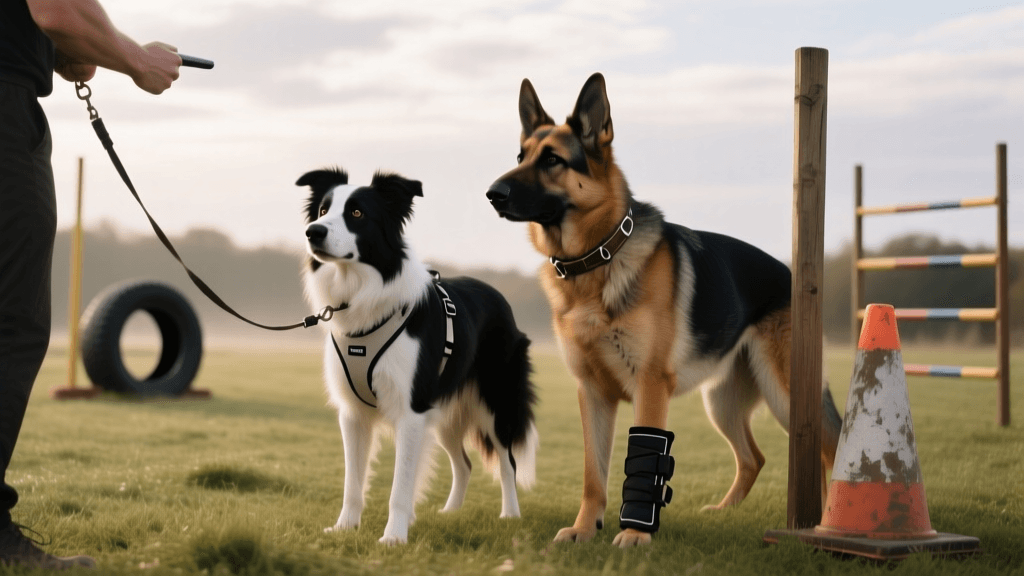
When selecting between a Border Collie and a German Shepherd Dog (GSD), prospective owners often focus on aesthetics or general intelligence. However, from a professional dog training perspective, these two breeds operate on entirely different neurological operating systems. While both are consistently ranked among the most trainable breeds by the American Kennel Club (AKC), their underlying motivations, environmental sensitivities, and physical drives require vastly different training methodologies. This guide breaks down the specific training strategies, equipment selections, and developmental timelines required to successfully condition a Border Collie versus a German Shepherd.
Understanding Genetic Drives: Herding vs. Guarding
To train a dog effectively, you must first understand its genetic baseline. Border Collies and German Shepherds were developed for entirely different purposes, which manifests in their modern behavioral conditioning.
The Border Collie: Eye, Stalk, and Chase
Border Collies are selectively bred for predatory motor patterns that stop short of the 'kill bite.' Their primary drives involve 'eye' (staring down livestock), 'stalk,' and 'chase.' In a domestic setting, this translates to high sensitivity to movement. A Border Collie will often attempt to herd running children, bicycles, or even shadows. Training must focus on impulse control and redirecting visual triggers into structured tasks.
The German Shepherd: Bite, Hold, and Defend
Conversely, the GSD was developed for herding, guarding, and later, police and military work. Their drives include a strong 'prey drive' (chasing and biting) combined with 'defense drive' (protecting territory and handler). A German Shepherd is less likely to be distracted by a blowing leaf but will immediately react to a perceived threat or an intruder entering their space. Training must focus on channeling their bite drive into controlled tug play and establishing rock-solid neutral behavior around strangers.
Puppy Selection: The 49-Day Temperament Test
If you are selecting a puppy from a litter for specific training goals, timing is everything. The most critical window for initial temperament evaluation is exactly 49 days of age. At this stage, the puppy's neurological development is complete enough to assess baseline traits, but they have not yet been heavily influenced by their littermates or environment.
Professional trainers frequently utilize the Volhard Puppy Aptitude Test (PAT) to evaluate traits like social attraction, following, restraint, and sound sensitivity.
- For Border Collies: Look for a puppy with moderate 'sound sensitivity' and high 'social attraction.' Puppies that cower at loud noises may develop noise phobias or reactive herding behaviors later in life.
- For German Shepherds: Prioritize a puppy with high 'restraint' tolerance and low 'defense drive' when touched by a stranger. A GSD that shows early aggression or extreme fear during the PAT will require thousands of dollars in professional behavioral modification later.
Core Obedience: Shaping vs. Luring
The methodology you use to teach basic commands like 'sit,' 'down,' and 'place' should adapt to the breed's cognitive style.
Border Collies: Rapid-Fire Shaping
Border Collies are problem solvers. They excel at 'shaping'—the process of clicking and rewarding incremental steps toward a final behavior. When teaching a 'place' command, use a clicker and reward the dog for simply looking at the mat, then stepping on it, then lying down. Keep training sessions incredibly short (3 to 5 minutes) but high-intensity. Border Collies can develop 'frustration barking' if lured too slowly with food.
German Shepherds: Drive-Building and Luring
German Shepherds respond exceptionally well to 'luring' with high-value food or a toy, followed by 'drive-building.' A GSD learns best when obedience is tied to a physical reward game. For example, teach the 'down' command by luring the dog to the floor, then immediately rewarding them with a vigorous game of tug with a fleece toy. This builds confidence and satisfies their need for physical engagement.
Train the dog in front of you, not the breed standard you read about. While genetics load the gun, environment and training pull the trigger.
Breed-Specific Equipment and Gear Comparison
Selecting the right training gear is not one-size-fits-all. A harness that provides excellent control for a 40-pound Border Collie may snap under the torque of an 85-pound German Shepherd. Below is a structured comparison of recommended training equipment, including specific product types, measurements, and estimated costs.
| Equipment Category | Border Collie Recommendation | German Shepherd Recommendation | Estimated Cost |
|---|---|---|---|
| Primary Harness | Ruffwear Front Range (No-Pull Clip) | Julius-K9 IDC Powerharness (Handle for control) | $40 - $180 |
| Reward Toy | West Paw Zisc (Frisbee for chase drive) | Goughnuts MAXX 50 Tug (For heavy biting) | $20 - $35 |
| Treat Delivery | Magnetic Closure Pouch (Rapid access) | Squeeze Tube (Real Meat/Baby Food) | $15 - $25 |
| Long Line | 15ft Biothane (1/2 inch width) | 30ft Biothane (3/4 inch width) | $30 - $50 |
| Crate Size | 36-inch Wire Crate | 42-inch or 48-inch Heavy Duty Crate | $60 - $150 |
Actionable Advice: When purchasing a Biothane long line for recall training, always measure the width. A 1/2-inch line is light enough not to drag down a Border Collie during agility drills, but a German Shepherd requires a 3/4-inch or 1-inch width to prevent the line from snapping if they bolt after a squirrel.
Socialization Timelines and Environmental Conditioning
Both breeds require rigorous socialization, but their critical focal points differ. The American Veterinary Medical Association (AVMA) emphasizes that the primary socialization window closes around 12 to 16 weeks of age. Waiting until a puppy has 'all their shots' (often 16 weeks) is a critical mistake that leads to lifelong behavioral issues.
Border Collie Socialization: Environmental Desensitization
Border Collies are notoriously sensitive to their environment, particularly sounds and erratic movements. Your socialization checklist between 8 and 14 weeks should prioritize:
- Walking on diverse surfaces (gravel, metal grates, wet grass).
- Exposure to loud, sudden noises (dropping pots, thunderstorms via audio tracks at low volume).
- Watching moving objects (skateboards, bicycles) from a distance while feeding high-value treats to build positive associations rather than chase instincts.
German Shepherd Socialization: Neutral-Dog and Human Exposure
German Shepherds are naturally suspicious of strangers and can develop dog-aggression if not properly socialized. Their checklist must prioritize:
- Meeting 50 to 100 diverse strangers (people wearing hats, uniforms, carrying umbrellas) who ignore the puppy or offer treats without making direct eye contact.
- Parallel walking with stable, adult dogs to teach neutral behavior. Avoid chaotic dog parks where a GSD puppy might be bullied, triggering a defensive response.
- Handling exercises: Touching paws, ears, and mouth daily to prepare for veterinary visits and grooming.
Advanced Conditioning and Sport Selection
Once foundational obedience and socialization are complete (usually around 6 to 9 months of age), owners must provide an outlet for their dog's working drive. Failing to do so will result in destructive behaviors, obsessive-compulsive disorders, or reactivity.
For the Border Collie, fast-paced, cognitively demanding sports are ideal. Agility, Flyball, and Disc Dog competitions allow them to utilize their chase drive and rapid problem-solving skills. A Border Collie can learn a complex agility course in a fraction of the time it takes other breeds, provided the handler uses clear, consistent verbal and physical cues.
For the German Shepherd, sports that involve scent work, tracking, and controlled biting are highly fulfilling. IGP (formerly Schutzhund), Nose Work, and advanced Obedience trials cater to their guarding and tracking heritage. The physical exertion of biting a decoy sleeve in IGP provides a massive endorphin release that a simple game of fetch cannot replicate for this breed.
Conclusion
Selecting between a Border Collie and a German Shepherd requires more than just choosing a favorite coat color. It demands a commitment to understanding their distinct genetic drives, utilizing breed-specific training tools, and respecting their unique developmental timelines. By tailoring your obedience strategies—shaping for the Collie and drive-building for the Shepherd—and investing in the correct equipment and early socialization, you can mold either breed into a highly functional, balanced, and deeply bonded companion. Remember, a tired working dog is a good dog, but a mentally fulfilled working dog is an exceptional one.
jonas-cole
All our authors care for dogs every day — read more of their work on the authors page.