Best Dog Breeds For Remote Workers In 2026: WFH Traits
Discover the best dog breeds for remote workers in 2026. Learn the psychology, instincts, and low-arousal traits that make them perfect WFH companions.
The Psychology of the Work-From-Home Dog in 2026
As remote and hybrid work models have fully matured in 2026, the home office has become a permanent fixture for millions of professionals. However, sharing a 500-square-foot living space with a canine companion requires more than just a cozy dog bed and a water bowl. It requires a deep understanding of canine psychology, breed-specific instincts, and arousal thresholds. Not every dog is wired to sit quietly beneath a standing desk while you navigate high-stakes virtual meetings. The best dog breeds for remote workers share specific psychological traits: low environmental reactivity, high proximity-seeking behavior, and an innate ability to self-soothe during long periods of human inactivity.
Understanding your dog's behavioral baseline is critical for maintaining productivity and ensuring your pet's mental well-being. Dogs that suffer from high environmental arousal or possess intense working drives often develop stress-induced behaviors when confined to a home office setting. Conversely, breeds historically selected for companionship or low-intensity coursing thrive in the quiet, predictable rhythm of a remote worker's day. In this comprehensive guide, we explore the instinctual drives that dictate home office harmony and highlight the top breeds that seamlessly integrate into the modern work-from-home lifestyle.
Why Breed Instincts Dictate Home Office Harmony
To understand why certain dogs excel as co-workers while others disrupt your workflow, we must look at their ancestral jobs. A dog's breed group heavily influences how they process the auditory and visual stimuli of a busy household. According to the American Kennel Club's Companion Group profiles, dogs bred specifically for companionship possess a genetic predisposition toward 'proximity-seeking' without the demand for 'task-oriented engagement.' This means they want to be near you, but they do not require you to give them a job to do.
Contrast this with herding breeds, which are genetically hardwired to monitor movement and control their environment. In a home office, a herding dog might interpret your pacing during a phone call as a flocking behavior that needs to be managed, leading to ankle-nipping or vocalizations. Similarly, terriers possess high 'alert barking' instincts. Every notification ping from your smartphone, every knock from a 2026 automated delivery drone, or every footstep in the hallway can trigger a terrier's prey drive and territorial instincts, turning your quiet office into a chaotic environment.
'A successful work-from-home dog is one whose genetic baseline aligns with the acoustic and kinetic reality of your home. We look for breeds with high sensory gating—the ability to filter out irrelevant household noises and settle into a resting state despite human movement.' — Canine Behavioral Psychology Consensus, 2026.
The 2026 WFH Breed Compatibility Chart
When evaluating a dog for a remote work environment, veterinary behaviorists look at three primary metrics: Environmental Reactivity (how easily they are startled or triggered), Proximity Drive (their desire to be in the same room), and Vocalization Tendency. Below is a structured comparison of how different breed categories perform in a home office setting.
| Breed Category | Instinctual Drive | Environmental Reactivity | Vocalization | WFH Compatibility |
|---|---|---|---|---|
| Companion Breeds | Proximity & Bonding | Very Low | Low | Excellent (9/10) |
| Sighthounds | Visual Chasing / Resting | Low (Indoors) | Very Low | Excellent (8/10) |
| Herding Breeds | Movement Control | High | High | Poor (3/10) |
| Terrier Breeds | Alert / Vermin Hunting | Very High | Very High | Poor (2/10) |
| Guardian Breeds | Territorial Protection | Moderate to High | High (Deep Barks) | Moderate (5/10) |
Top 5 Best Dog Breeds for Remote Workers
Based on behavioral data, low-arousal temperaments, and adaptability to indoor environments, these five breeds stand out as the ultimate co-workers for the 2026 remote professional.
1. Cavalier King Charles Spaniel
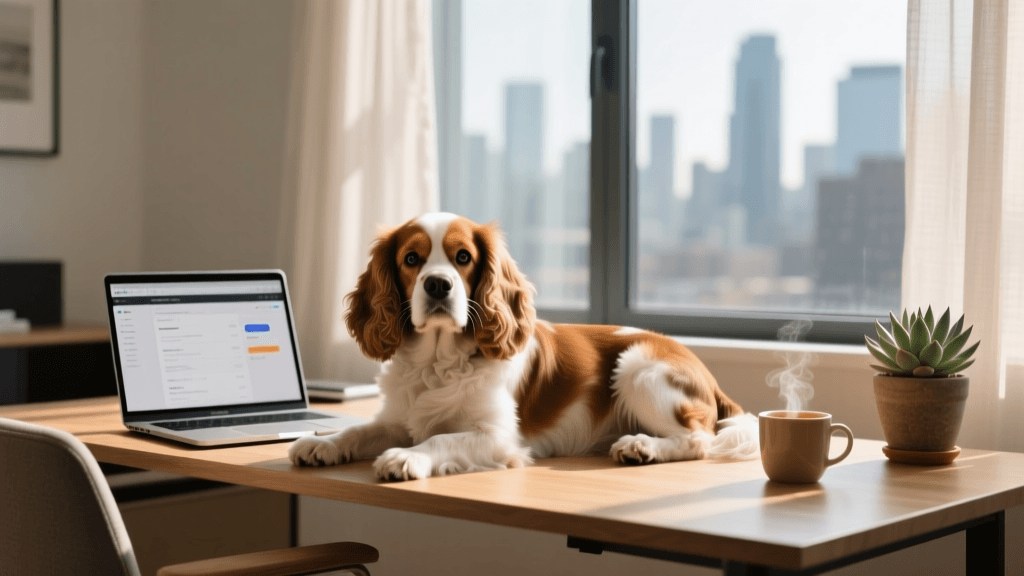
The Cavalier King Charles Spaniel is the quintessential home office companion. Bred for centuries to sit on the laps of royalty, their psychological profile is defined by an intense desire for physical closeness paired with an incredibly low demand for rigorous activity. They possess exceptional 'empathic mirroring,' meaning they easily pick up on your stress levels and will often respond by offering quiet, grounding physical contact. They rarely bark at doorbells or digital notifications, making them ideal for professionals who spend hours on video conferences.
2. Greyhound
Often misunderstood as high-energy athletes, retired Greyhounds are famously known in the canine community as '45-mph couch potatoes.' Psychologically, sighthounds operate on a binary system: intense visual focus outdoors, followed by deep, unbroken lethargy indoors. A Greyhound will happily claim a plush orthopedic bed in the corner of your office and sleep for six hours straight while you code, write, or design. Their lack of territorial barking and general indifference to household noises make them stellar, silent partners.
3. Basset Hound
If your home office requires deep concentration and zero interruptions, the Basset Hound is a top contender. Originally bred for slow, methodical scent tracking, their modern temperament is characterized by a stubborn but deeply relaxed demeanor. They are heavy, low to the ground, and highly unlikely to pace around the room or demand play during your working hours. Their primary activity of choice is napping, and their low environmental reactivity means the sound of your mechanical keyboard will not trigger an alert response.
4. Japanese Chin
The Japanese Chin is an ancient aristocratic breed that excels in the modern home office due to its feline-like independence combined with deep loyalty. Unlike velcro dogs that suffer from separation anxiety if you close the office door, the Chin is content to simply occupy the same airspace as you. They are highly observant, virtually silent, and possess a natural dignity that keeps them from engaging in frantic, attention-seeking behaviors while you are focused on a deadline.
5. Shih Tzu
Bred exclusively to be a companion and a living hot-water bottle for Chinese emperors, the Shih Tzu lacks the working drives that complicate home office life. They do not herd, they do not guard, and they do not hunt. Their psychological reward system is entirely based on social bonding and comfort. A Shih Tzu will happily utilize a heated pet mat under your desk, providing a calming, steady presence that has been shown to lower human cortisol levels during stressful workdays.
High-Arousal Breeds: Why They Struggle in the Home Office
While every dog is an individual, certain breeds are psychologically mismatched for the sedentary nature of remote work. The ASPCA's General Dog Care guidelines emphasize that failing to meet a dog's breed-specific mental and physical needs leads to destructive and neurotic behaviors. Breeds like the Border Collie, Belgian Malinois, and Siberian Husky possess intense 'task-completion' drives. In a home office, a lack of structured work leads to frustration. A Malinois may begin to shadow your every movement, whine during meetings, or develop obsessive-compulsive behaviors like light-chasing or flank-sucking out of sheer boredom. Unless you are utilizing a 2026 smart-home automated treadmill or have a highly structured mid-day canine sports routine, these breeds will turn your home office into a high-stress environment.
Structuring the 2026 Remote Work Day for Your Dog
Even the most low-arousal companion breed requires a structured routine to maintain psychological balance. The Humane Society's resources on canine anxiety highlight that predictability is the cornerstone of a confident, relaxed dog. To ensure your WFH dog remains settled, implement the following routine:
- The Morning Decompression Walk: Before logging on, engage in a 30-minute 'sniffari.' Allow your dog to dictate the pace and sniff extensively. This engages their olfactory cortex, which is mentally exhausting and promotes deep sleep during your morning meetings.
- Mid-Day Enrichment: Instead of a high-energy game of fetch that spikes their adrenaline and leaves them panting on camera, provide a frozen lick-mat or a complex snuffle puzzle. Licking and foraging release endorphins and lower the heart rate, encouraging a return to the dog bed.
- Acoustic Management: Utilize a white noise machine or a smart speaker playing classical frequencies designed for canine auditory relaxation to mask the sound of delivery drivers or neighborhood construction.
Conclusion
Choosing the best dog breed for remote work is ultimately an exercise in matching canine psychology with your professional lifestyle. By prioritizing breeds with low environmental reactivity, high sensory gating, and a genetic history of companionship over utility, you create a harmonious ecosystem where both human productivity and canine well-being can flourish. As we navigate the evolving landscape of remote work in 2026, understanding the instinctual drives of our pets ensures that our home offices remain sanctuaries of focus, comfort, and mutual respect.
jonas-cole
All our authors care for dogs every day — read more of their work on the authors page.