Best Puppy Crates for Training: Ultimate Buyer Guide
Discover the best puppy crates for safe crate training. Compare top wire, plastic, and soft-sided crates with sizing tips and expert recommendations.
The Ultimate Buyer's Guide to Puppy Crates
Bringing a new puppy home is one of the most exciting milestones for any dog owner, but it also comes with a unique set of challenges. From potty training to preventing destructive chewing, managing a young dog requires the right tools. Among the most essential investments you will make during your puppy's first year is a high-quality crate. A crate is not just a containment device; it is a safe haven, a training tool, and a critical component of your puppy's early development. In this comprehensive buyer's guide, we break down the best puppy crates on the market, how to choose the correct size, and the accessories you need to create the perfect den for your growing dog.
Why Crate Training is Essential for Puppies
Dogs are naturally den animals. In the wild, canines seek out small, enclosed spaces to sleep, hide, and raise their young. A properly introduced crate taps into this natural instinct, providing your puppy with a sense of security and a place to retreat when the household becomes overwhelming. According to the American Kennel Club (AKC), crate training is highly recommended because it aids in housebreaking, prevents destructive behavior when you are away, and keeps your puppy safe from household hazards like electrical cords and toxic plants.
Furthermore, a crate establishes boundaries. Puppies lack impulse control, and giving them free roam of the house before they are fully trained is a recipe for accidents and chewed furniture. A crate teaches them bladder control, as dogs naturally avoid soiling their sleeping area. This biological mechanism is the cornerstone of successful potty training.
How to Measure Your Puppy for a Crate
Buying the wrong size crate is the most common mistake new owners make. If a crate is too large, your puppy may use one corner as a bathroom and the other for sleeping, completely defeating the purpose of housebreaking. If it is too small, your puppy will be uncomfortable and develop a negative association with the crate.
The ASPCA recommends that your dog should be able to stand up without hitting their head, turn around comfortably, and lie down stretched out. To find the ideal dimensions:
- Length: Measure from the tip of your puppy's nose to the base of their tail (do not include the tail). Add 2 to 4 inches to this measurement.
- Height: Measure from the floor to the top of their head (or the tip of their ears if they are erect). Add 2 to 4 inches.
Pro-Tip for Growing Puppies: You do not need to buy a new crate every month. Purchase a crate sized for your dog's estimated adult weight, and use an adjustable divider panel to block off the excess space. Move the divider back as your puppy grows.
Types of Puppy Crates: Pros and Cons
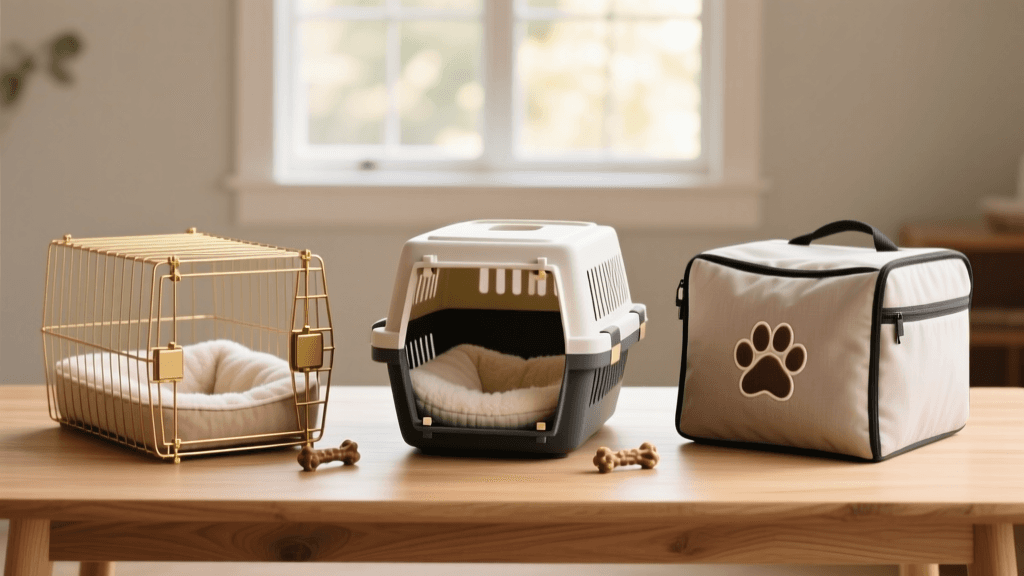
Before diving into specific product reviews, it is important to understand the three main types of crates available on the market.
1. Wire Crates
Wire crates are the most popular choice for puppy training. They offer excellent visibility and ventilation, and they fold flat for easy storage. Most wire crates come with a divider panel, making them perfect for growing puppies. However, they can be heavy, and some puppies may find the open exposure stressful without a cover.
2. Plastic Crates
Plastic kennels offer a more enclosed, den-like environment, which many anxious puppies prefer. They are also the standard for airline travel. The downside is that they offer less ventilation than wire crates, are harder to clean if a potty accident occurs, and do not fold down for storage.
3. Soft-Sided Crates
Soft-sided crates are lightweight, portable, and great for travel or outdoor use. However, they are strictly for fully trained, older puppies. A teething or anxious puppy will easily chew through the mesh and escape, making them unsuitable for early crate training.
Top 5 Puppy Crates Reviewed
1. MidWest Homes for Pets iCrate Double Door (Best Overall Wire Crate)
The MidWest iCrate is widely considered the gold standard for puppy crate training. It features sturdy metal construction, a secure double-latch door, and a composite plastic pan that is easy to remove and clean in the event of accidents. Crucially, it includes a free divider panel, allowing you to adjust the living space as your puppy grows from a 10-pound furball into a fully grown adult.
- Best For: Everyday home training and growing puppies.
- Measurements: Available in 18" to 48" lengths. The 24" (24x18x19 inches) is ideal for small breeds like Pomeranians, while the 36" (36x23x25 inches) suits medium breeds like Beagles.
- Cost: $45 - $85 depending on size.
2. Petmate Sky Kennel (Best for Travel and Anxious Puppies)
If you plan to fly with your puppy or if your dog prefers a darker, more enclosed den, the Petmate Sky Kennel is an outstanding choice. Made from heavy-duty, recycled plastic, it meets most IATA airline cargo requirements (always check with your specific airline). It features 360-degree ventilation and comes with snap-on food and water bowls.
- Best For: Airline travel, car rides, and puppies who need a cozy, den-like feel.
- Measurements: Ranges from 21" to 48". The 28" model (28x20.5x21.5 inches) is perfect for growing French Bulldogs or Cocker Spaniels.
- Cost: $70 - $160.
3. Frisco Fold & Carry Single Door Crate (Best Budget Option)
For owners on a strict budget who still need a reliable wire crate, the Frisco Fold & Carry (available via major pet retailers) offers incredible value. It includes the essential divider panel and a leak-proof plastic pan. While the wire gauge is slightly thinner than premium brands, it is more than sufficient for small to medium-breed puppies.
- Best For: Budget-conscious buyers and small-breed puppies.
- Measurements: 22" to 42" lengths.
- Cost: $35 - $65.
4. EliteField 3-Door Folding Soft Dog Crate (Best for Traveled Older Puppies)
Once your puppy has passed the destructive chewing phase and is fully housebroken, the EliteField soft crate is phenomenal for road trips and hotel stays. It sets up in seconds, features three mesh doors for ventilation, and includes a removable, washable fleece bed and a carrying bag.
- Best For: Fully trained older puppies, camping, and hotel stays.
- Measurements: 20" to 42" lengths.
- Cost: $55 - $90.
5. ProSelect Empire Zinc Plated Steel Crate (Best Heavy-Duty Option)
If you are adopting a large-breed puppy known for extreme chewing or escape-artist tendencies (like a Husky or German Shepherd), standard wire crates may not suffice. The ProSelect Empire is built from reinforced steel tubing with dual latches and casters. It is virtually indestructible, though it comes with a premium price tag and is very heavy.
- Best For: Large, destructive breeds and severe separation anxiety.
- Measurements: 37" and 42" lengths.
- Cost: $400 - $600.
Puppy Crate Comparison Chart
| Product Name | Type | Best For | Price Range | Key Feature |
|---|---|---|---|---|
| MidWest iCrate | Wire | Everyday Training | $45 - $85 | Adjustable Divider Panel |
| Petmate Sky Kennel | Plastic | Travel & Anxious Dogs | $70 - $160 | Airline Cargo Compliant |
| Frisco Fold & Carry | Wire | Budget Buyers | $35 - $65 | Affordable with Divider |
| EliteField Soft Crate | Soft-Sided | Trained Puppies / Travel | $55 - $90 | Lightweight & Portable |
| ProSelect Empire | Heavy-Duty Steel | Destructive Chewers | $400 - $600 | Indestructible Construction |
Essential Crate Accessories for Puppies
A bare wire crate is not inviting. To make the crate a positive space, consider these buyer-approved accessories:
- Snuggle Puppy Heartbeat Toy ($40): This plush toy features a battery-operated heartbeat and heat pack. It mimics the feeling of sleeping next to littermates, drastically reducing nighttime whining for newly adopted 8-week-old puppies.
- MidWest QuietTime Fleece Bed ($20): A soft, machine-washable fleece pad that fits perfectly into standard wire crates. Avoid thick, stuffed orthopedic beds for young puppies, as they tend to chew and ingest the stuffing, which can cause life-threatening intestinal blockages.
- Stainless Steel Clip-On Bowls ($15): These attach directly to the wire bars, preventing your puppy from tipping over their water bowl and soaking their bedding.
- Crate Cover ($25): A breathable fabric cover blocks out light and visual stimuli, helping hyperactive puppies settle down for naps and bedtime.
A Step-by-Step Crate Training Timeline
Patience is the most critical element of crate training. The Humane Society of the United States emphasizes that a crate should never be used as a punishment. It must be associated with positive experiences, treats, and comfort.
Week 1 (8 Weeks Old): Introduction
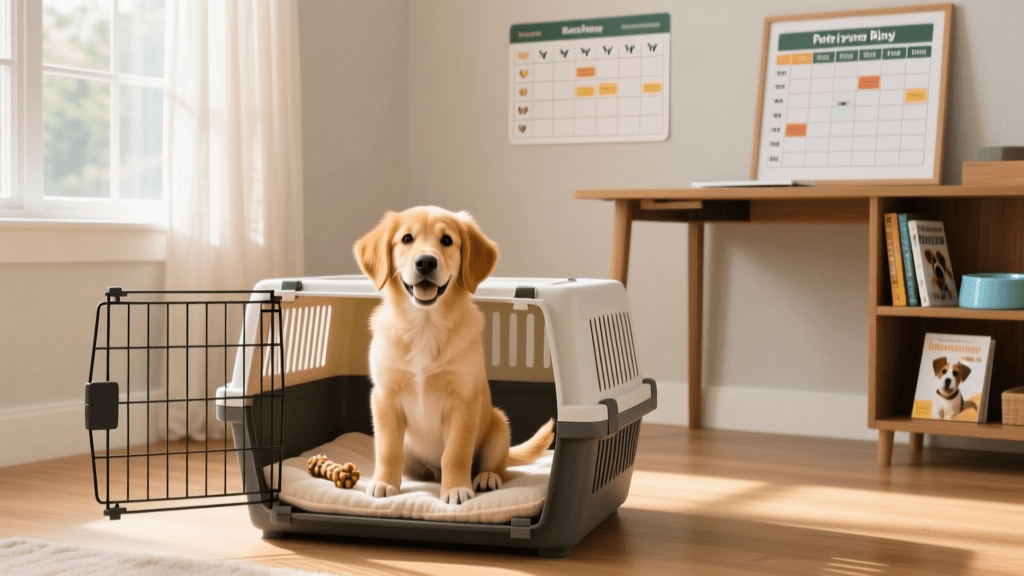
Keep the crate door open and toss high-value treats inside. Feed your puppy all their meals inside the crate with the door open. Place their favorite chew toys inside to encourage voluntary entry. Do not force them inside or lock the door yet.
Week 2 (9 Weeks Old): Closing the Door
Begin closing the door while your puppy is eating. Open it immediately when they finish. Gradually increase the time the door remains closed by 10-second increments while you sit right next to the crate. If they whine, wait for a brief moment of silence before opening the door so you do not reward the whining.
Week 3 (10 Weeks Old): Stepping Away
Start leaving the room for very short periods (1 to 5 minutes) while your puppy is crated and relaxed. Return before they become anxious. This builds the understanding that you always come back.
Week 4+ (11 Weeks and Beyond): Building Duration
A general rule of thumb for bladder control is one hour per month of age. A 2-month-old puppy can hold it for roughly 2 hours; a 3-month-old for 3 hours. Never exceed these limits during the day, as forcing a puppy to soil their crate will ruin their den instinct and severely set back your potty training progress.
Never use the crate as a timeout or punishment. If your puppy associates the crate with isolation and anger, they will resist entering, and the training process will fail. Always use a cheerful voice and high-value rewards when guiding them inside.
Final Thoughts
Investing in the right crate and taking the time to properly introduce it to your puppy will pay dividends for the rest of your dog's life. For the vast majority of puppy owners, the MidWest Homes for Pets iCrate offers the perfect balance of durability, adjustability, and value. Pair it with a Snuggle Puppy and a washable fleece pad, follow a patient training timeline, and you will set your puppy up for a lifetime of confidence, safety, and excellent house manners.
marcus-aldridge
All our authors care for dogs every day — read more of their work on the authors page.