Expert Behavior Analysis to Cure Canine Resource Guarding
Discover how applied behavior analysis and counterconditioning can safely resolve canine resource guarding. Expert tips, timing, and protocols inside.
Understanding Resource Guarding Through Applied Behavior Analysis
Resource guarding is one of the most misunderstood behaviors in canine psychology. To the untrained eye, a dog growling over a bone, stiffening when approached while eating, or snapping when a toy is removed appears aggressive or dominant. However, through the lens of Applied Behavior Analysis (ABA), resource guarding is simply a functional behavior maintained by negative reinforcement. The dog performs a behavior to increase distance from a perceived threat, and when the threat retreats, the behavior is reinforced because it successfully protected the resource. As expert behavior analysts, we must look past the emotional interpretation of the behavior and focus strictly on the environmental variables that predict and maintain it.
The ABC Model of Guarding Behavior
To modify any behavior, a behavior analyst first conducts a functional assessment using the ABC model: Antecedent, Behavior, and Consequence. Understanding this triad is critical for resolving resource guarding without escalating the dog's anxiety.
- Antecedent (The Trigger): The environmental event that occurs immediately before the behavior. In guarding, this is typically a human or another animal approaching within a specific proximity threshold while the dog possesses a high-value item (e.g., a raw bone, a stolen sock, or their food bowl).
- Behavior (The Response): The observable action the dog takes. This exists on a continuum of escalation: freezing, whale eye (showing the whites of the eyes), lip licking, stiffening, growling, snarling, air snapping, and finally, biting.
- Consequence (The Reinforcer): What happens immediately after the behavior. If the dog growls and the human backs away, the human's retreat serves as a negative reinforcer. The dog learns that growling successfully removes the threat, making future growling more likely and occurring earlier in the antecedent sequence.
Why Punishment Fails: The Behavioral Fallout
Many outdated training methodologies suggest using positive punishment (adding an aversive stimulus, such as a leash pop, alpha roll, or verbal scolding) to suppress guarding behaviors. From a behavioral science perspective, this is highly contraindicated. Punishment does not change the underlying emotional response (classical conditioning) of the dog; it merely suppresses the outward warning signs (operant conditioning).
Suppressing warning signals like growling creates a dog that bites without warning. The emotional association that 'approaching humans predict the loss of my resources' remains intact, but the dog's threshold for biting is dangerously lowered.
The American Veterinary Society of Animal Behavior (AVSAB) explicitly advises against the use of punishment for behavior modification, noting that it can increase fear and anxiety, exacerbate aggression, and damage the human-animal bond. Instead, expert behaviorists rely on Desensitization and Counterconditioning (DS/CC) to change the dog's underlying emotional state.
The Expert Protocol: Desensitization and Counterconditioning
DS/CC works by pairing the antecedent (a human approaching) with a high-value unconditioned stimulus (premium food), effectively changing the dog's conditioned emotional response from 'threat' to 'opportunity'. This requires strict adherence to sub-threshold exposure and precise timing.
Step 1: Establish the Baseline Threshold
The threshold is the exact distance at which the dog notices the trigger (you approaching) but does not exhibit any stress signals or guarding behaviors. For some dogs, this is 15 feet; for others, it is 5 feet. You must start your protocol at a distance where the dog is completely relaxed and willingly offers eye contact. If the dog freezes, stops chewing, or tracks your movement with a hard stare, you are over threshold, and learning cannot occur.
Step 2: Classical Conditioning (The Pavlovian Phase)
Stand at your established sub-threshold distance (e.g., 10 feet). The moment the dog looks up from their item and makes eye contact with you, use a marker word like 'Yes!' or a clicker, and immediately toss a high-value treat directly to them. Repeat this 10 to 15 times per session. The goal is to build a Pavlovian association: 'Human approaching predicts the arrival of chicken, not the theft of my bone.' Over multiple sessions, you will gradually decrease the distance by 1-foot increments, provided the dog remains relaxed.
Step 3: Operant Conditioning (The Trade-Up Protocol)
Once the dog happily anticipates your approach, you can introduce an operant behavior: the 'Drop It' or 'Trade' cue. Never forcibly remove an item from a guarding dog. Instead, approach with a treat of significantly higher value than the guarded item. Present the treat near the dog's nose. When the dog drops the lower-value item to eat the higher-value treat, mark the behavior ('Yes!'), feed the treat, and then return the original item. Returning the item is crucial; it proves to the dog that giving up a resource does not result in permanent loss, thereby reducing the motivation to guard.
Threshold Distance and Treat Value Matrix
Matching the intensity of the trigger with the value of the reinforcer is a core principle of behavior analysis. Use the following matrix to structure your training sessions:
| Distance to Dog | Dog's State / Behavior | Required Reinforcer Value | Action Required by Handler |
|---|---|---|---|
| 10+ Feet | Relaxed, chewing normally | Medium Value (e.g., Kibble, Dry Biscuits) | Toss treat, retreat to original position |
| 5 to 9 Feet | Alert, pauses chewing briefly | High Value (e.g., Zuke's Mini Naturals, Cheese) | Toss treat, take one step back |
| 2 to 4 Feet | Stiffening, whale eye, hovering | Premium Value (e.g., Freeze-Dried Liver, Boiled Chicken) | Stop approach immediately, toss treat, retreat |
| Under 2 Feet | Growling, snapping, guarding | N/A (Dog is Over Threshold) | Abort session. Management failure. Increase distance. |
Essential Tools, Timings, and Costs
Successful behavior modification requires the right equipment and precise timing. In operant conditioning, the interval between the marker (the click or the word 'Yes') and the delivery of the primary reinforcer (the food) should not exceed 3 seconds. The marker itself must occur within 0.5 seconds of the desired behavior.
Here is a breakdown of the recommended tools and their approximate costs for a comprehensive behavior modification kit:
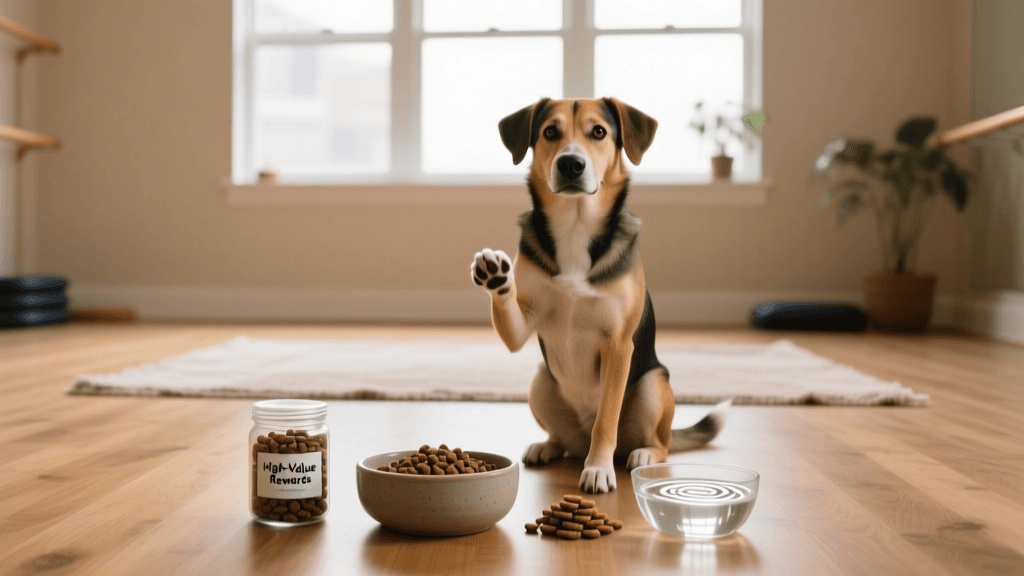
- Premium Reinforcers: Freeze-dried beef liver or Zuke's Mini Naturals. These provide a high olfactory stimulus that easily overrides the value of standard kibble or household objects. (Cost: $8 to $15 per bag).
- Management Tools: The Kong Classic (Cost: $15) or a Snuffle Mat (Cost: $20). These are vital for environmental enrichment and management. When you cannot actively train, feed the dog exclusively from these puzzle toys in a separate, gated room to prevent rehearsal of the guarding behavior.
- Hands-Free Treat Pouch: A magnetic-closure treat pouch (Cost: $15 to $25) allows for rapid treat delivery without the fumbling that can cause a dog to become frustrated or suspicious of your hand movements.
- Drag Leash (Indoor Management): A lightweight, 4-foot leash left on the dog's flat collar indoors. If the dog steals a dangerous item, you can safely guide them away by the leash without reaching for the collar or the item, thereby avoiding a bite trigger. (Cost: $10).
When to Seek Professional Help
While mild resource guarding over food bowls can often be resolved with a structured DS/CC protocol, severe guarding that involves snapping, biting, or guarding multiple locations and people requires professional intervention. The ASPCA strongly recommends consulting a certified professional if a dog has already broken the skin or if the household includes young children, who are highly vulnerable to facial bites due to their height and erratic movements.
Furthermore, the American Kennel Club (AKC) emphasizes that resource guarding is a natural survival instinct, not a sign of a 'bad' dog. Seeking help from a Certified Applied Animal Behaviorist (CAAB) or a veterinary behaviorist (DACVB) ensures that the behavior modification plan is tailored to the specific neurological and environmental needs of your dog, keeping your family safe while improving your dog's welfare.
robin-maitland
All our authors care for dogs every day — read more of their work on the authors page.