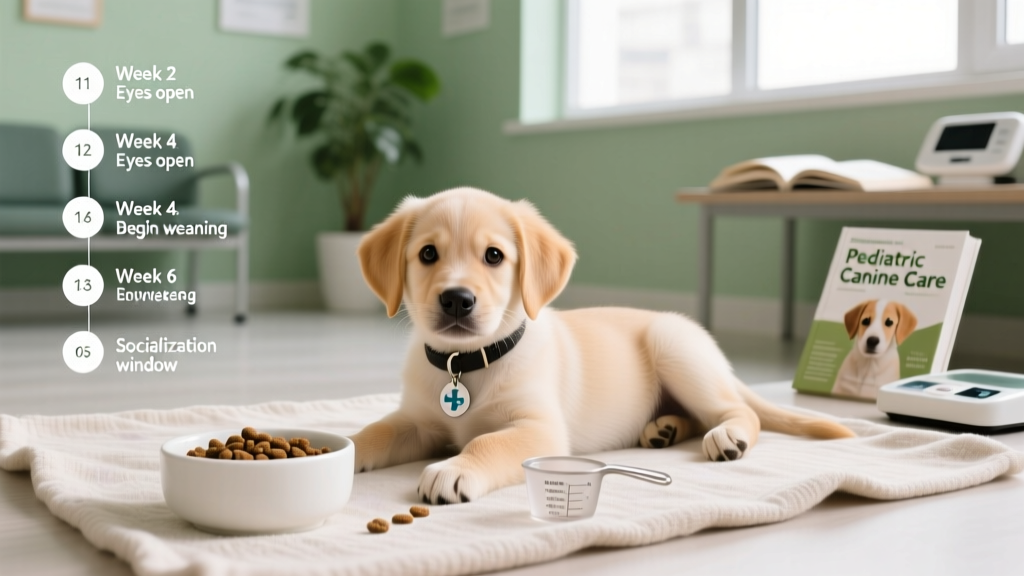
Siberian Husky Puppy Guide: Milestones, Feeding & Training by Age
Complete Siberian Husky puppy guide covering age milestones, feeding portions, potty training timelines, vaccination schedules, and first-year costs.

Raising a Siberian Husky puppy is unlike raising almost any other breed. These are high-drive, vocal, escape-prone working dogs wrapped in a fluffy package that will test every ounce of your patience before they turn two. Having worked with dozens of Husky owners through the puppy months, I can tell you the difference between success and surrender almost always comes down to preparation and realistic expectations.
This guide walks you through exactly what to expect from your Siberian Husky puppy at every stage — from the day you bring them home through their first year — with specific feeding amounts, training timelines, and the breed-specific curveballs most generic puppy guides never mention.
When Should You Bring Your Siberian Husky Puppy Home?
The ideal window for bringing a Siberian Husky puppy home is 8 to 10 weeks of age. While some breeders release puppies at 8 weeks, many reputable Siberian Husky breeders prefer to hold puppies until 10 or even 12 weeks. Here's why that matters for this breed specifically:
Siberian Huskies are a pack-oriented breed with complex social hierarchies. The weeks between 8 and 12 are when puppies learn bite inhibition and social cues from littermates. A Husky puppy pulled at 7 weeks is significantly more likely to develop mouthy, nippy behavior that persists into adulthood compared to one that stayed with littermates through week 9.
According to the American Kennel Club, puppies go through a critical fear imprint period between 8 and 11 weeks. Moving to a new home during this window is manageable, but it means you must be intentional about keeping experiences positive. Avoid scheduling your puppy's first vet visit, grooming session, and nail trim all in the same week they arrive home.
Siberian Husky Puppy Milestones: Week by Week
Understanding what's developmentally appropriate at each stage prevents the two biggest mistakes new Husky owners make: expecting too much too soon, and missing critical socialization windows.
Weeks 4–8: The Litter Stage (Before You)
During this period, your puppy is still with the breeder. Eyes and ears are fully open, deciduous (baby) teeth are erupted, and puppies are transitioning from mother's milk to softened kibble. By week 6, a responsible breeder will have started basic handling — touching paws, ears, and mouth — and introduced novel surfaces like tarps, wobble boards, and different flooring textures. This early neurological stimulation (ENS) protocol sets the foundation for the confident adult Husky you want.
Weeks 8–12: The Arrival & Bonding Phase
This is your honeymoon period. Your Husky puppy will likely follow you everywhere, sleep 18–20 hours a day, and seem surprisingly manageable. Take advantage of this window:
- Weight range: 10–20 lb (4.5–9 kg) depending on sex and genetics
- Attention span: 3–5 minutes per training session, maximum
- Bladder capacity: Approximately 1 hour per month of age (so ~2 hours at 8 weeks, 3 hours at 12 weeks) during waking hours
- Key milestone: Name recognition should be established within 5–7 days of arrival
- Sleep schedule: Expect overnight waking every 2–4 hours for potty breaks
Weeks 12–16: The Testing Phase Begins
Your puppy is now gaining independence and will start testing boundaries. The "come when called" response that worked at 10 weeks may suddenly be ignored. This is normal developmental behavior, not a sign your puppy is "stubborn" — a label often misapplied to Huskies.
- Weight range: 20–35 lb (9–16 kg)
- Exercise capacity: 5 minutes of structured leash walking per month of age (so 15–20 minutes at this stage), twice daily
- Teething onset: Baby teeth begin loosening around week 14–16
- Key milestone: Reliable sit, down, and name response in low-distraction environments
Weeks 16–24: The Adolescent Transition
This is where most Husky owners feel overwhelmed. Your puppy is bigger, faster, more vocal, and increasingly interested in the world beyond you. Recall reliability drops significantly. Leash pulling intensifies as the dog's natural sled-pulling instinct engages.
- Weight range: 35–50 lb (16–23 kg)
- Exercise needs: 30–45 minutes of structured activity daily, plus mental enrichment
- Vocalization: Howling, "talking," and demand barking often peak during this window
- Key milestone: Should be reliably potty trained (see timeline below) and comfortable in a crate for 4–5 hours
Months 6–12: The Juvenile Marathon
Your Siberian Husky is now an adolescent — physically approaching adult size (males: 45–60 lb / 20–27 kg, females: 35–50 lb / 16–23 kg) but mentally still a puppy. Impulse control is minimal. This is the age where many Huskies end up in rescue because owners underestimated the commitment.
- Exercise needs: 45–60+ minutes daily — split into multiple sessions
- Training priority: Leash manners, reliable recall in fenced areas, and settle/mat training
- Key milestone: By 12 months, should pass the AKC Canine Good Citizen test foundations (loose-leash walking, sit-stay for 30 seconds, accepting a friendly stranger)
- Spay/neuter timing: For large, active breeds like Huskies, many veterinary orthopedic specialists now recommend waiting until 12–18 months to allow growth plate closure. Discuss timing with your veterinarian.
Feeding Your Siberian Husky Puppy: Portions by Age
Siberian Huskies are notoriously efficient eaters — a trait inherited from their sled-dog ancestry where they needed to extract maximum calories from limited rations. This means overfeeding is a real risk, and excess weight during puppyhood accelerates hip dysplasia progression.
Feed a large-breed puppy formula (look for an AAFCO statement specifying "growth" or "all life stages" and "large breed puppy") until at least 12 months. These formulas maintain a calcium-to-phosphorus ratio between 1.1:1 and 1.4:1, which is critical for proper bone development.
| Age | Meals Per Day | Daily Portion (Dry Kibble) | Notes |
|---|---|---|---|
| 8–12 weeks | 3–4 meals | 1.5–2 cups (150–200 g) | Moisten kibble with warm water if puppy has trouble chewing |
| 3–4 months | 3 meals | 2–2.5 cups (200–250 g) | Transition to dry kibble fully |
| 4–6 months | 2–3 meals | 2.5–3.5 cups (250–350 g) | Reduce to 2 meals by 6 months |
| 6–12 months | 2 meals | 3–4 cups (300–400 g) | Males typically need upper range |
| 12+ months | 2 meals | 2.5–3.5 cups (250–350 g) | Switch to adult maintenance formula |
Body Condition Score (BCS) check: You should be able to feel your Husky puppy's ribs without pressing hard, and see a visible waist when viewed from above. A BCS of 4–5 out of 9 is ideal for growing puppies. If you can't feel ribs, reduce portions by 10% and recheck in two weeks.
Husky-specific feeding tip: Many Huskies are prone to skipping meals or eating only when they feel like it — a trait called "self-regulating appetite" that's more common in northern breeds. Don't panic if your 5-month-old occasionally skips breakfast, but do monitor weight weekly. If skipping becomes frequent or is accompanied by lethargy, consult your veterinarian to rule out gastrointestinal issues.
Potty Training Timeline: Realistic Expectations for Husky Puppies
Siberian Huskies are generally clean dogs — they don't like soiling their immediate living area, which works in your favor for crate-assisted potty training. However, their independent nature means they may not signal clearly that they need to go out. Many Husky owners report their puppy simply walks to the door and stares, or worse, gives no signal at all.
Realistic Potty Training Timeline
- 8–12 weeks: Accidents every day are normal. Take puppy out every 1–2 hours during the day, plus within 15 minutes of eating, drinking, waking from a nap, or playing. Expect 1–2 overnight accidents per week.
- 3–4 months: Accidents drop to 2–4 per week if you're consistent. Puppy may begin going to the door independently. Overnight, most can hold 5–6 hours.
- 4–6 months: 1–2 accidents per week is still within normal range. Marking behavior may begin, especially in males. Overnight holding reaches 7–8 hours for most puppies.
- 6–9 months: Most Huskies are reliably house-trained by this point — meaning fewer than 1 accident per month. Some males may still have occasional marking incidents.
- 9–12 months: Fully reliable in most cases. If accidents persist beyond 9 months with consistent training, consult your veterinarian to rule out urinary tract infection, ectopic ureters (a congenital condition seen more in northern breeds), or other medical causes.
- Puppy won't go outside but goes immediately when back inside: Your puppy has learned that outside = no potty, inside = potty. Extend outdoor time to 15–20 minutes. Use a specific potty cue word ("go potty") and reward immediately with a high-value treat (freeze-dried liver or chicken) the second they eliminate outside.
- Submissive/excitement urination when greeting: Common in young Huskies. Ignore the puppy for the first 30 seconds when you arrive home. Greet calmly, outside if possible. This typically resolves by 6–8 months.
- Regression at 6–8 months: Hormonal changes can cause temporary setbacks. Return to 3-month-old schedule (more frequent trips out) for 2 weeks.
Crate Training Your Husky Puppy: A Progressive Approach
Crate training is non-negotiable for Siberian Huskies. This is a breed that will dismantle baseboards, eat through drywall, and escape through windows if left unsupervised as a puppy. A properly crate-trained Husky is a safer, less anxious dog.
Crate Time Limits by Age
| Age | Maximum Daytime Crate Time | Maximum Overnight Crate Time | Crate Size Recommendation |
|---|---|---|---|
| 8–10 weeks | 1–2 hours | 3–4 hours (with potty break) | 24-inch crate with divider |
| 11–14 weeks | 2–3 hours | 5–6 hours (with potty break) | 36-inch crate with divider |
| 3–4 months | 3–4 hours | 6–7 hours | 36-inch crate, expand divider |
| 5–6 months | 4–5 hours | 7–8 hours | 42-inch crate (final adult size) |
| 7–12 months | 5–6 hours max | 8 hours | 42-inch crate, full space |
Crate training progression:
- Week 1: Leave the crate door open. Feed all meals inside the crate. Toss high-value treats (Kong stuffed with frozen peanut butter and kibble) inside and let puppy enter and exit freely. Goal: puppy voluntarily naps in crate.
- Week 2: Close the door during meals, open immediately after. Begin closing the door for 5-minute intervals while you sit nearby. Reward quiet behavior with treats pushed through the crate bars.
- Week 3: Extend closed-door time to 15–30 minutes while you remain in the room. Begin brief absences (step out of the room for 1–5 minutes).
- Week 4+: Gradually extend absences. Always exercise the puppy thoroughly before crating. A tired Husky puppy is a quiet crate-mate.
Husky-specific crate note: Huskies are vocal. Expect protest howling and "talking" during the first 1–2 weeks of crate training. This is not distress — it's communication. Differentiate between protest vocalization (intermittent howling with pauses, puppy settles between episodes) and genuine panic (continuous frantic scratching, self-injury, drooling, urination). If you see panic signs, slow the progression and consult a certified force-free trainer.
Vaccination Schedule for Your Siberian Husky Puppy
Your puppy will receive a series of core vaccines over the first 16 weeks of life. Maternal antibodies (received through colostrum) gradually wane during this period, which is why boosters are given at specific intervals. The American Veterinary Medical Association recommends the following core vaccine protocol:
| Age | Vaccines Given | Purpose | Estimated Cost |
|---|---|---|---|
| 6–8 weeks | DHPP (1st dose) | Distemper, Hepatitis (Adenovirus), Parainfluenza, Parvovirus | $25–$50 |
| 10–12 weeks | DHPP (2nd dose), Bordetella, Leptospirosis (optional) | Booster immunity, kennel cough, bacterial infection | $40–$75 |
| 14–16 weeks | DHPP (3rd dose), Rabies | Final core booster, legally required rabies protection | $40–$85 |
| 12–16 months | DHPP booster, Rabies booster | 1-year boosters (then every 3 years for most) | $50–$100 |
When can your puppy go outside and meet other dogs? Your puppy is NOT fully protected until 1–2 weeks after the final DHPP dose at 14–16 weeks. Before that, you can carry your puppy in public spaces (parks, outdoor cafes) for socialization exposure, but avoid setting them on the ground where unknown dogs have been. Do not visit dog parks or allow play with unvaccinated dogs until your veterinarian confirms full immunity — typically around 17–18 weeks of age.
Non-core vaccines to discuss with your veterinarian based on lifestyle:
- Lyme disease: Recommended if you live in or travel to tick-endemic areas (Northeast, Upper Midwest, Pacific Northwest)
- Canine influenza (H3N2/H3N8): Recommended if your puppy will attend daycare, boarding, or group training classes
- Leptospirosis: Increasingly recommended for dogs with outdoor exposure, even in urban areas
The Critical Socialization Window: Weeks 3–14
This is the single most important section of this entire guide. The primary socialization period for puppies closes between 12 and 14 weeks of age. After this window, unfamiliar things trigger fear rather than curiosity. For Siberian Huskies — a breed already prone to same-sex aggression, prey drive, and wariness of strangers — missing this window can create lifelong behavioral challenges.
According to the Merck Veterinary Manual, puppies that receive diverse, positive socialization experiences during this window are significantly less likely to develop fear-based aggression, separation anxiety, and noise phobias later in life.
Siberian Husky Socialization Checklist (Weeks 8–14)
Aim for 100 positive exposures before 14 weeks. Here is a breed-targeted checklist:
| Category | Specific Exposures (Aim for 5+ per category) | Why It Matters for Huskies |
|---|---|---|
| People | Men with beards, children under 5, people wearing hats/sunglasses, people using mobility aids, delivery workers, people of different ethnicities | Huskies can be aloof with strangers; early exposure builds confident greetings |
| Other Animals | Calm adult dogs (fully vaccinated), cats (controlled introductions), small animals at a distance (squirrels, birds observed from leash) | Critical for managing high prey drive — teach "look at me" around small animals early |
| Surfaces | Gravel, metal grates, wet grass, snow (if applicable), sand, tarps, wobble boards, stairs (carpeted and open-back) | Confident footing prevents future reactivity on unusual terrain |
| Sounds | Thunderstorm recordings (low volume, paired with treats), vacuum cleaner, doorbell, traffic, fireworks audio, clapping, dropped pots/pans | Huskies are sensitive to noise; early desensitization prevents noise phobia |
| Handling | Paw handling, ear inspection, mouth opening, nail clipping practice, gentle restraint, towel wrapping, toothbrush introduction | Huskies can be grooming-resistant; vet visits are easier with handling desensitization |
| Environments | Car rides (short trips ending in fun), parking lots, outdoor shopping areas, friend's houses, groomer visit (happy visit only), vet office (happy visit) | Prevents car anxiety and builds adaptability — Huskies that travel well are happier dogs |
The golden rule of socialization: Every new experience must be paired with something positive (food, play, praise). If your puppy shows fear, increase distance from the stimulus and decrease intensity. Never force a puppy to "face their fears" — this creates trauma imprints, not confidence.
Teething Timeline and Safe Chew Strategies
Siberian Husky puppies go through two teething phases, and both can be destructive if you're not prepared.
- 3–4 weeks: Deciduous (baby) teeth erupt — 28 total
- 12–16 weeks: Baby teeth begin loosening as permanent teeth push through
- 4–6 months: Peak teething discomfort. All 42 permanent teeth should be in place by 6–7 months
- 6–8 months: Retained deciduous teeth should be evaluated by your veterinarian (common in smaller breeds, less common in Huskies but still possible — particularly the canine teeth)
Safe Chew Recommendations by Age
- 8–12 weeks: Soft rubber toys (Kong Classic, size Small), frozen wet washcloth twisted into a rope, Bullymake puppy chews. Avoid hard nylon or antlers — puppy teeth can fracture.
- 3–5 months: Kong Classic (size Medium) stuffed and frozen with a mixture of plain yogurt and kibble, Nylabone Puppy Chew (flexible formula), Benebone Puppy. Monitor all chews and discard pieces that break off.
- 5–7 months: Transition to adult-weight chew toys. Kong Extreme (black rubber), Goughnuts Maxx, and Whimzees dental chews (size-appropriate). Raw meaty bones (raw chicken necks or turkey necks for puppies under 30 lb) can be introduced under supervision — never cooked bones, which splinter.
Common Siberian Husky Puppy Problems and Solutions
Every breed has its puppy-stage challenges. Here are the issues that show up most frequently in Husky litters — and how to handle them with positive reinforcement methods.
Puppy Biting and Nipping
Huskies are mouthy dogs. They explore the world with their mouths, play with their mouths, and express excitement with their mouths. This is not aggression — it's breed-typical behavior that needs redirection, not suppression.
Solution framework:
- Redirect: When puppy teeth touch skin, immediately offer a chew toy. Reward enthusiastically when they bite the toy instead.
- Withdraw attention: If redirection fails, stand up, cross your arms, and turn away for 10–15 seconds. No talking, no eye contact. Resume interaction when puppy is calm.
- Manage arousal: Biting spikes when puppies are overtired. If your Husky puppy is biting excessively, they likely need a nap, not more stimulation. Put them in their crate with a frozen Kong for a 1–2 hour enforced rest.
- Never: Hold the mouth shut, alpha roll, yell, or use physical punishment. These methods damage trust and can escalate to defensive biting.
When does biting stop? Most Huskies show significant reduction in mouthing by 5–6 months as adult teeth come in and bite inhibition improves. Some continue gentle mouthing through 8–10 months. If biting is hard enough to break skin consistently after 5 months, consult a certified professional dog trainer (CPDT-KA or IAABC certified).
Excessive Whining and Howling
Huskies are one of the most vocal breeds in existence. They howl, they "talk" (a series of woo-woo sounds), they whine, and they scream. This is genetic, not a training failure.
Management strategies:
- Ensure 100% of physical and mental exercise needs are met before crating or leaving the puppy alone
- Use white noise or calming music (Through a Dog's Ear playlists) to mask outside sounds that trigger vocalization
- Teach a "quiet" cue: wait for a natural pause in vocalization, say "quiet," and reward the silence. Gradually extend the silent duration before rewarding
- Never reward vocalization with attention, food, or release from the crate — this creates a dog that screams to get what it wants
Destructive Chewing
A bored Husky puppy is a destructive force. Baseboards, furniture legs, shoes, remote controls — nothing is safe. This is manageable through three layers:
- Prevention: Puppy-proof your home. Use baby gates, crate when unsupervised, keep all chewable items elevated or locked away.
- Appropriate outlets: Provide 5–8 different chew toys with varying textures. Rotate them every 3 days so they stay novel.
- Exercise: A Husky puppy that gets adequate physical exercise (age-appropriate amounts listed above) and mental enrichment (snuffle mats, frozen Kongs, training sessions) chews furniture far less.
First-Year Cost Breakdown for a Siberian Husky Puppy
Budgeting accurately prevents the financial surprises that lead to surrendered dogs. Here are realistic 2026 cost ranges for a Siberian Husky's first year, based on national averages:
| Category | Low Estimate | Mid-Range | High Estimate | Details |
|---|---|---|---|---|
| Puppy purchase/adoption | $300 (rescue) | $1,200 (AKC breeder) | $2,500+ (show-line breeder) | Reputable SHCA breeders typically $1,000–$2,000 |
| Veterinary care (vaccines, exams, spay/neuter) | $600 | $1,100 | $1,800 | Includes heartworm test, fecal exams, microchip |
| Food (large-breed puppy formula) | $400 | $650 | $1,000 | Based on $1.50–$3.50/lb premium kibble |
| Supplies (crate, bed, harness, bowls, toys) | $250 | $500 | $900 | 42-inch wire crate: $60–$120; escape-proof harness: $30–$60 |
| Training (group classes + private sessions) | $200 | $500 | $1,500 | Puppy kindergarten: $150–$250/6-week session |
| Preventive medications (heartworm, flea/tick) | $200 | $350 | $500 | Simparica Trio, Interceptor Plus, or similar |
| Pet insurance (optional but recommended) | $400 | $600 | $900 | $35–$75/month; enroll before conditions develop |
| Total First-Year Cost | $2,350 | $4,900 | $9,100+ | Excludes emergency veterinary care |
Emergency fund recommendation: Set aside an additional $1,000–$2,000 for unexpected veterinary emergencies. Siberian Husky puppies are particularly prone to ingesting foreign objects (toys, socks, rocks) and developing gastrointestinal blockages that require surgical intervention — a $3,000–$7,000 procedure.
Frequently Asked Questions
How often should I feed my Siberian Husky puppy at 8 weeks?
Feed 3–4 meals per day, totaling approximately 1.5–2 cups of large-breed puppy kibble daily. Space meals evenly — for example, 6:30 AM, 11:30 AM, 4:30 PM, and 8:00 PM. Remove uneaten food after 15–20 minutes to establish a feeding routine and monitor appetite changes (an early illness indicator).
When will my Husky puppy be fully potty trained?
Most Siberian Huskies are reliably house-trained between 6 and 9 months of age with consistent schedule-based training. "Fully reliable" — meaning no accidents for 30+ consecutive days — typically happens by 9–12 months. Males may take slightly longer due to marking behavior that emerges around 6–8 months.
How do I stop my Husky puppy from biting my hands and ankles?
Use the redirect-and-withdraw method: offer a chew toy the instant teeth touch skin. If the puppy persists, stand up and turn away for 10–15 seconds, removing all attention. Ensure your puppy gets adequate nap time (enforced crate naps of 1–2 hours) since overtired puppies bite more. Expect gradual improvement over 4–8 weeks. Hard biting that breaks skin after 5 months warrants professional trainer consultation.
When can my Husky puppy go to the dog park?
Not until 1–2 weeks after the final DHPP vaccination at 14–16 weeks — typically around 17–18 weeks of age. Even then, many trainers recommend waiting until 5–6 months for dog park visits because young puppies are vulnerable to bullying by larger dogs, which can create lasting fear reactivity. Structured puppy playgroups (supervised, size-matched, vaccination-verified) are a safer alternative for the 3–5 month window.
My Husky puppy howls in the crate at night. What should I do?
First, ensure the puppy has been exercised, has pottied, and is not hungry or thirsty. Place the crate near your bed for the first 2–3 weeks so the puppy can hear and smell you. Use a covered crate (breathable blanket over three sides) to create a den-like feel. If howling is protest-based (pauses between episodes, settles eventually), wait for a moment of silence before offering calm reassurance. If howling escalates to panic (continuous screaming, self-injury, excessive drooling), the crate training pace is too fast — return to shorter daytime sessions and consult a force-free trainer.
Should I get pet insurance for my Siberian Husky puppy?
Yes, strongly recommended. Enroll before any conditions are diagnosed — pre-existing conditions are universally excluded. Huskies are predisposed to hip dysplasia (estimated 7–10% prevalence per OFA data), eye conditions including juvenile cataracts and corneal dystrophy, and zinc-responsive dermatosis. Insurance premiums for an 8-week-old Husky puppy average $40–$65/month in 2026, and costs increase with age. Companies like Trupanion, Healthy Paws, and Lemonade offer breed-appropriate plans with no payout caps.
Raising a Siberian Husky puppy is a marathon, not a sprint. The effort you invest in structured socialization, consistent potty training, and positive reinforcement during these first 12 months will pay dividends for the next 12–15 years you share with your dog. When in doubt, consult your veterinarian or a certified professional dog trainer — there's no shame in asking for help with a breed this complex.
Anouk Beaumont
All our authors care for dogs every day — read more of their work on the authors page.