Purina Pro Plan Puppy Feeding & Care Guide: First-Year Milestones
Complete Purina Pro Plan Puppy feeding guide with age-specific portions, vaccination schedules, potty training timelines, and first-year cost breakdown.
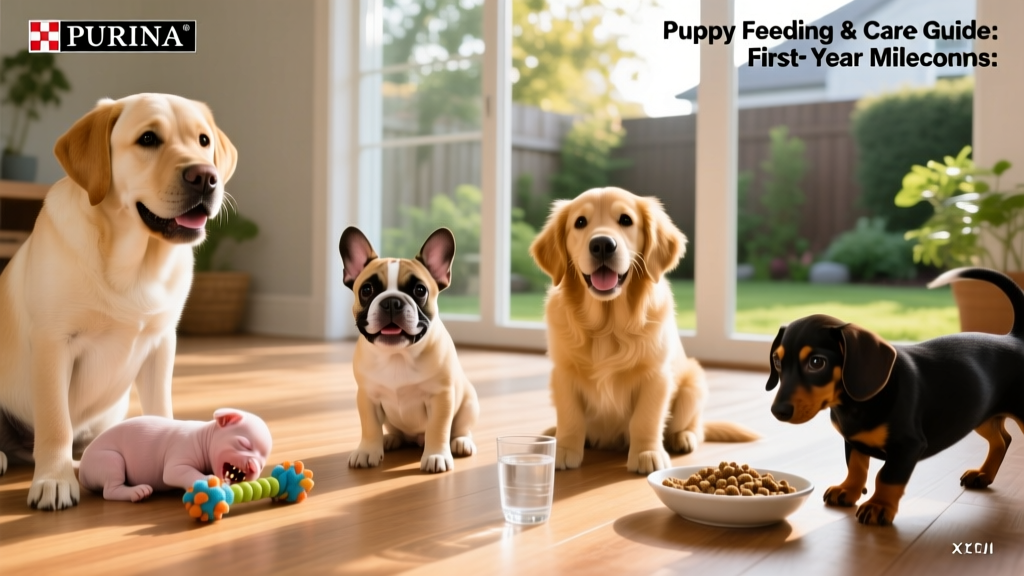
Bringing a new puppy home means navigating a maze of feeding decisions, vaccination appointments, and training milestones — often all at once. If you've chosen Purina Pro Plan Puppy formulas (or are considering them), this guide maps out exactly what your puppy needs from week 4 through month 12, with concrete portions, timelines, and troubleshooting strategies drawn from veterinary nutrition standards and real-world puppy raising.
Purina Pro Plan offers several puppy-specific lines — including Pro Plan Puppy Chicken & Rice, Pro Plan Puppy Sensitive Skin & Stomach, Pro Plan Puppy Large Breed, and Pro Plan Puppy Sport — each formulated to meet AAFCO nutrient profiles for growth. We'll break down which formula fits your dog's projected adult size, how much to feed at every life stage, and how feeding integrates with training, socialization, and veterinary care.
When Should I Bring My Puppy Home?
The American Kennel Club and most veterinary behaviorists agree: 8 weeks is the earliest appropriate age to bring a puppy home, with 8–10 weeks being the sweet spot for most breeds. Some small or toy breeds benefit from staying with the breeder until 10–12 weeks due to slower physical maturation and higher hypoglycemia risk.
During weeks 4–8 (still with the breeder or rescue), puppies learn critical bite inhibition from littermates, begin transitioning from mother's milk to solid food, and enter the primary socialization window. Reputable breeders will have already started your puppy on an age-appropriate diet — ask specifically which food they're using so you can transition gradually rather than switching cold, which triggers gastrointestinal upset in 60–70% of puppies.
Transitioning to Purina Pro Plan Puppy
If your puppy arrives on a different food, follow a 7-day transition protocol:
| Days | Old Food | Purina Pro Plan Puppy |
|---|---|---|
| 1–2 | 75% | 25% |
| 3–4 | 50% | 50% |
| 5–6 | 25% | 75% |
| 7+ | 0% | 100% |
Age-Specific Puppy Milestones: Week by Week
Weeks 4–8 (With Breeder/Rescue)
- Nutrition: Weaning onto gruel/puppy mush 3–4 times daily; fully on solid kibble by week 7
- Development: Deciduous (baby) teeth fully erupted; eyesight and hearing fully functional; littermate play teaches bite inhibition
- Socialization: Human handling exposure, novel surface walking (grass, tile, gravel), household sound desensitization
- What to expect: If picking up at 8 weeks, puppy should be eating solid food independently, responding to human voice, and showing curiosity about new environments
Weeks 8–12 (Home Adjustment Period)
- Nutrition: 3–4 meals per day; this is when Purina Pro Plan Puppy portions become your responsibility
- Development: Rapid brain growth; peak fear imprint period (8–11 weeks) — negative experiences can create lasting phobias
- Training: Name recognition, sit, basic crate introduction, handling exercises (paw touching, ear inspection)
- What to expect: First 3–5 nights often involve crying in the crate; bladder control is approximately 1 hour per month of age (so ~2 hours max at 8 weeks)
Weeks 12–16 (Confidence Building)
- Nutrition: Transition to 3 meals per day; growth rate accelerates noticeably
- Development: Second fear period may emerge around 12 weeks; adult teeth begin pushing in around 14–16 weeks
- Training: Leash walking foundations, recall (come when called), impulse control games, continued socialization
- What to expect: Puppy may suddenly seem "forgetful" of previously learned cues — this is developmental, not regression; consistency pays off
Weeks 16–24 (Adolescent Transition)
- Nutrition: Drop to 2 meals per day around 16–20 weeks (varies by breed size); large breeds stay on puppy food longer
- Development: Teething peaks between 4–6 months; chewing intensity increases dramatically
- Training: Formal puppy kindergarten classes (post-vaccination clearance); longer duration exercises
- What to expect: Testing boundaries, selective hearing on recall, increased independence on walks
Months 6–12 (Junior/Adolescent Phase)
- Nutrition: Small/medium breeds transition to adult food around 10–12 months; large/giant breeds remain on Pro Plan Puppy Large Breed until 18–24 months
- Development: Sexual maturity (spay/neuter typically performed 6–9 months unless your vet recommends later for large breeds); growth plates still closing in large breeds
- Training: Advanced obedience, proofing behaviors in distracting environments, adolescent socialization maintenance
- What to expect: Energy levels may increase before settling; some breeds show breed-specific behaviors emerging (herding, prey drive, guarding)
Purina Pro Plan Puppy Feeding Schedule by Age and Weight
Purina Pro Plan Puppy formulas are calorie-dense — the Chicken & Rice formula contains approximately 419 kcal/cup, while the Sport formula delivers 487 kcal/cup. This means portions matter more than you might think. Overfeeding during growth accelerates skeletal development faster than muscles and tendons can support, increasing hip dysplasia and joint injury risk in predisposed breeds.
The following table provides daily totals — divide by the number of meals per day for each feeding.
| Estimated Adult Weight | 8–12 Weeks (cups/day ÷ 4 meals) |
3–6 Months (cups/day ÷ 3 meals) |
6–12 Months (cups/day ÷ 2 meals) |
Recommended Formula |
|---|---|---|---|---|
| Toy/Small 5–20 lb (2–9 kg) |
½ – 1 cup (⅛–¼ per meal) |
¾ – 1¼ cups (¼–⅓ per meal) |
1 – 1½ cups (½–¾ per meal) |
Pro Plan Puppy Chicken & Rice (small kibble) |
| Medium 21–50 lb (10–23 kg) |
1 – 2 cups (¼–½ per meal) |
1½ – 3 cups (½–1 per meal) |
2 – 3½ cups (1–1¾ per meal) |
Pro Plan Puppy Chicken & Rice or Sensitive Skin |
| Large 51–90 lb (23–41 kg) |
1¾ – 3 cups (⅓–¾ per meal) |
2½ – 4½ cups (¾–1½ per meal) |
3½ – 5 cups (1¾–2½ per meal) |
Pro Plan Puppy Large Breed (critical for joint health) |
| Giant 91+ lb (41+ kg) |
2½ – 4 cups (⅝–1 per meal) |
4 – 6 cups (1⅓–2 per meal) |
5 – 7+ cups (2½–3½ per meal) |
Pro Plan Puppy Large Breed (continue until 18–24 mo) |
How Often Should I Feed My Puppy?
| Age | Meals Per Day | Spacing | Why It Matters |
|---|---|---|---|
| 8–12 weeks | 4 | Every 4–5 hours (skip overnight) | Prevents hypoglycemia in small breeds; supports potty training rhythm |
| 3–6 months | 3 | Every 5–6 hours | Matches increasing stomach capacity; maintains energy for training |
| 6–12 months | 2 | Every 8–10 hours | Aligns with adult feeding patterns; easier for working owners |
Vaccination Schedule: What Your Puppy Needs and When
The American Veterinary Medical Association (AVMA) and the AAHA Canine Vaccination Guidelines recommend a core vaccine series starting at 6–8 weeks, with boosters every 2–4 weeks until at least 16 weeks of age. Maternal antibodies interfere with vaccine response in young puppies, which is why the series — not a single shot — provides reliable immunity.
| Age | Vaccines | Type | Typical Cost Range |
|---|---|---|---|
| 6–8 weeks | DHPP (Distemper, Hepatitis/Adenovirus-2, Parainfluenza, Parvovirus) | Core | $25–$45 |
| 10–12 weeks | DHPP booster + Bordetella (optional, recommended if attending puppy classes or boarding) | Core + Non-core | $40–$75 |
| 14–16 weeks | DHPP booster + Rabies (required by law in most US states) | Core | $45–$85 |
| 12–16 months | DHPP booster + Rabies booster (1-year or 3-year depending on product) | Core | $50–$90 |
Non-core vaccines your vet may recommend based on lifestyle and geography: Leptospirosis (urban/water-exposed dogs), Lyme disease (tick-endemic regions), and Canine Influenza (H3N2/H3N8 — recommended for dogs in group settings like daycare). Discuss these at your 12-week visit.
When Can My Puppy Go Outside and Meet Other Dogs?
This is where vaccination science meets socialization urgency. The AVMA position is clear: puppies should avoid high-risk environments (dog parks, pet store floors, unknown dogs' yards) until at least 7 days after their final puppy vaccine at 14–16 weeks. However, controlled socialization with known, fully-vaccinated adult dogs in clean home environments can begin immediately after the first DHPP at 6–8 weeks.
Carry your puppy on walks through your neighborhood (avoiding areas with heavy dog traffic), visit friends' homes with vaccinated dogs, and attend well-managed puppy classes that require proof of at least one DHPP dose. The socialization window closes around 14–16 weeks — waiting until full vaccination to expose your puppy to the world risks behavioral problems that are statistically more dangerous than infectious disease in most areas.
Socialization Window: The Critical Weeks 3–14 Checklist
Behavioral research published in the Journal of Veterinary Behavior consistently shows that puppies with inadequate socialization during the 3–14 week primary window are significantly more likely to develop fear-based aggression, separation anxiety, and noise phobias. This window is not a suggestion — it's a neurodevelopmental fact.
Potty Training Timeline: Realistic Expectations and Troubleshooting
Let's set expectations clearly: most puppies are not reliably house-trained until 4–6 months of age, and some small breeds take until 8–10 months due to proportionally smaller bladders and faster metabolisms. Anyone promising "potty trained in 3 days" is selling something that doesn't exist.
Bladder Capacity by Age
The general rule: a puppy can hold their bladder for approximately one hour per month of age, plus one. So a 3-month-old puppy can manage roughly 4 hours — but this is a maximum, not a target. During active training, take them out far more frequently.
| Age | Take Out Every | Overnight Capacity | Accidents Expected |
|---|---|---|---|
| 8–10 weeks | 30–60 minutes | 2–3 hours (set alarm) | Multiple daily — completely normal |
| 3–4 months | 1–2 hours | 4–5 hours | 1–2 per week is progress |
| 5–6 months | 2–3 hours | 6–8 hours | Rare; regression possible during stress |
| 7–12 months | 3–4 hours | 8+ hours | Should be rare; if frequent, rule out UTI with vet |
When Will My Puppy Be Fully Potty Trained?
"Fully trained" means zero accidents for 4+ consecutive weeks. Most puppies reach this between 4–6 months with consistent management. Key factors that accelerate training:
- Feeding on a strict schedule (food down for 15–20 minutes, then picked up) creates predictable elimination timing — typically 15–30 minutes after eating
- Taking puppy to the same spot each time builds location association
- Using a consistent cue word ("go potty") paired with the act, then rewarding immediately after — not after they come back inside
- Crate use between outings prevents unsupervised accidents that reinforce bad habits
- Puppy strains to urinate or produces only drops (possible UTI or blockage)
- Blood in urine or stool
- Previously trained puppy suddenly having daily accidents (medical causes include UTI, diabetes, Cushing's disease, or spinal issues)
- Excessive thirst paired with increased urination
Crate Training Progression and Teething Survival Guide
Crate Time Limits by Age
The crate is a management tool and safe space — not a punishment. Maximum continuous crate time (outside of overnight sleep) should follow these limits:
| Age | Max Daytime Crate Time | Overnight |
|---|---|---|
| 8–10 weeks | 30–60 minutes | 2–3 hours (alarm needed) |
| 11–14 weeks | 1–2 hours | 3–5 hours |
| 15–16 weeks | 2–3 hours | 5–6 hours |
| 4–6 months | 3–4 hours | 7–8 hours |
| 6+ months | 4–5 hours | 8 hours |
Teething Timeline (3–6 Months) and Relief Strategies
Puppies have 28 deciduous teeth that begin erupting at 3–4 weeks and are fully in by 6–8 weeks. Starting around 12–16 weeks, adult teeth push in, and the baby teeth fall out — a process usually complete by 6–7 months. During peak teething (4–5 months), expect:
- Increased chewing on everything — furniture, hands, shoes, baseboards
- Drooling more than usual
- Small amounts of blood on chew toys (normal)
- Reluctance to eat hard kibble briefly (if persistent beyond 2 days, see your vet)
- Finding baby teeth on the floor (many puppies swallow them — also normal)
Safe chew relief options:
- Frozen, wet washcloth twisted into a rope (supervise to prevent swallowing fabric)
- Kong Classic (puppy size) stuffed with Purina Pro Plan Puppy kibble soaked in water or low-sodium chicken broth and frozen
- Benebone or Nylabone puppy-specific textured chews (size-appropriate — must be too large to swallow)
- Chilled carrot sticks or green beans (low calorie, safe if your puppy tolerates them)
Common Puppy Problems and Solutions
Puppy Biting and Nipping
How do I stop puppy biting? Puppy mouthing is normal developmental behavior — they explore the world with their mouths and are learning bite inhibition. The goal isn't to eliminate mouthing entirely at 8 weeks (that's unrealistic) but to teach progressively softer contact and redirect to appropriate objects.
- Redirect: When puppy teeth touch skin, immediately offer a chew toy. Praise enthusiastically when they bite the toy instead.
- Withdraw attention: If biting continues after redirection, stand up, cross your arms, and be still for 10–15 seconds. This teaches "biting ends play." Resume interaction once puppy is calm.
- Time-outs: For persistent hard biting, calmly place puppy in a playpen or safe area for 30–60 seconds. This is not punishment — it's a brief reset.
- Satisfy the need: Ensure puppy has 15–20 minutes of structured chewing time daily with appropriate items. Overtired puppies bite more — enforce nap times in the crate (puppies need 18–20 hours of sleep per day at 8–12 weeks).
Biting typically decreases significantly by 5–6 months as adult teeth come in and impulse control improves. If biting is aggressive (growling, stiffening, snapping with intent to harm rather than explore), consult a certified professional dog trainer or veterinary behaviorist.
Night Whining in the Crate
Place the crate in or near your bedroom for the first 2–3 weeks. A Snuggle Puppy (with heartbeat simulator) or a ticking clock wrapped in a towel can ease the transition from littermates. Take puppy out to eliminate once during the night (set an alarm for 3–4 hours after bedtime), keep it boring and dark, then return to crate. Ignore protest whining after you've confirmed they don't need to eliminate — responding teaches that whining opens the crate.
Destructive Chewing
Puppies chew for three reasons: teething discomfort, boredom, and exploration. Manage the environment by puppy-proofing rooms (shoes in closets, cords covered, toxic plants removed), providing 5–7 varied chew toys rotated weekly to maintain novelty, and ensuring adequate physical exercise and mental enrichment (snuffle mats, frozen Kongs, training sessions).
First-Year Cost Breakdown: What to Budget
New puppy owners consistently underestimate first-year costs. Here's a realistic breakdown based on 2026 pricing for a medium-breed puppy (21–50 lb adult weight) fed on Purina Pro Plan Puppy:
| Category | Low Estimate | Typical | High Estimate | Notes |
|---|---|---|---|---|
| Food (Purina Pro Plan Puppy) | $280 | $380 | $520 | 34 lb bag ~$55–$65; lasts 4–8 weeks depending on breed size |
| Veterinary (vaccines, wellness, spay/neuter) | $600 | $900 | $1,500 | Includes 3 puppy visits, vaccines, fecal tests, heartworm prevention, spay/neuter |
| Supplies (crate, bed, leash, bowls, toys) | $200 | $350 | $600 | Crate ($50–$100), bed ($30–$80), leash/harness ($25–$50), toys ($50–$150) |
| Preventive Medications | $150 | $250 | $400 | Heartworm (e.g., Heartgard ~$80/yr), flea/tick (e.g., NexGard ~$150/yr) |
| Training (puppy class + materials) | $100 | $200 | $500 | Group puppy class: $100–$200 for 6 weeks; private sessions $75–$150/hour |
| Pet Insurance (optional but recommended) | $300 | $500 | $720 | $25–$60/month; enroll before first illness for pre-existing condition coverage |
| TOTAL FIRST YEAR | $1,630 | $2,580 | $4,240 | Does not include puppy purchase/adoption fee or emergency vet visits |
Emergency fund recommendation: Set aside an additional $500–$1,000 for unexpected illness. Puppies commonly ingest foreign objects, develop gastrointestinal infections, or suffer minor injuries — each of which can cost $300–$2,000+ depending on diagnostics and treatment needed.
Frequently Asked Questions
Is Purina Pro Plan Puppy a good food for my puppy?
Purina Pro Plan Puppy formulas meet AAFCO nutrient profiles for growth (including large-breed growth for the Large Breed formula) and are formulated with input from veterinary nutritionists. Purina conducts feeding trials — a step many premium brands skip. The DHA content supports brain and vision development, and the large breed formula maintains controlled calcium:phosphorus ratios (1.1–1.4:1) critical for proper skeletal development. It's a well-supported choice backed by decades of nutritional research. If your puppy has specific sensitivities, the Sensitive Skin & Stomach variant uses salmon as the primary protein and includes oat-based carbohydrates for easier digestion.
How do I know if I'm feeding the right amount of Purina Pro Plan Puppy?
Use the feeding chart on the bag as a starting point, then adjust based on your puppy's Body Condition Score every 2 weeks. Weigh your puppy weekly using a home scale (for small breeds) or your vet's scale during visits. Steady growth along your breed's expected curve — not rapid weight gain or visible rib prominence — is the goal. If your puppy finishes meals instantly and seems hungry, try a slow-feeder bowl or divide meals into smaller, more frequent portions rather than simply adding more food.
When should I switch from Purina Pro Plan Puppy to adult food?
Small breeds (under 20 lb / 9 kg adult weight): transition at 10–12 months. Medium breeds (21–50 lb / 10–23 kg): transition at 12 months. Large breeds (51–90 lb / 23–41 kg): transition at 15–18 months. Giant breeds (91+ lb / 41+ kg): remain on Pro Plan Puppy Large Breed until 18–24 months. Switching too early deprives developing bones and joints of the specific nutrient ratios they need. When you do transition, follow the same 7-day gradual protocol used when first bringing puppy home.
My puppy has soft stools on Purina Pro Plan Puppy — is that normal?
Loose stools during the first 5–7 days on a new food are common during dietary transition. If stools remain soft (formed but not firm, like soft-serve consistency) beyond the transition period, consider the Sensitive Skin & Stomach formula, which uses easily digestible proteins and prebiotic fiber. Persistent diarrhea (watery, more than 3 times daily, or containing blood/mucus) warrants a vet visit to rule out parasites like giardia or coccidia — extremely common in puppies regardless of diet.
Can I mix Purina Pro Plan Puppy with wet food or toppers?
Yes, Pro Plan also offers canned puppy formulas that can be mixed with kibble for palatability. Keep toppers to no more than 10% of total daily caloric intake to maintain nutritional balance. Reduce kibble proportionally when adding wet food (approximately 1 can of wet food replaces about ¾ to 1 cup of dry, depending on the specific product's caloric density). Avoid adding human table scraps, which disrupt the carefully balanced calcium-to-phosphorus ratio essential for growing puppies.
Anouk Beaumont
All our authors care for dogs every day — read more of their work on the authors page.


