Red Doberman Pinscher Puppies: Complete First-Year Care Guide
Everything you need to raise red Doberman Pinscher puppies — feeding schedules, vaccination timelines, potty training, socialization, and first-year costs.

The rust-and-mahogany coat of a red Doberman Pinscher puppy turns heads at every outing, but behind that striking appearance is a high-drive working breed that demands structured early care. Red Doberman Pinscher puppies share the same genetics, temperament, and health predispositions as their black-and-rust counterparts — the only difference is a recessive dilution at the B-locus that produces a warm brown base coat instead of black. That means every feeding guideline, vaccine milestone, and training protocol below applies specifically to the Doberman Pinscher breed, calibrated for the rapid growth and sensitive temperament these puppies are known for.
This guide walks you through weeks 4 through 12 months with exact numbers, realistic timelines, and breed-specific troubleshooting so you can raise a confident, healthy Doberman.
When to Bring Your Red Doberman Pinscher Puppy Home
Responsible Doberman breeders typically release puppies between 8 and 10 weeks of age. While some states legally allow sales at 7 weeks, the American Kennel Club and most veterinary behaviorists recommend waiting until at least 8 weeks. During weeks 6–8, littermates teach bite inhibition and canine body language — skills that are extremely difficult to replicate in a single-puppy household.
For red Doberman Pinscher puppies specifically, the extra two weeks with the breeder (weeks 8–10) offer benefits:
- Week 8: First DHPP booster typically administered by the breeder's vet
- Week 9: Fear imprint period begins — transitioning in a calm, structured home environment is less stressful than a chaotic multi-child household
- Week 10: Puppy has had additional socialization with littermates, reducing resource guarding tendencies later
Ask your breeder for a written record of deworming (typically pyrantel pamoate at 2, 4, 6, and 8 weeks), any early neurological stimulation (ENS) protocols used, and the puppy's individual weight curve. A healthy 8-week Doberman puppy should weigh between 12–18 lb (5.4–8.2 kg).
Age-Specific Milestones: Weeks 4 Through 12 Months
Weeks 4–8 (Still With Breeder)
Transitional period. Eyes and ears fully functional. Puppies begin eating gruel (kibble soaked in warm water or puppy milk replacer) 3–4 times daily alongside nursing. Start of primary socialization window. Puppies learn bite inhibition through littermate play. Expected weight gain: roughly 1–2 lb per week.
Weeks 8–12 (Home Transition)
Peak bonding period. Your red Doberman Pinscher puppy will test boundaries and form lasting associations with people, surfaces, and sounds. Expect 18–20 hours of sleep per day. Bladder capacity: approximately 1 hour per month of age (so a 2-month-old puppy can hold for about 2 hours maximum). Start name recognition and basic marker training (clicker or verbal "yes"). Weight at 12 weeks: typically 25–35 lb (11–16 kg).
Weeks 12–16 (Foundation Training)
Second fear imprint period may occur around 12 weeks — avoid overwhelming experiences. Begin structured leash walking with a front-clip harness (not a collar, to protect the developing trachea). Puppy kindergarten classes can start once 2 rounds of DHPP are complete. Weight at 16 weeks: roughly 35–50 lb (16–23 kg).
Weeks 16–24 (Adolescence Begins)
Teething peaks between 4–6 months. Permanent teeth replace deciduous teeth. Expect increased chewing and mouthing. Begin impulse control exercises (wait at doors, leave-it, settle on mat). Growth plates still open — avoid repetitive high-impact exercise like jogging or forced jumping. Weight at 6 months: approximately 50–65 lb (23–29 kg).
Months 6–12 (Young Adult Transition)
Sexual maturity approaches if not yet spayed/neutered. Energy remains high but attention span lengthens. Continue structured socialization. Begin longer walks (30–45 minutes) and introduce low-impact activities like swimming. Weight at 12 months: males 65–80 lb (29–36 kg), females 55–70 lb (25–32 kg). Dobermans continue filling out until 18–24 months.
Feeding Schedule and Portions by Age
Doberman Pinschers are a large-breed dog, which means you must feed a diet specifically formulated for large-breed puppies to control growth rate and reduce the risk of developmental orthopedic diseases like hip dysplasia and osteochondritis dissecans (OCD). Look for an AAFCO statement that reads "formulated for growth/all life stages including growth of large-size dogs."
| Age | Meals Per Day | Approximate Daily Portion (Large-Breed Puppy Kibble) | Notes |
|---|---|---|---|
| 8–12 weeks | 3–4 | 1.5–2.5 cups (divided across meals) | Soften kibble if puppy struggles to chew; always provide fresh water |
| 3–4 months | 3 | 2.5–3.5 cups | Transition to dry kibble; monitor body condition score (BCS) weekly |
| 5–6 months | 2 | 3.5–5 cups | Drop the midday meal gradually over 3–4 days |
| 7–12 months | 2 | 4–6 cups | Adjust based on activity level and BCS; ribs should be easily felt but not visible |
Brand-specific guidance (2026 pricing): Purina Pro Plan Large Breed Puppy (approximately $55–65 per 34 lb bag), Royal Canin Doberman Pinscher Puppy (approximately $80–95 per 25 lb bag), or Hill's Science Diet Large Breed Puppy (approximately $60–75 per 30 lb bag). These ranges reflect the caloric density differences — always follow the feeding chart on your specific bag and adjust based on your puppy's individual weight gain.
A critical note for Dobermans: this breed has a documented predisposition to dilated cardiomyopathy (DCM). Consult your veterinarian about taurine levels in your chosen diet and whether grain-inclusive formulas are preferable. The FDA has investigated a potential link between grain-free diets and DCM in predisposed breeds. Until more research is conclusive, most veterinary cardiologists recommend grain-inclusive diets for Dobermans.
Vaccination Schedule for Red Doberman Pinscher Puppies
Doberman puppies follow the standard large-breed core vaccination protocol, but their sensitive immune systems can occasionally produce stronger post-vaccine reactions (lethargy, mild fever, injection-site soreness) than some breeds. Monitor your puppy for 24 hours after each round and contact your vet if symptoms persist beyond 48 hours.
| Age | Vaccines Administered | Details |
|---|---|---|
| 6–8 weeks | DHPP (1st dose), Bordetella (optional) | Distemper, Hepatitis (Adenovirus-2), Parainfluenza, Parvovirus. Often given by breeder. |
| 10–12 weeks | DHPP (2nd dose), Leptospirosis (1st dose), Bordetella | Leptospirosis is a 2-dose series given 2–4 weeks apart. Recommended for dogs with outdoor exposure. |
| 14–16 weeks | DHPP (3rd dose), Leptospirosis (2nd dose), Rabies | Rabies is legally required; timing varies by state (usually 12–16 weeks). Final DHPP ensures maternal antibodies no longer interfere. |
| 12–16 months | DHPP booster, Rabies booster, Leptospirosis annual | First annual boosters. After this, DHPP may move to a 3-year interval depending on your vet's protocol and local law. |
Cost per visit (2026 estimates): $75–$150 per puppy wellness exam, plus $20–$40 per individual vaccine. A full puppy vaccine series typically costs $200–$400 total across three visits. Many veterinary clinics offer puppy wellness packages that bundle these costs at a 10–20% discount.
Post-Vaccine Red Flags — Call Your Vet If:
- Facial swelling or hives within 1–4 hours of vaccination
- Vomiting or diarrhea lasting more than 12 hours
- Difficulty breathing or collapse (emergency — go to nearest 24-hour clinic immediately)
- Lethargy or refusal to eat lasting more than 48 hours
The Socialization Window: Weeks 3–14
The American Veterinary Society of Animal Behavior (AVSAB) identifies weeks 3 through 14 as the critical socialization period for puppies. For red Doberman Pinscher puppies, this window is especially important because Dobermans are a naturally alert, handler-focused breed that can develop fear-based reactivity if under-socialized. The goal is not to overwhelm your puppy but to create positive associations with novel stimuli.
Critical rule: Until your puppy has completed at least two rounds of DHPP (around 12 weeks), avoid public dog parks, pet store floors, and any area with unknown dog traffic. Parvovirus can survive in soil for months and is lethal to unvaccinated puppies. Carry your puppy in a sling or stroller for outdoor exposure, or host vaccinated dogs at your home.
Potty Training Timeline and Realistic Expectations
Doberman puppies are intelligent and typically learn potty routines faster than many breeds — but "faster" still means 4–6 months for reliable house training, with occasional accidents possible until 8–10 months. Any guide promising full potty training in a week is setting you up for frustration.
| Age | Expected Bladder Hold Time | Outing Frequency | Milestone |
|---|---|---|---|
| 8–10 weeks | 1.5–2 hours | Every 1.5 hours + after every meal, nap, and play session | Learning the concept of "outside = potty" |
| 11–14 weeks | 2–3 hours | Every 2–3 hours + key trigger times | Beginning to signal (sniffing, circling, going to door) |
| 4–5 months | 3–4 hours | Every 3–4 hours | Most accidents happen when routine is disrupted |
| 6–8 months | 5–6 hours | Every 4–5 hours | Reliable with consistent schedule; regression possible during adolescence |
| 9–12 months | 6–8 hours | 3–4 outings per day | Functionally house-trained; overnight hold of 7–8 hours typical |
Troubleshooting common setbacks:
- Submissive urination (common in Dobermans 3–8 months): Your puppy pees when greeted. Solution: ignore puppy for first 2 minutes when arriving home, greet calmly at their level, avoid direct eye contact initially.
- Marking behavior (males, typically 6+ months): Small amounts of urine on vertical surfaces indoors. Solution: interrupt with a neutral "oops" and redirect outside; consider neutering if marking escalates; use enzymatic cleaner (Nature's Miracle or Rocco & Roxie) on all marked spots.
- Regression at 7–9 months: Adolescent hormonal changes can temporarily undo months of progress. Solution: return to puppy-frequency outings for 2 weeks, increase positive reinforcement for outdoor elimination, rule out urinary tract infection with a vet visit.
Crate Training Progression and Time Limits
A crate is essential for a Doberman puppy — this breed's combination of intelligence, athleticism, and destructive chewing capacity means unsupervised freedom before 12–18 months is a recipe for destroyed furniture and potential injury. Choose a 42-inch or 48-inch wire crate (MidWest iCrate or Frisco double-door are reliable options in the $50–$80 range) with a divider panel to limit space as your puppy grows.
| Age | Maximum Daytime Crate Time | Maximum Nighttime Crate Time | Notes |
|---|---|---|---|
| 8–10 weeks | 1–2 hours | 3–4 hours (set alarm for potty break) | Crate in bedroom; cover with light blanket for den feel |
| 11–14 weeks | 2–3 hours | 4–5 hours | Begin moving crate to permanent location if desired |
| 4–5 months | 3–4 hours | 6–7 hours | Puppy should be entering crate voluntarily for naps |
| 6–8 months | 4–5 hours | 7–8 hours | Never exceed 5 hours daytime without a potty/play break |
| 9–12 months | 4–6 hours | 8 hours | Begin testing short periods of supervised freedom outside crate |
Crate training method (force-free):
- Leave crate door open with high-value treats (freeze-dried liver, KONG stuffed with peanut butter) inside. Let puppy enter and exit freely for 3–5 days.
- Begin closing door for 10-second intervals while you sit nearby. Gradually extend to 1 minute, then 5 minutes, then 15 minutes over the first week.
- Start leaving the room for brief intervals (30 seconds, building to 5 minutes). Return before puppy shows distress.
- Associate a cue word ("kennel" or "crate") with entering. Toss treat inside, say cue, praise when puppy enters.
- Never use the crate as punishment. Never release puppy while whining (wait for 3 seconds of silence to avoid reinforcing vocalization).
Teething Timeline and Relief Strategies
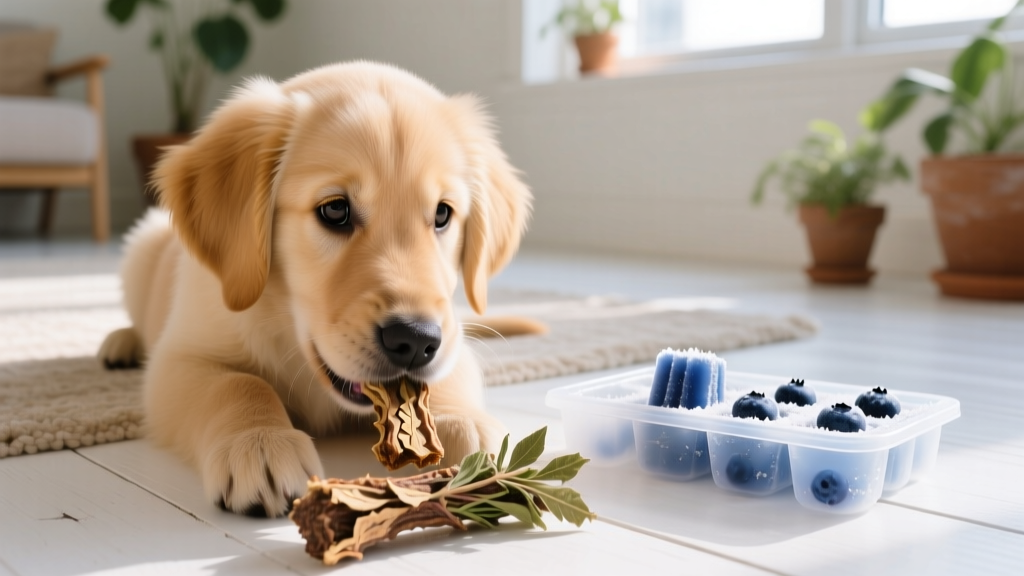
Doberman puppies begin losing their 28 deciduous (baby) teeth around 12–16 weeks, with all 42 permanent teeth typically erupted by 6–7 months. The most intense chewing phase occurs between 4–6 months when the canine teeth (fangs) and premolars push through the gums.
Safe chew recommendations by stage:
- 3–4 months: Chilled (not frozen) rubber teething rings designed for puppies, wet washcloth twisted and frozen, Benebone Puppy Wishbone (softer rubber formula)
- 4–6 months: Frozen KONG Classic stuffed with plain yogurt and banana, Nylabone Puppy Chew (softer texture), bully sticks (supervised only, remove when small enough to swallow)
- 6–7 months: Transition to adult chew toys — West Paw Zogoflex Hurley, Goughnuts MAXX for power chewers (Dobermans typically qualify)
What to avoid: Rawhide (choking and intestinal blockage risk), hard antlers or weight-bearing bones from large animals (tooth fracture risk in developing teeth), and any toy small enough to fit entirely inside your puppy's mouth. The ASPCA Animal Poison Control hotline at (888) 426-4435 is available 24/7 if your puppy ingests a non-food object — a consultation fee applies, but it can be lifesaving.
Common Red Doberman Pinscher Puppy Problems and Solutions
Puppy Biting and Nipping
Why it happens: Dobermans are a mouth-oriented breed originally developed for personal protection work. Puppies explore the world with their teeth, and Doberman pups tend to mouth more intensely than, say, a Cavalier King Charles Spaniel.
Solution: Redirect to an appropriate chew toy every single time teeth touch skin. If puppy persists, stand up and withdraw attention for 10–15 seconds (negative punishment — removing something the puppy wants). Consistency across all household members is non-negotiable. Expect 3–6 weeks of consistent redirection before you see significant improvement. Never hold the puppy's mouth shut, slap, or use physical corrections — these methods increase fear and can create defensive aggression in a breed that is already naturally protective.
Separation-Related Whining and Vocalization
Why it happens: Dobermans are a velcro breed that bonds intensely with their people. Crate whining, door-scratching, and distress vocalization are common in the first 2–4 weeks home.
Solution: Practice graduated departure training. Start with 5-second absences, building duration in small increments over weeks. Provide a frozen KONG or lick mat (spread with pumpkin puree) when crating — licking is a self-soothing behavior. Consider a white noise machine or Snuggle Puppy (a plush toy with a heartbeat simulator, approximately $30–$40) for nighttime anxiety. If whining persists beyond 4 weeks of consistent training, consult a certified veterinary behaviorist (DACVB) or a Karen Pryor Academy-certified trainer.
Destructive Chewing
Why it happens: A combination of teething discomfort, high energy, and the breed's natural drive. An under-exercised, under-stimulated Doberman puppy will invent its own entertainment — usually at the expense of your baseboards.
Solution: Ensure minimum daily enrichment: 20–30 minutes of structured training (short 5-minute sessions, 4–6 times daily), 30–45 minutes of physical exercise appropriate to age (5 minutes per month of age is a common guideline for walks), and at least one puzzle feeder meal per day. Rotate chew toys every 3–4 days to maintain novelty. Puppy-proof your home: bitter apple spray on furniture legs, baby gates to restrict access, and all shoes/electrical cords elevated or enclosed.
When Can My Puppy Go Outside and Meet Other Dogs?
This is one of the most common questions new Doberman owners ask, and the answer requires balancing disease risk against the closing socialization window.
Safe from day one (8 weeks):
- Your own fenced yard (if no unknown dogs have access)
- Carried outings in a sling or backpack — parks, outdoor cafés, busy sidewalks
- Playdates at your home with fully vaccinated, healthy adult dogs you know
- Puppy socialization classes that require proof of vaccination and sanitize floors between sessions
Wait until 1 week after the third DHPP (typically 16–17 weeks):
- Public dog parks (high parvo risk from unknown dogs)
- Pet store floors
- Dog-friendly beaches or trails with heavy dog traffic
- Boarding facilities or doggy daycare
The AVSAB recommends beginning socialization before the full vaccine series is complete, provided you manage exposure carefully. The risk of behavioral problems from under-socialization in a Doberman outweighs the disease risk when you control the environment.
First-Year Cost Breakdown for a Red Doberman Pinscher Puppy
| Category | Estimated Cost (2026) | Details |
|---|---|---|
| Puppy purchase (responsible breeder) | $2,500–$4,500 | Red Dobermans may command a slight premium ($200–$500 above black-and-rust) due to rarity; AKC-registered, health-tested parents |
| Veterinary care (first year) | $800–$1,500 | Includes 3–4 wellness exams, full vaccine series, fecal tests, heartworm prevention start, spay/neuter ($400–$700) |
| Food (large-breed puppy formula) | $600–$1,000 | Approximately 12–18 bags (30 lb each) over the first year |
| Supplies | $400–$800 | Crate ($50–$80), harness ($25–$50), leash, collar, ID tags, chew toys, grooming tools, baby gates, enzymatic cleaner, bed |
| Training | $300–$800 | Puppy kindergarten ($150–$250 for 6–8 week course), basic obedience ($200–$400), optional: private sessions for specific issues ($80–$150/hour) |
| Pet insurance (optional but recommended) | $500–$900/year | Dobermans are predisposed to costly conditions (DCM, von Willebrand disease, hip dysplasia); enroll before any pre-existing conditions develop |
| Emergency fund buffer | $500–$2,000 | Puppies ingest foreign objects, develop infections, or sustain injuries; having accessible savings prevents delayed care |
Total first-year estimated cost: $5,600–$11,500 depending on purchase price, veterinary needs, and whether you carry pet insurance. After the first year, annual costs typically settle to $1,500–$3,000 for food, routine veterinary care, insurance, and supplies.
Frequently Asked Questions
Are red Doberman Pinscher puppies healthier or less healthy than black-and-rust Dobermans?
Coat color does not affect health. Red Dobermans carry two recessive alleles at the B-locus (bb genotype), which dilutes eumelanin from black to brown. This is purely cosmetic. The same breed health concerns — dilated cardiomyopathy (DCM), von Willebrand disease (vWD), cervical vertebral instability (wobbler syndrome), and hip dysplasia — apply equally. Always request health clearances from the breeder: OFA cardiac evaluation, vWD DNA test, and OFA hip scores for both parents.
How often should I feed my 10-week-old red Doberman puppy?
Three to four meals per day, totaling approximately 1.5–2.5 cups of large-breed puppy kibble divided evenly across meals. Feed at consistent times (e.g., 7 AM, 12 PM, 5 PM, and optionally 9 PM) to support potty training predictability. Remove uneaten food after 15–20 minutes to prevent grazing habits.
When will my Doberman puppy be fully potty trained?
Most Doberman puppies are functionally house-trained by 6–8 months with a consistent schedule, though occasional accidents may occur until 10–12 months. Males may take slightly longer than females. Submissive urination can persist until 12–18 months and is a separate behavioral issue from incomplete house training.
What vaccines does my puppy need and when?
The core series is DHPP at 6–8 weeks, 10–12 weeks, and 14–16 weeks. Rabies is given at 14–16 weeks (timing varies by state). Leptospirosis is a strongly recommended 2-dose series starting at 10–12 weeks. Bordetella (kennel cough) is recommended if your puppy will attend group classes, daycare, or boarding. Consult your veterinarian to customize the protocol based on your region's disease prevalence.
How do I stop my Doberman puppy from biting my hands?
Redirect every bite to an appropriate chew toy. If teeth contact skin, immediately stand up and withdraw attention for 10–15 seconds. Resume interaction only when all four paws are on the floor and the puppy is calm. Ensure your puppy receives adequate physical exercise and mental enrichment — an under-tired puppy bites more. Never use physical punishment, which can escalate mouthing into fear-based aggression in this sensitive breed.
When can my puppy meet other dogs at the park?
Wait until at least one week after the third DHPP vaccine (typically 16–17 weeks of age). Before that, socialize through controlled playdates with known, vaccinated dogs at your home, and carry your puppy in public spaces for environmental exposure without direct contact with unknown dogs or contaminated surfaces.
This guide provides general educational information about raising red Doberman Pinscher puppies. Always consult your veterinarian for personalized health, nutrition, and vaccination advice tailored to your individual puppy. The Merck Veterinary Manual and the AKC Doberman Pinscher breed standard are excellent ongoing references as your puppy grows.
Dr. Hannah Wickes
All our authors care for dogs every day — read more of their work on the authors page.