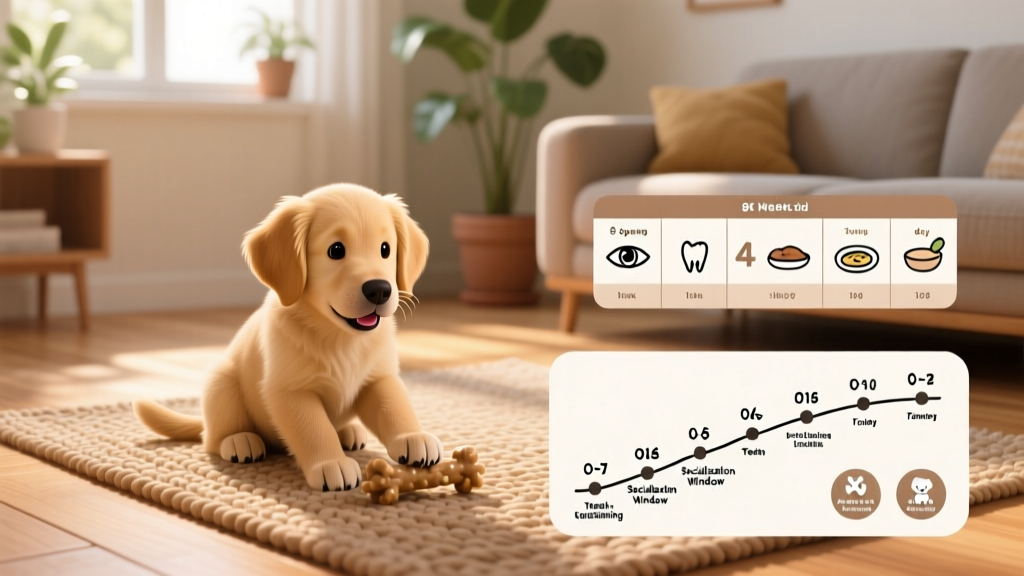
Best Puppy Dental Chews by Age & Breed Size
When can puppies have dental chews? This breed-size-specific teething guide covers safe puppy dental chews, chewing milestones, and relief strategies from

Teething is one of the most chaotic phases of puppyhood. Between the needle-sharp baby teeth and the relentless urge to gnaw on everything in sight, new puppy parents quickly learn that having the right chew options isn't optional — it's survival. But not all puppy dental chews are safe for every age, and giving the wrong type at the wrong developmental stage can fracture immature teeth, cause intestinal blockages, or create long-term oral health problems.
This guide maps exactly when puppies can safely use dental chews, which types suit each breed size category, and how to integrate chewing into a broader teething relief strategy from 8 weeks through adolescence. We'll also cover the full puppy development timeline so you know what to expect at every stage.
The Puppy Teething Timeline: What Happens and When
Understanding the dental development sequence is essential before choosing any chew product. Puppies go through a predictable series of dental milestones, and each stage has different implications for what's safe to put in their mouth.
Dental Development Milestones
| Age Range | Dental Stage | What's Happening | Chew Safety Level |
|---|---|---|---|
| Weeks 2–4 | Deciduous (baby) teeth erupt | 28 baby teeth emerge; puppy still nursing | No chews — still with breeder |
| Weeks 4–8 | Full baby teeth, weaning | All 28 deciduous teeth present; exploring through mouthing | Soft, edible only (moistened kibble, soft puppy treats) |
| Weeks 8–12 | Baby teeth stable, heavy mouthing | Peak nipping/biting behavior; baby teeth fully rooted | Soft rubber toys, frozen washcloths, edible puppy-specific chews only |
| Weeks 12–16 | Baby teeth begin loosening | Adult teeth start pushing up; gums inflamed, increased chewing drive | Soft-to-medium puppy dental chews; frozen items; textured rubber |
| Months 4–6 | Active tooth loss and eruption | Baby teeth fall out (often swallowed); 42 adult teeth erupt; peak chewing intensity | Medium-density puppy dental chews; approved teething toys; avoid hard nylon/bone |
| Months 6–8 | Adult teeth fully erupted | All 42 adult teeth in; gums settling; jaw still developing | Standard dental chews OK; introduce harder options gradually |
| Months 8–12 | Adult dentition mature | Teeth fully rooted and hardened; chewing behavior may decrease | Full range of dental chews; size-appropriate harder chews acceptable |
The critical takeaway: before 12 weeks, puppies should never receive hard dental chews. Their deciduous teeth have shallow roots and thin enamel, making them susceptible to slab fractures that can expose the pulp cavity and require extraction. According to the Merck Veterinary Manual, dental fractures in young puppies are more common than many owners realize, and the pain often goes unnoticed because dogs instinctively hide oral discomfort.
Safe Puppy Dental Chews by Breed Size and Age
Breed size matters enormously when selecting dental chews. A Great Dane puppy at 16 weeks weighs more than an adult Chihuahua, and their jaw strength, mouth size, and swallowing capacity are vastly different. Here's a breed-size-specific framework for choosing puppy dental chews safely.
Toy & Small Breeds (Under 20 lb Adult Weight)
Examples: Chihuahua, Pomeranian, Yorkshire Terrier, Toy Poodle, Maltese
- 8–12 weeks: Skip commercial dental chews entirely. Use frozen, water-soaked washcloths twisted into rope shapes, or soft silicone teething toys like the KONG Puppy (XS size, ~$8–10).
- 12–16 weeks: Introduce very soft edible chews like Whimzees Puppy Chews (small size, ~$12 for a 12-pack) or Earth Animal No-Hide Puppy Chews. Limit to one chew per day, supervised.
- 4–6 months: Puppy-specific dental sticks like Pedigree Dentastix Puppy (small breed, ~$6 for 25-pack) or Nylabone Puppy Chew (soft flex material, ~$5–7). Always select the size labeled for your puppy's current weight.
- 6–12 months: Graduate to standard small-breed dental chews. Greenies Teenie size (~$15 for 36-pack) are VOHC-accepted for tartar control.
Medium Breeds (20–60 lb Adult Weight)
Examples: Beagle, Cocker Spaniel, Australian Shepherd, Border Collie, Bulldog
- 8–12 weeks: Frozen carrot sticks (peeled, cut to 4-inch lengths) or frozen KONG Puppy (Medium, ~$12) stuffed with plain canned pumpkin. No commercial dental chews yet.
- 12–16 weeks: Whimzees Puppy Chews (medium, ~$14 for 21-pack) or SmartBones SmartSticks Puppy (medium, ~$10 for 18-pack). Supervise all chewing sessions; limit to 10–15 minutes.
- 4–6 months: Nylabone Puppy Power Chew (medium, ~$7–9) or Benebone Puppy Wishbone (medium, ~$13). These provide resistance without the fracture risk of real bone or hard nylon.
- 6–12 months: Greenies Regular or Teenie (~$18–22), Virbac VeggieDent (~$16 for 12-pack), or OraVet Dental Hygiene Chews (small/medium, ~$20 for 14-pack).
Large & Giant Breeds (60+ lb Adult Weight)
Examples: Labrador Retriever, Golden Retriever, German Shepherd, Rottweiler, Great Dane
- 8–12 weeks: Frozen washcloth ropes, KONG Puppy (Large, ~$14) stuffed with softened kibble. Large breed puppies have powerful jaws early — do not underestimate their bite force even at 10 weeks.
- 12–16 weeks: Nylabone Puppy Chew (large, ~$8–10), Whimzees Puppy Stix (large, ~$16 for 14-pack). Large breed puppies may attempt to swallow chews whole — always choose sizes that cannot fit entirely inside the mouth.
- 4–6 months: Benebone Puppy Wishbone (large, ~$16), Goughnuts Puppy Ring (~$22). At this stage, large breed puppies can generate 150–200+ PSI of bite force, so durable but not rock-hard is the target.
- 6–12 months: Greenies Large or Jumbo (~$22–28), Purina Pro Plan Veterinary Dental Chewz (~$25 for 12-pack), or Himalayan Dog Chews (small size, ~$12 for 2-pack — supervise closely as these are dense).
When Can Puppies Safely Start Dental Chews?
The most common question I hear from new puppy owners is: "When can I start giving dental chews?" The honest answer is layered:
Edible, soft puppy-specific dental chews: Safe from approximately 12 weeks of age, once the puppy has been home for a few weeks and is eating solid kibble confidently. Start with products explicitly labeled "puppy" — these are formulated with softer textures and smaller sizes.
Standard adult dental chews (like regular Greenies or Dentastix): Wait until all adult teeth have fully erupted and the gums have healed, typically around 6–7 months for most breeds. Giant breeds may not finish teething until 8 months.
Hard chews (antlers, hooves, bones, hard nylon): Not recommended until at least 10–12 months, and even then, many veterinary dentists advise against them entirely. The American Veterinary Dental College specifically warns that hard chew objects can cause tooth fractures regardless of the dog's age.
A practical rule I recommend: if you can't indent the chew with your thumbnail, it's too hard for any dog under 12 months. This "thumbnail test" eliminates most antlers, weight-bearing bones, and ultra-hard nylon products from consideration during puppyhood.
Teething Relief Strategies Beyond Dental Chews
Dental chews are just one tool. During peak teething (months 3–6), puppies need variety to manage gum inflammation and the compulsive need to chew. Here's a rotation strategy that keeps puppies engaged without over-relying on any single product:
7-Day Chew Rotation Plan (4–6 Month Puppy)
| Day | Morning (15 min) | Afternoon (15 min) | Evening (15 min) |
|---|---|---|---|
| Mon | Frozen KONG with yogurt | Puppy dental stick | Textured rubber chew toy |
| Tue | Frozen carrot stick | Benebone Puppy | Frozen washcloth rope |
| Wed | Puppy dental chew | Nylabone Puppy Flex | Frozen KONG with pumpkin |
| Thu | Frozen banana chunks | Puppy dental stick | Soft rubber ring toy |
| Fri | Frozen KONG with broth | Whimzees Puppy Chew | Textured tug toy (supervised) |
| Sat | Puppy dental chew | Frozen apple slices (no seeds) | Benebone Puppy Wishbone |
| Sun | Frozen washcloth rope | Puppy dental stick | Frozen KONG with peanut butter (xylitol-free) |
Always supervise chewing sessions. Remove any chew that has been gnawed down to a size your puppy could swallow whole. For edible chews, a 15-minute time limit prevents excessive calorie intake — most puppy dental chews contain 25–70 calories each, and overfeeding chews can contribute to rapid weight gain, especially in large breeds where controlled growth is critical for joint health.
Stopping Puppy Biting and Nipping: A Teething-Aware Approach
Puppy biting peaks between 8 and 16 weeks and often intensifies again during active teething at 4–5 months. The biting isn't aggression — it's a combination of exploratory behavior, play solicitation, and oral discomfort. Here's how to address it without suppressing normal development:
Step 1 — Redirect to appropriate chews. Every time teeth touch skin, immediately offer a puppy dental chew or frozen toy. This teaches "teeth go on objects, not people." Keep chews in every room so redirection is instant.
Step 2 — Use the "ouch" protocol. When bitten, make a brief high-pitched yelp (mimicking littermate feedback), then withdraw attention for 10–15 seconds. Return and redirect to a chew. This is a force-free method supported by the AKC's training guidelines.
Step 3 — Manage arousal levels. Overtired puppies bite more. At 8–12 weeks, puppies need 18–20 hours of sleep per day. If biting escalates, your puppy likely needs an enforced nap in their crate, not more stimulation.
Step 4 — Provide adequate chewing outlets. A puppy who has 3–4 appropriate chewing sessions per day will direct less oral energy toward your hands and furniture. The chewing drive is biological — you can't train it away, only redirect it.
Never use physical punishment, mouth-holding, alpha rolls, or bitter sprays on puppies. These methods increase fear and can create defensive biting patterns that persist into adulthood. Positive reinforcement and environmental management are both more effective and safer.
Puppy Development Beyond Teething: Feeding, Vaccines, and Potty Training
Teething doesn't happen in isolation. Here's how the broader puppy care picture fits together during the chew-intensive months.
Feeding Schedule by Age
| Age | Meals/Day | Small Breed (10 lb target) | Medium Breed (40 lb target) | Large Breed (75 lb target) |
|---|---|---|---|---|
| 8–12 weeks | 3–4 | ¼–½ cup total/day | ½–1 cup total/day | 1–2 cups total/day |
| 12–16 weeks | 3 | ⅓–⅔ cup total/day | 1–1½ cups total/day | 2–3 cups total/day |
| 4–6 months | 3 | ½–¾ cup total/day | 1½–2½ cups total/day | 3–4 cups total/day |
| 6–12 months | 2 | ½–1 cup total/day | 2–3 cups total/day | 3½–5 cups total/day |
Portions are approximate and based on AAFCO-recommended caloric needs for growing puppies. Adjust based on body condition score — you should feel but not see ribs. Large breed puppies should be fed a large-breed-specific puppy formula to control growth rate and reduce orthopedic disease risk.
Chew calorie accounting: Subtract dental chew calories from daily food allowance. A typical puppy dental chew contains 25–70 calories. If you're giving 2 chews daily at 50 calories each, reduce kibble by roughly ¼ cup to maintain healthy weight.
Vaccination Schedule and Outdoor Access
| Age | Vaccines | Outdoor Access Level | Estimated Cost |
|---|---|---|---|
| 6–8 weeks | DHPP (Distemper, Hepatitis, Parainfluenza, Parvovirus) — 1st dose | Carry only; no public ground contact | $25–45 |
| 10–12 weeks | DHPP — 2nd dose; Bordetella (optional, recommended for socialization classes) | Controlled outdoor exposure in low-risk areas (your yard, known-vaccinated dog playdates) | $35–60 |
| 14–16 weeks | DHPP — 3rd dose; Rabies (required by law in most US states) | Full outdoor access 5–7 days after final DHPP | $40–75 |
| 12–16 months | DHPP booster; Rabies booster (1-year or 3-year depending on jurisdiction) | Full access | $50–90 |
The AVMA's vaccination guidelines emphasize that puppies are not fully protected against parvovirus until approximately 7 days after their final DHPP dose at 14–16 weeks. During the vulnerable window (8–16 weeks), avoid dog parks, pet store floors, and unknown-dog areas — but do continue controlled socialization with known-vaccinated dogs.
Socialization Window: The Critical Weeks 3–14
The primary socialization window closes around 12–14 weeks of age. This means your puppy's most formative period for learning what's "normal and safe" overlaps almost exactly with their most vulnerable pre-vaccination period. The American Veterinary Society of Animal Behavior recommends that puppies receive structured socialization before full vaccination is complete, because the behavioral risks of under-socialization (fear, aggression, anxiety) statistically outweigh the disease risk when managed properly.
Potty Training Timeline: Realistic Expectations
Potty training timelines are frequently oversold. Here's what actually happens in practice:
- 8–10 weeks: Puppy can hold bladder approximately 1–2 hours maximum. Expect 8–12 elimination events per day. Accidents are inevitable.
- 10–14 weeks: Bladder capacity increases to 2–3 hours. Puppy begins to show pre-elimination signals (sniffing, circling, sudden stillness). Take out every 1–2 hours plus immediately after meals, naps, and play.
- 4–6 months: Bladder control extends to 4–5 hours. Most puppies are reliably signaling to go out by this stage, though accidents still happen during excitement or schedule disruptions.
- 6–9 months: Most puppies are considered "fully potty trained" by this age — meaning fewer than 1 accident per month in the home. Small breeds may take longer due to smaller bladder capacity.
- 9–12 months: Reliable house training in most dogs. If accidents persist beyond 9 months, consult your veterinarian to rule out urinary tract infection, ectopic ureters, or behavioral causes.
Crate training progression by age: Use the crate as a potty training aid (dogs naturally avoid soiling their sleeping area). Maximum crate time guidelines: 8–10 weeks = 30–60 minutes; 11–14 weeks = 1–2 hours; 15–16 weeks = 2–3 hours; 4–6 months = 3–4 hours. Never exceed these durations during the day — overnight, puppies can typically hold 1 hour longer than daytime limits.
First-Year Cost Breakdown: Budgeting for Your Puppy
Puppy dental chews are a small line item in a much larger first-year budget. Here's what new owners should realistically expect to spend:
| Category | Small Breed | Medium Breed | Large Breed |
|---|---|---|---|
| Vaccines & vet visits (first year) | $250–500 | $300–600 | $350–700 |
| Spay/neuter | $200–500 | $300–700 | $400–900 |
| Food (puppy formula, 12 months) | $180–360 | $360–600 | $480–900 |
| Dental chews & toys (first year) | $120–240 | $150–300 | $180–360 |
| Crate, bed, leash, collar, bowls | $100–250 | $150–350 | $200–450 |
| Puppy training classes | $150–300 | $150–300 | $150–300 |
| Flea/tick/heartworm prevention | $150–300 | $180–360 | $200–420 |
| TOTAL FIRST YEAR | $1,150–2,450 | $1,590–3,210 | $1,960–4,030 |
Costs reflect 2026 US averages and do not include purchase/adoption price or emergency veterinary care. Pet insurance ($30–70/month) can offset unexpected illness costs. Dental chews represent roughly 5–8% of annual supply costs — a worthwhile investment when they prevent $500–1,500 professional dental cleanings later in life.
Frequently Asked Questions About Puppy Dental Chews
When should I bring my puppy home?
Most puppies are ready to go home between 8 and 10 weeks of age. Toy breeds sometimes benefit from staying with the breeder until 10–12 weeks due to their fragility and slower developmental pace. Avoid bringing a puppy home before 8 weeks — the final weeks with littermates are critical for learning bite inhibition and social cues.
How often should I feed my puppy?
At 8–12 weeks: 3–4 meals per day. At 12–16 weeks: 3 meals per day. At 4–6 months: 3 meals per day. At 6–12 months: transition to 2 meals per day. Small breeds may need more frequent meals to prevent hypoglycemia — consult your veterinarian for breed-specific guidance.
When will my puppy be fully potty trained?
Most puppies achieve reliable house training between 6 and 9 months of age. Small breeds may take up to 12 months. Consistency in schedule, crate use, and positive reinforcement for outdoor elimination are the primary factors determining speed. If your puppy is still having frequent accidents after 9 months, consult your veterinarian.
What vaccines does my puppy need and when?
The core puppy vaccine series is DHPP (Distemper, Hepatitis, Parainfluenza, Parvovirus), given at 6–8 weeks, 10–12 weeks, and 14–16 weeks. Rabies is given at 14–16 weeks (timing varies by state law). Bordetella is recommended before puppy classes. Your veterinarian will tailor the schedule based on local disease prevalence and your puppy's lifestyle.
How do I stop puppy biting and nipping?
Redirect to appropriate puppy dental chews or frozen toys every time teeth touch skin. Use a brief yelp and 10–15 second attention withdrawal to mimic littermate feedback. Ensure your puppy is getting 18–20 hours of sleep per day (overtired puppies bite more). Never use physical punishment — force-free methods are more effective and don't create fear-based behavioral problems.
When can my puppy go outside and meet other dogs?
Controlled outdoor exposure can begin after the first DHPP dose (6–8 weeks) — carry your puppy in public spaces and allow ground contact only in your own yard or known-clean areas. Full outdoor access is safe 5–7 days after the final DHPP at 14–16 weeks. Playdates with known-vaccinated, healthy dogs can begin at any time and are encouraged during the socialization window.
Can puppy dental chews cause blockages?
Any chew can potentially cause gastrointestinal obstruction if a puppy swallows a piece too large to pass. This risk is highest in puppies who "inhale" chews without adequate chewing. Mitigate this by selecting size-appropriate chews, supervising all sessions, and removing chews once they're small enough to swallow whole. If your puppy vomits, shows abdominal distension, or becomes lethargic after swallowing a large chew piece, contact your veterinarian immediately — intestinal blockage is a surgical emergency.
Are rawhide chews safe for puppies?
Traditional rawhide is generally not recommended for puppies. It can be difficult to digest, poses a choking and blockage risk, and some products are treated with chemicals during processing. If you want a rawhide-like experience, consider alternatives like SmartBones (rawhide-free), Earth Animal No-Hide chews, or digestible dental chews with VOHC acceptance.
Puppy dental chews, chosen correctly for your dog's age and breed size, are a valuable tool for managing teething discomfort, redirecting destructive chewing, and establishing lifelong oral health habits. The key is matching the chew's density and size to your puppy's current dental development stage — and always supervising. When in doubt, ask your veterinarian to recommend specific products at your puppy's next wellness visit.
Jonas Cole
All our authors care for dogs every day — read more of their work on the authors page.