How Much to Feed a Puppy by Weight (kg): Complete Week-by-Week Guide
Learn exactly how much to feed a puppy by weight kg at every age.

Bringing home a new puppy means juggling a dozen new responsibilities at once, but none causes more anxiety than getting nutrition right. Overfeeding leads to rapid growth and orthopedic damage; underfeeding stunts development and weakens immunity. The question every new owner asks — how much to feed a puppy by weight kg — doesn't have a single answer. It shifts weekly as your puppy grows, and it varies by breed size, activity level, and the caloric density of the food you choose.
This guide gives you concrete, data-backed numbers for every developmental stage from 4 weeks to 12 months, plus the vaccination, potty training, socialization, and cost frameworks you need to raise a healthy, well-adjusted dog.
Age-Specific Puppy Milestones: Weeks 4 Through 12 Months
Understanding what's developmentally normal at each stage prevents you from expecting too much too soon — or missing critical windows. Here's what to expect.
Weeks 4–8: Transitional Period
- Physical: Baby teeth fully erupted; weaning from mother's milk to soft food complete by week 7. Eyes and ears fully functional. Weight typically doubles from birth.
- Behavioral: Littermate play teaches bite inhibition basics. Fear periods begin around week 8 — loud noises or traumatic events can create lasting phobias.
- Your role: If you're the breeder or foster, introduce gruel (puppy kibble soaked in warm water or puppy-formula milk replacer) at week 4, increasing solid ratio daily.
Weeks 8–12: Primary Socialization Window Opens
- Physical: Rapid growth phase — large breeds may gain 1–2 kg per week. Bladder control limited to roughly 1 hour per month of age (so ~2 hours max at 8 weeks).
- Behavioral: Peak curiosity and receptivity to new experiences. Separation from littermates means YOU become the social partner. Nipping and mouthing intensify as teething begins.
- Your role: Begin structured socialization, crate training, and name recognition. Keep experiences positive — forced interactions create fear.
Weeks 12–16: Fear Impact Period
- Physical: Adult teeth begin pushing out baby teeth around week 14–16. Growth rate remains high but begins to plateau in small breeds.
- Behavioral: A second fear period (weeks 12–14) means previously confident puppies may suddenly spook at familiar objects. Patience and positive reinforcement are critical.
- Your role: Continue socialization but let your puppy set the pace. Begin short, structured training sessions (5 minutes max). Introduce handling exercises for grooming and vet visits.
Weeks 16–24: Adolescence Begins
- Physical: Most baby teeth replaced by adult teeth by 6 months. Small breeds approach adult size; large breeds are roughly 50–60% of adult weight. Sex hormones begin rising in intact dogs.
- Behavioral: "Selective hearing" emerges — previously reliable recall may deteriorate. Chewing peaks as adult teeth settle. Boundary testing increases.
- Your role: Maintain training consistency. Increase physical exercise appropriately (5 minutes of structured exercise per month of age, twice daily, is a common guideline). Schedule spay/neuter discussion with your vet.
Months 6–12: Late Adolescence to Young Adult
- Physical: Small breeds (under 10 kg adult weight) reach full size by 9–10 months. Medium breeds by 12 months. Large/giant breeds continue growing until 18–24 months.
- Behavioral: Energy remains high but focus improves. Social maturity begins — some dogs develop same-sex aggression or resource guarding if not addressed early.
- Your role: Transition to adult food at appropriate time (small breeds ~10 months; large breeds ~12–18 months, using a large-breed adult formula). Continue training and socialization — it's a lifelong process.
How Much to Feed a Puppy by Weight (kg): Complete Feeding Schedule
The feeding amounts below are based on a standard puppy kibble providing approximately 3,500–4,000 kcal/kg (typical of AAFCO-compliant growth formulas from brands like Purina Pro Plan Puppy, Royal Canin Puppy, or Hill's Science Diet Puppy). If your food has a different caloric density — check the bag's kcal/cup or kcal/kg statement — adjust proportionally.
According to the ASPCA's dog nutrition guidelines, puppies need roughly twice the calories per kilogram of body weight compared to adult dogs during their first few months, tapering down as they approach maturity.
Daily Feeding Amounts by Current Puppy Weight
| Puppy Current Weight | 8–12 Weeks (cups/day) | 3–4 Months (cups/day) | 5–6 Months (cups/day) | 7–12 Months (cups/day) |
|---|---|---|---|---|
| 1–3 kg (toy breeds) | ½ – ¾ | ¾ – 1 | ¾ – 1 | ½ – ¾ (transition to adult) |
| 3–5 kg (small breeds) | ¾ – 1¼ | 1 – 1½ | 1 – 1½ | 1 – 1¼ |
| 5–10 kg (medium breeds) | 1¼ – 2 | 1½ – 2½ | 2 – 3 | 2 – 2¾ |
| 10–20 kg (large breeds) | 2 – 3½ | 3 – 4½ | 3½ – 5 | 3½ – 5 |
| 20–35 kg (giant breeds) | 3 – 5 | 4½ – 6½ | 5½ – 7½ | 5 – 7 |
Meal Frequency by Age
| Age | Meals Per Day | Spacing |
|---|---|---|
| 8–12 weeks | 4 | Every 3–4 hours during waking hours |
| 3–6 months | 3 | Morning, midday, early evening |
| 6–12 months | 2 | Morning and evening (~12 hours apart) |
Caloric calculation method: For precision, calculate your puppy's Resting Energy Requirement (RER) using the formula: RER = 70 × (body weight in kg)^0.75. Then multiply by the appropriate factor: 3.0 for puppies under 4 months, 2.0 for puppies 4–12 months. Divide total daily kcal by the kcal/cup listed on your food bag. Your veterinarian can help fine-tune this calculation at each wellness visit.
Vaccination Schedule: What Your Puppy Needs and When
The American Veterinary Medical Association (AVMA) recommends core vaccines for all puppies, with optional (lifestyle-dependent) vaccines based on exposure risk. The schedule below follows the AAHA (American Animal Hospital Association) canine vaccination guidelines.
| Age | Vaccine | Type | Estimated Cost |
|---|---|---|---|
| 6–8 weeks | DHPP (Distemper, Hepatitis/Adenovirus, Parainfluenza, Parvovirus) — 1st dose | Core | $20–$40 |
| 10–12 weeks | DHPP — 2nd dose; Bordetella (kennel cough) — optional | Core + Lifestyle | $30–$60 |
| 14–16 weeks | DHPP — 3rd dose; Rabies (required by law in most US states) | Core | $40–$75 |
| 12–16 months | DHPP booster; Rabies booster | Core | $40–$70 |
Optional vaccines to discuss with your vet: Leptospirosis (4-serovar), Lyme disease (for tick-endemic areas), and Canine Influenza (H3N2/H3N8) for dogs that attend daycare or boarding facilities. Your veterinarian will assess risk based on your geography and lifestyle.
The Socialization Window (Weeks 3–14): Your Puppy's Critical Exposure Period
Research published in the Journal of Veterinary Behavior confirms that puppies have a primary socialization period between approximately 3 and 14 weeks of age. Experiences missed during this window are significantly harder to introduce later — and missed socialization is the leading behavioral reason dogs are surrendered to shelters.
The goal isn't to overwhelm your puppy but to provide positive, brief exposures to as many novel stimuli as possible. Let your puppy approach at their own pace; pair every new experience with high-value treats (small pieces of boiled chicken, freeze-dried liver, or commercial training treats like Zuke's Mini Naturals).
Socialization Exposure Checklist
For structured guidance, the AKC's puppy socialization checklist provides a printable tracker you can work through systematically.
Potty Training Timeline and Realistic Expectations
Let's set the record straight: no puppy is reliably house-trained in three days, one week, or even one month. Bladder control is a physiological capability, not just a learned behavior. A puppy physically cannot hold urine longer than approximately one hour per month of age (plus one hour at night when metabolism slows).
| Age | Max Daytime Hold | Max Nighttime Hold | Expected Accidents/Week |
|---|---|---|---|
| 8–10 weeks | 1–2 hours | 2–3 hours | Daily (multiple) |
| 3–4 months | 3–4 hours | 4–6 hours | 3–5 |
| 5–6 months | 4–6 hours | 6–8 hours | 1–3 |
| 7–9 months | 6–8 hours | 8–10 hours | 0–2 |
| 10–12 months | 8+ hours | 8–10 hours | 0–1 |
Potty Training Protocol That Works
- Supervise or confine: When you cannot watch your puppy with your full attention, they are in a crate or exercise pen. No exceptions — unsupervised roaming is how habits form.
- Schedule outings: Take your puppy outside immediately after waking, after every meal (within 15–20 minutes), after play sessions, and before bedtime. Use a consistent phrase like "go potty" as they eliminate.
- Reward generously: High-value treat (real chicken, cheese) delivered immediately upon completion — not after they come back inside. Pair with verbal praise.
- Interrupt, don't punish: If you catch them mid-accident, clap once to interrupt, scoop them up, carry outside, and reward if they finish there. Never rub their nose in it or yell — this teaches them to hide when they need to go.
- Enzyme clean accidents: Use an enzymatic cleaner (Nature's Miracle, Rocco & Roxie) to eliminate odor markers. Standard household cleaners don't break down uric acid crystals, and residual scent invites repeat offenses.
When will your puppy be fully potty trained? Most puppies are reliably house-trained between 4 and 6 months, though small breeds (with proportionally smaller bladders) may take until 8–10 months. Males who begin leg-lifting around 6–9 months may mark indoors — neutering and management typically resolve this.
Crate Training Progression and Time Limits
A crate is not a punishment — it's a den substitute that leverages a dog's natural instinct to keep their sleeping area clean. Done correctly, crate training accelerates potty training, prevents destructive chewing, and gives your puppy a safe retreat. Done poorly, it creates anxiety and confinement distress.
| Age | Max Crate Time (Day) | Max Crate Time (Night) | Notes |
|---|---|---|---|
| 8–10 weeks | 30–60 min | 2–3 hours (set alarm) | Crate in bedroom; expect whining |
| 11–14 weeks | 1–2 hours | 3–5 hours | Begin short absences from room |
| 15–16 weeks | 2–3 hours | 5–6 hours | Can move crate to permanent location |
| 5–6 months | 3–4 hours | 7–8 hours | Introduce pen for longer daytime absences |
| 7+ months | 4–6 hours max | 8 hours | No dog should be crated >6 hours during the day regularly |
Crate training steps: Start by feeding meals inside the open crate. Progress to closing the door during meals, then for 5-minute intervals while you're present, then while you leave the room briefly. Never release a whining puppy from the crate (unless you suspect a potty need) — this reinforces vocalization. Wait for 3 seconds of silence before opening.
Teething Timeline (3–6 Months): Relief Strategies and Safe Chews
Puppies have 28 deciduous (baby) teeth that begin erupting at 3–4 weeks and are typically all in by 8 weeks. Starting around 12–16 weeks, adult teeth push out the baby teeth, with the process completing by approximately 6–7 months (42 adult teeth total). During this window, your puppy's gums are inflamed, sore, and itchy — and they will seek relief by chewing everything.
Safe Chew Options During Teething
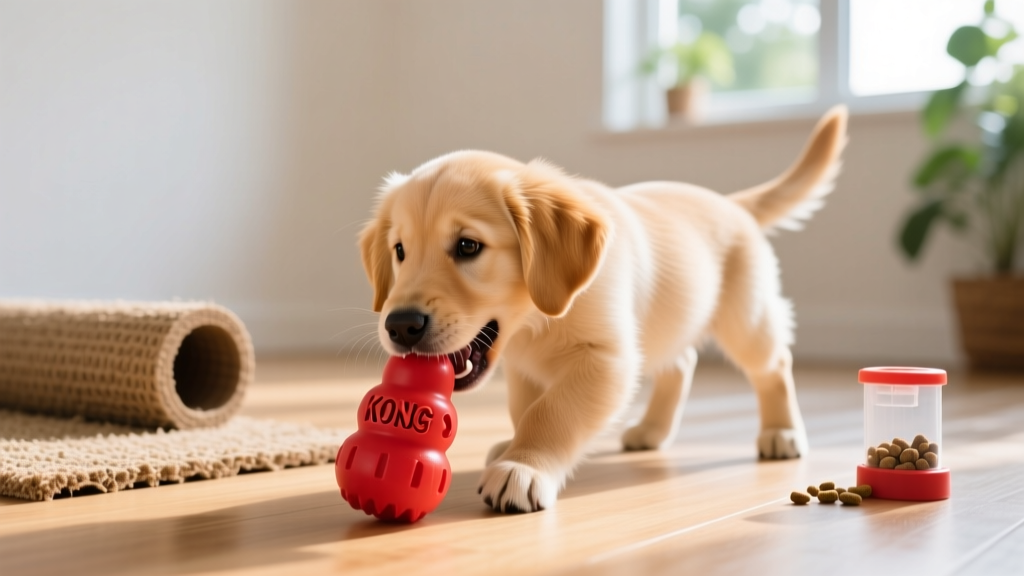
- KONG Classic (puppy rubber, pink/blue): Stuff with a mixture of canned pumpkin (plain, not pie filling), plain yogurt, and kibble. Freeze for 2–4 hours for extended relief.
- Nylabone Puppy Chew (soft flex material): Designed to be gentler than adult versions. Replace when worn down to the knuckle.
- Frozen washcloth: Wet a clean washcloth, twist into a rope, freeze. Supervise use — remove when threads begin to unravel.
- Benebone Puppy (softer formula): Flavor-infused nylon. Choose the size appropriate for your puppy's weight class.
- Carrots (whole, raw, chilled): Natural, edible, and appropriately firm for puppy teeth. Supervise to prevent choking on broken pieces.
Common Puppy Problems: Biting, Whining, and Chewing — With Solutions
Puppy Biting and Nipping
Puppies explore the world with their mouths, and littermate play teaches bite inhibition — but your hands are not littermates. Here's the protocol:
- Redirect: When teeth touch skin, say "ouch" in a calm voice, withdraw your hand, and immediately offer an appropriate chew toy. Praise when they bite the toy.
- Time-out: If redirecting fails after 2–3 attempts, calmly stand up and leave the interaction for 15–30 seconds. This mimics littermate behavior — when play gets too rough, the other puppy walks away.
- Never: Hold the puppy's mouth shut, alpha roll, or physically punish. These methods increase fear-based biting and damage your bond. The American Veterinary Society of Animal Behavior explicitly recommends against dominance-based training methods.
- Timeline: Nipping peaks between 12–16 weeks and gradually diminishes with consistent redirection. Expect it to resurface briefly during teething (3–6 months).
Night Whining in the Crate
For the first 1–2 weeks home, keep the crate in your bedroom. Your presence is reassuring. If whining occurs:
- Wait 3–5 minutes — many puppies self-soothe.
- If whining continues, take puppy outside on leash for a potty break (keep it boring — no play).
- If they eliminate, reward and return to crate.
- If they don't eliminate, return to crate without interaction.
- Gradually increase the interval before responding (5 min → 10 min → 15 min) over successive nights.
Destructive Chewing
Between 3–6 months, chewing is driven by teething discomfort. Between 6–18 months, it's driven by boredom and excess energy. Solutions:
- Provide 4–5 approved chew options and rotate them every 2–3 days to maintain novelty.
- Manage the environment: shoes in closets, cords behind furniture, remote controls on shelves.
- Ensure adequate exercise: an under-exercised puppy is a destructive puppy.
- Use bitter apple spray (Grannick's Bitter Apple) on furniture legs as a deterrent — but pair with appropriate alternatives, not as a standalone solution.
First-Year Cost Breakdown: What to Budget
New owners consistently underestimate first-year costs. Here's a realistic breakdown based on 2026 US pricing. Costs vary significantly by region (urban areas are typically 20–40% higher than rural) and by breed size (large breeds eat more and require larger-dose medications).
| Category | Small Breed (5–10 kg) | Medium Breed (10–25 kg) | Large Breed (25–45 kg) |
|---|---|---|---|
| Puppy vaccine series (3–4 visits) | $150–$300 | $150–$300 | $150–$300 |
| Spay/neuter | $300–$600 | $400–$800 | $500–$1,000 |
| Food (puppy formula, full year) | $250–$450 | $400–$700 | $600–$1,100 |
| Heartworm/flea/tick prevention | $200–$350 | $250–$400 | $300–$500 |
| Supplies (crate, bed, leash, bowls, toys) | $200–$400 | $250–$500 | $300–$600 |
| Training (group classes, 6–8 weeks) | $150–$300 | $150–$300 | $150–$300 |
| Microchip + registration | $50–$75 | $50–$75 | $50–$75 |
| Pet insurance (annual premium) | $350–$600 | $400–$700 | $500–$900 |
| Emergency fund (recommended reserve) | $500–$1,000 | $500–$1,500 | $500–$2,000 |
| Total First-Year Estimate | $2,150–$4,075 | $2,550–$5,275 | $3,050–$6,775 |
These figures exclude the initial purchase or adoption fee ($50–$3,000+ depending on source and breed). Pet insurance is strongly recommended — a single emergency surgery (foreign body removal, for example) can cost $3,000–$7,000, and puppies are notorious for ingesting things they shouldn't.
Frequently Asked Questions
When should I bring my puppy home?
The ideal age is 8–10 weeks. Puppies should remain with their mother and littermates until at least 8 weeks for critical social learning (bite inhibition, canine communication signals). Some breeders of toy breeds retain puppies until 10–12 weeks due to their fragility and hypoglycemia risk. Avoid bringing home a puppy younger than 7 weeks under any circumstances — early separation is linked to increased behavioral problems including fear, aggression, and difficulty with other dogs.
How often should I feed my puppy at each age?
At 8–12 weeks: 4 meals per day, spaced roughly 3–4 hours apart during waking hours. At 3–6 months: 3 meals per day. At 6–12 months: 2 meals per day. Consistent meal timing supports potty training predictability — puppies typically need to eliminate 15–30 minutes after eating.
When can my puppy go outside and meet other dogs?
Your puppy can go outside in your own yard immediately (assuming no known parvo exposure in the area). For public spaces — sidewalks, parks, pet stores — wait until 2 weeks after the final DHPP vaccine (typically around 16–18 weeks of age). However, controlled playdates with fully vaccinated, healthy adult dogs in private yards are beneficial and safe starting at 8–10 weeks. The socialization window is too important to keep your puppy completely isolated — manage risk rather than eliminating all exposure.
How do I stop puppy biting and nipping?
Use the redirect-and-withdraw method: when teeth contact skin, say "ouch" calmly, remove your hand, and offer a chew toy. If biting persists after 2–3 redirects, end the interaction by standing up and turning away for 15–30 seconds. This teaches that biting ends play. Consistency from every household member is essential — mixed signals (sometimes allowing mouthing, sometimes not) confuse puppies and prolong the behavior. Most puppies show significant improvement by 16–20 weeks with daily practice.
What if my puppy won't eat the recommended amount?
First, rule out illness — contact your vet if appetite loss persists beyond 24 hours or is accompanied by vomiting, diarrhea, or lethargy. If your puppy is healthy but picky: ensure you're not over-treating between meals (treats should be under 10% of daily caloric intake), try warming the food slightly to enhance aroma, or add a tablespoon of warm water or low-sodium chicken broth to kibble. Avoid switching foods frequently — this often creates a pickier eater.
My puppy is gaining weight too fast — should I reduce food?
Rapid growth in large-breed puppies (Great Danes, German Shepherds, Labrador Retrievers) is a risk factor for developmental orthopedic diseases like hip dysplasia and osteochondrosis. Use a body condition score chart (your vet can demonstrate): you should be able to feel ribs without pressing hard, see a waist tuck from above, and observe an abdominal tuck from the side. If your puppy looks "rotund" rather than athletic, reduce daily portions by 10–15% and reassess in 2 weeks. Large-breed puppy formulas (which have controlled calcium and calorie levels) are strongly recommended for breeds expected to exceed 25 kg adult weight.
Tom Renshaw
All our authors care for dogs every day — read more of their work on the authors page.