Puppy Gates & Beyond: A Complete Golden Retriever Puppy Guide
Complete Golden Retriever puppy guide covering puppy gates setup, feeding schedules, potty training, vaccinations, and first-year costs with breed-specific milestones.

Setting Up Puppy Gates for Your Golden Retriever: The Foundation
Golden Retrievers are large, athletic dogs that grow rapidly — a 10-week-old Golden can already weigh 15-20 lb (7-9 kg) and will test every boundary you set. Puppy gates aren't just convenient; they're essential for managing a breed that combines high energy, powerful chewing instincts, and a 60-75 lb (27-34 kg) adult frame. In my years helping new Golden owners, I've seen too many households skip proper gate setup and pay for it in destroyed baseboards, house-soiling setbacks, and preventable emergency vet visits from swallowed objects.
Gate Placement Strategy by Age
| Age Range | Gate Locations | Gate Type | Purpose |
|---|---|---|---|
| 8-12 weeks | Kitchen doorway, living room entry | Hardware-mounted, 30" height, walk-through door | Contain to easy-clean floors for potty training |
| 12-16 weeks | Add stairway gates (top AND bottom) | Hardware-mounted, 36" height | Prevent hip/joint injury from stair falls during growth |
| 4-6 months | Block off bedrooms, home office | Hardware-mounted, 36"+ with auto-close | Prevent destructive chewing during peak teething |
| 6-12 months | Gradually remove interior gates as trust is earned | Keep stairway and outdoor access gates permanent | Transition to supervised freedom |
Golden Retrievers are notorious for following their people everywhere, which makes them prone to dashing through open doors. Install a gate at every exterior doorway if you don't have a fenced yard, and consider a gate with a built-in pet door (small enough that your puppy can't fit through until they're reliably house-trained) for long-term use.
Golden Retriever Puppy Milestones: Week by Week
Weeks 4-8: The Breeder's Window
During this period, your Golden puppy is still with their breeder. Key developments include:
- Week 4-5: Deciduous teeth erupt; puppy begins eating gruel (kibble soaked in warm water or puppy milk replacer). Weight: approximately 3-5 lb (1.4-2.3 kg).
- Week 6-7: Peak socialization with littermates; bite inhibition learning begins. First deworming (pyrantel pamoate) typically administered. Weight: 5-8 lb (2.3-3.6 kg).
- Week 7-8: Fear imprint period begins — negative experiences now can create lasting phobias. Responsible breeders expose puppies to varied surfaces, sounds, and gentle handling. Weight: 8-12 lb (3.6-5.4 kg).
Weeks 8-12: Homecoming and Adjustment
This is when most Golden Retriever puppies join their new families. Expect:
- Week 8: First DHPP vaccine if not given by breeder. Weight: 10-15 lb (4.5-6.8 kg). Sleep needs: 18-20 hours per day.
- Week 9-10: Human bonding intensifies. Puppy begins recognizing their name. Separation anxiety whining peaks — this is normal and temporary.
- Week 11-12: Second DHPP vaccine. Weight: 15-22 lb (6.8-10 kg). Puppy can hold bladder approximately 2-3 hours during the day. Basic sit and recall training begins clicking.
Weeks 12-16: Rapid Growth and Learning
- Week 12-13: Third DHPP vaccine. Puppy begins testing boundaries — expect increased mouthing and jumping. Weight: 20-30 lb (9-13.6 kg).
- Week 14-16: Socialization window closes around week 14 (some behaviorists extend to 16 weeks). Rabies vaccine given at 14-16 weeks. Weight: 25-40 lb (11.3-18.1 kg). House training should show consistent progress.
Weeks 16-24: The Adolescent Transition
- 4-5 months: Baby teeth begin loosening. Chewing intensity increases dramatically. Weight: 35-50 lb (15.9-22.7 kg).
- 5-6 months: Most deciduous teeth shed; adult teeth erupt. Spay/neuter surgery typically scheduled. Weight: 45-60 lb (20.4-27.2 kg). Energy levels spike — this is peak "Golden Retriever chaos" age.
Months 6-12: Approaching Maturity
- 6-8 months: Sexual maturity (if not yet altered). Second fear period may emerge. Weight: 50-65 lb (22.7-29.5 kg).
- 9-12 months: Growth rate slows. Weight approaches adult range: females 55-65 lb (25-29.5 kg), males 65-75 lb (29.5-34 kg). Puppy gates can begin coming down in trusted areas if no destructive behaviors persist.
Feeding Schedule: Exact Portions for Golden Retriever Puppies
Golden Retrievers are prone to rapid growth-related orthopedic problems including hip dysplasia and elbow dysplasia. The Merck Veterinary Manual notes that overfeeding during puppyhood significantly increases hip dysplasia risk. Feed a large-breed puppy formula that meets AAFCO standards for growth, and follow these portion guidelines based on expected adult weight of 60-75 lb (27-34 kg):
| Age | Meals Per Day | Daily Total (Large Breed Puppy Kibble) | Per Meal | Notes |
|---|---|---|---|---|
| 8-12 weeks | 4 | 1.5 - 2 cups | ~0.5 cup | Soak kibble in warm water for first 2 weeks home |
| 3-4 months | 3 | 2 - 2.5 cups | ~0.75 cup | Transition to dry kibble fully |
| 4-6 months | 3 | 2.5 - 3.5 cups | ~1 cup | Monitor body condition score — ribs should be palpable |
| 6-9 months | 2 | 3 - 4 cups | 1.5 - 2 cups | Switch to 2 meals/day; reduce if BCS exceeds 5/9 |
| 9-12 months | 2 | 3 - 4.5 cups | 1.5 - 2.25 cups | Begin transition to adult formula at 12 months |
Recommended large-breed puppy foods with appropriate calcium-phosphorus ratios (1.1:1 to 1.4:1) include Purina Pro Plan Large Breed Puppy, Royal Canin Golden Retriever Puppy, and Hill's Science Diet Large Breed Puppy. Budget approximately $45-$70/month for quality kibble during the first year.
Potty Training Timeline: Realistic Expectations for Golden Puppies
Golden Retrievers are generally eager-to-please dogs, which works in your favor for house training. However, their large bladder capacity develops slowly, and their excitement can cause submissive urination well into adolescence. Here's a realistic timeline:
| Age | Max Bladder Hold (Daytime) | Expected Accidents/Week | Milestone |
|---|---|---|---|
| 8-10 weeks | 1-1.5 hours | 3-5 | Learning the concept of "outside = potty" |
| 10-14 weeks | 2-3 hours | 1-3 | Beginning to signal (sniffing, circling, going to door) |
| 14-20 weeks | 3-4 hours | 0-2 | Reliably going outside when taken; occasional regression |
| 5-7 months | 4-6 hours | 0-1 | Mostly reliable; accidents usually indicate missed signal or UTI |
| 8-12 months | 6-8 hours | Rare | Fully house-trained (overnight hold up to 8 hours) |
Potty Training Protocol Using Puppy Gates
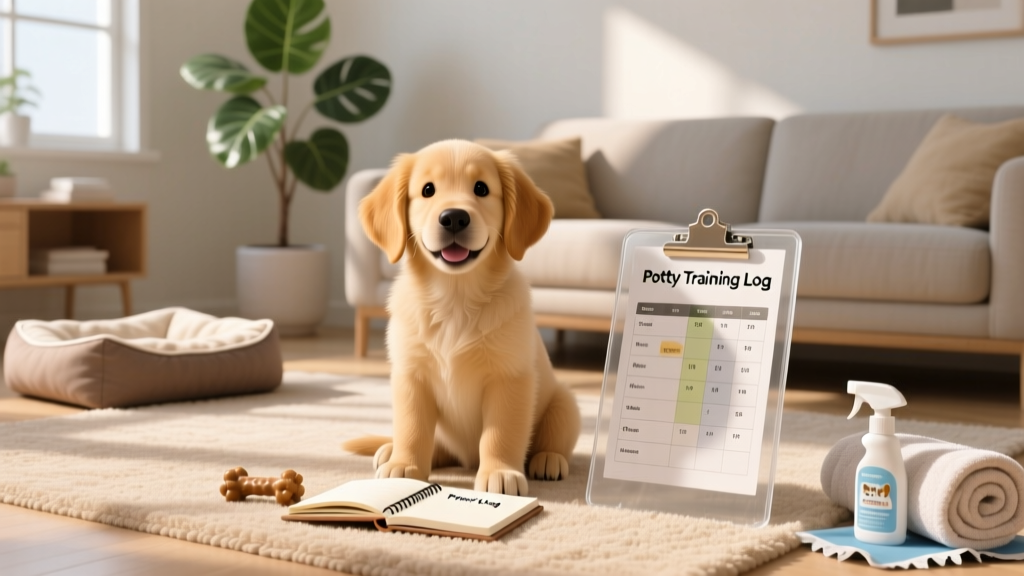
Your puppy gate setup is your most powerful potty training tool. Here's the method:
- Confine your Golden puppy to a gated area with easy-clean flooring (kitchen or utility room) when you cannot supervise directly.
- Take outside on a leash every 1-2 hours, immediately after meals, after naps, and after play sessions. Use a consistent phrase: "Go potty" or "Do your business."
- Reward immediately with a high-value treat (small piece of boiled chicken or freeze-dried liver) the moment they finish eliminating outside. Timing matters — reward within 2 seconds.
- Supervise or confine — there is no middle ground. When your puppy is loose in the house, maintain direct visual contact. When you can't, they go behind the puppy gate or in their crate.
- Clean accidents with an enzymatic cleaner (Nature's Miracle or Rocco & Roxia) — never ammonia-based products, which smell like urine to dogs and encourage re-soiling.
- Submissive urination (8-16 weeks): Puppy pees when greeted. Solution: Ignore puppy for first 2 minutes when arriving home, greet calmly at their level, avoid direct eye contact initially. This resolves with maturity.
- Excitement urination: Similar to submissive but during play. Solution: Keep play sessions calm, take potty breaks mid-play.
- Regression at 4-6 months: Puppy who was reliable suddenly has accidents. Rule out UTI with vet visit (common in female Goldens), then return to strict supervision protocol.
Vaccination Schedule: Protecting Your Golden Retriever Puppy
Golden Retrievers follow the standard core vaccination protocol recommended by the AVMA and the American Animal Hospital Association (AAHA). Maternal antibodies interfere with early vaccines, which is why boosters are given at specific intervals:
| Age | Vaccine | Type | Estimated Cost |
|---|---|---|---|
| 6-8 weeks | DHPP (Distemper, Hepatitis, Parainfluenza, Parvovirus) | Core | $20-$40 |
| 10-12 weeks | DHPP booster + Bordetella (kennel cough) | Core + Non-core (recommended for Goldens due to social nature) | $35-$60 |
| 14-16 weeks | DHPP final booster + Rabies | Core | $40-$70 |
| 12-16 months | DHPP booster + Rabies booster | Core | $40-$70 |
| Annually or per vet protocol | Bordetella (every 6-12 months), Leptospirosis (annual, recommended for Goldens) | Non-core | $25-$45 each |
Optional but recommended for Golden Retrievers based on lifestyle: Leptospirosis (Goldens love water and are at higher exposure risk), Lyme disease (if in tick-endemic areas), and Canine Influenza (if attending doggy daycare or boarding). Consult your veterinarian to determine which non-core vaccines are appropriate for your puppy's specific risk profile.
Socialization Window: Weeks 3-14 Exposure Checklist
The primary socialization period for puppies closes between 12-14 weeks of age. According to the AKC, puppies who don't receive adequate positive exposure during this window are significantly more likely to develop fear-based behavioral problems — the leading cause of euthanasia in dogs under 3 years old. For Golden Retrievers, who are expected to be confident, friendly family dogs, this window is critical.
Golden Retriever Socialization Checklist (Complete Before 14 Weeks)
| Category | Specific Exposures | Target Count |
|---|---|---|
| People | Men with beards, children under 5, people in hats/sunglasses, people using mobility aids, delivery workers, tall people, people in uniforms | 15-20 different people |
| Surfaces | Gravel, grass, wet pavement, metal grates, carpet, tile, wood floors, tarps, wobble boards | 10+ surface types |
| Sounds | Vacuum cleaner, thunder recordings (low volume), doorbell, car horns, children screaming, construction noise, fireworks recordings | 10+ sound types |
| Handling | Paw handling, ear examination, mouth opening, nail clipping practice, being held on back, gentle restraint, toothbrush introduction | Daily handling sessions |
| Animals | Vaccinated adult dogs (known health status), cats (supervised), livestock if accessible, birds | 5-8 positive dog interactions |
| Environments | Car rides, veterinary clinic (happy visits), outdoor café patio, school playground (perimeter), parking lots, elevators | 8-10 locations |
| Objects | Umbrellas opening, balloons, plastic bags, skateboards, bicycles, wheelchairs, flags | 10+ novel objects |
Socialization rules: Every exposure must be positive. If your puppy shows fear (cowering, tail tucking, freezing), increase distance from the stimulus and offer high-value treats. Never force a puppy to approach something frightening. Pair novel experiences with food — this is classical conditioning, and it builds a confident adult dog.
Teething Timeline and Chew Management for Golden Retrievers
Golden Retrievers are mouth-oriented dogs — they were bred to carry waterfowl gently in their jaws. This means teething combines normal puppy discomfort with an already strong instinct to carry and chew. Expect intense mouthing behavior from 3-7 months.
Teething Stages
- 3-4 months: Incisors begin loosening. You may find tiny teeth in bedding or toys. Puppy chews more but may also eat less due to gum soreness.
- 4-5 months: Canines and premolars shed. This is peak discomfort. Bleeding gums are normal — offer frozen, wet washcloths (twisted and frozen solid) for soothing.
- 5-6 months: Molars erupt (these don't replace baby teeth — they're new). Chewing intensity reaches maximum. This is when furniture and shoes are at highest risk.
- 6-7 months: All 42 adult teeth should be in place. Schedule a veterinary dental check to confirm no retained deciduous teeth (common in smaller breeds, less so in Goldens, but still possible).
Safe Chew Recommendations by Age
| Age | Safe Options | Avoid |
|---|---|---|
| 8-16 weeks | Kong Classic (puppy rubber, black or pink), Nylabone Puppy Chew, frozen carrot sticks, bully sticks (supervised) | Rawhide, antlers, hard nylon bones, cooked bones |
| 4-6 months | Kong Classic (stuffed and frozen), Benebone Wishbone, yak cheese chews, rubber tug toys | Weight-bearing bones from large animals, ice cubes (tooth fracture risk) |
| 6-12 months | Kong Extreme (black rubber), Goughnuts Maxx, Earth Animal No-Hide chews, dental chews (VOHC-approved) | Tennis balls (abrasive to enamel), sticks (splinter risk) |
Budget $15-$30/month on appropriate chew toys during teething months. This is significantly cheaper than replacing a door frame or treating a gastrointestinal obstruction from swallowed objects.
Crate Training Progression and Time Limits
Your crate and your puppy gates work together as a complete management system. The crate is for sleep and short confinement; gates manage awake-but-unsupervised time. Golden Retrievers generally adapt well to crates because they naturally seek den-like spaces, but the progression must be gradual.
Crate Training Timeline
| Age | Maximum Daytime Crate Duration | Overnight Duration | Training Focus |
|---|---|---|---|
| 8-10 weeks | 30-60 minutes | 3-4 hours (expect 1-2 nighttime potty breaks) | Building positive association — feed meals in crate, treat tosses, door open |
| 10-14 weeks | 1-2 hours | 4-5 hours (1 nighttime potty break) | Closing door for short periods while you're visible, then stepping away briefly |
| 14-20 weeks | 2-3 hours | 5-7 hours (may sleep through the night) | Leaving the house for short absences, building duration gradually |
| 5-7 months | 3-4 hours | 7-8 hours | Transitioning to gated area instead of crate for longer daytime periods |
| 8-12 months | 4-5 hours maximum | 8 hours (overnight) | Beginning to leave crate door open; puppy chooses to sleep inside |
Crate sizing for Golden Retrievers: Purchase a 42-inch wire crate with a divider panel. Start with the divider creating a space just large enough for your puppy to stand, turn around, and lie down. Expand as they grow. A crate that's too large allows the puppy to eliminate in one corner and sleep in another, undermining house training. A Midwest iCrate or Frisco double-door crate in the 42-inch size runs $50-$80 and will last your Golden's entire life.
Common Golden Retriever Puppy Problems and Solutions
Puppy Biting and Nipping
Golden Retrievers were bred to carry things in their mouths, and this translates to intense mouthing behavior as puppies. This is the number one complaint from new Golden owners. Solutions using positive reinforcement:
- Redirect: When puppy mouths skin, immediately offer an appropriate chew toy. Praise enthusiastically when they take the toy.
- Reverse time-out: If redirecting fails, stand up, fold your arms, and turn away for 15-30 seconds. No talking, no eye contact. Return and try again. This teaches that biting ends play.
- Bite inhibition training: When puppy bites too hard during play, let out a high-pitched "Ow!" and go limp for 3 seconds. This mimics littermate behavior. Gradually raise your threshold so only gentle mouthing is tolerated, then no mouthing at all by 5-6 months.
- Provide adequate chewing outlets: A Golden puppy who doesn't have 4-5 appropriate chew options available will find inappropriate ones.
Whining and Crying
Golden Retrievers are social dogs and vocalize when distressed. Common whining scenarios:
- Crate whining (first 2-3 weeks): Distinguish protest whining (intermittent, stops when ignored) from distress whining (continuous, escalating, with panting/pawing). For protest whining, wait for 3 seconds of silence before opening the crate. For distress, the puppy may need to be moved closer to your bedroom temporarily.
- Nighttime whining: Usually indicates need to eliminate. Take puppy outside on leash, keep it boring and dark, return to crate immediately. If they don't eliminate, they're seeking attention — wait for quiet.
- Attention whining during the day: Ignore completely. Reward quiet behavior with attention and treats. Golden Retrievers learn quickly that silence gets them what they want.
Destructive Chewing
Golden Retrievers chew through adolescence and often into adulthood. Management strategies:
- Use puppy gates to restrict access to rooms with tempting items (shoes, books, remote controls).
- Rotate chew toys every 3-4 days to maintain novelty.
- Apply bitter apple spray (Grannick's Bitter Apple, $8-$12) to furniture legs and baseboards — test on a hidden area first for staining.
- Ensure 45-60 minutes of physical exercise and 20-30 minutes of mental enrichment daily (snuffle mats, frozen Kongs, training sessions). A tired Golden is a well-behaved Golden.
First-Year Cost Breakdown for a Golden Retriever Puppy
Budget realistically before bringing your puppy home. Golden Retrievers are large dogs, and costs scale accordingly. Here's a detailed first-year estimate based on 2026 pricing:
| Category | Items | Estimated Cost Range |
|---|---|---|
| Purchase/Adoption | Reputable breeder (health-tested parents, OFA hips/elbows, eye certification) OR breed rescue | $1,500-$3,500 (breeder) / $300-$600 (rescue) |
| Veterinary (Year 1) | Initial exam, 3 puppy vaccine sets, rabies, deworming (3 rounds), heartworm test + prevention, spay/neuter, fecal exams, microchip | $600-$1,200 |
| Food | Large breed puppy kibble (12 months), treats for training | $500-$800 |
| Supplies | 42" crate with divider, puppy gates (2-3), leash, collar, harness, bowls, bed, grooming tools, enzymatic cleaner, chew toys, slow feeder | $300-$500 |
| Training | Puppy kindergarten class (6-8 weeks), basic obedience (6-8 weeks) | $200-$400 |
| Grooming | Golden Retrievers need regular brushing but professional grooming is optional. If using a groomer: bath + nail trim every 6-8 weeks | $0 (home grooming) / $300-$480 (professional) |
| Preventive Medications | Heartworm prevention (monthly), flea/tick prevention (monthly) | $200-$400/year |
| Insurance (Optional) | Comprehensive pet insurance (e.g., Trupanion, Healthy Paws) | $40-$80/month ($480-$960/year) |
| Total First Year | $3,780-$7,840 (without insurance) / $4,260-$8,800 (with insurance) |
These numbers don't include emergency veterinary care. Golden Retrievers are predisposed to conditions that may require urgent attention — foreign body ingestion (they eat everything), allergic reactions, and joint injuries. An emergency fund of $1,000-$2,000 or active pet insurance is strongly recommended.
Frequently Asked Questions
When should I bring my Golden Retriever puppy home?
The ideal age is 8-10 weeks. Reputable breeders will not release puppies before 8 weeks, and many Golden Retriever breeders keep puppies until 9-10 weeks to ensure proper littermate socialization and first-round vaccinations. Bringing a puppy home before 8 weeks increases risk of behavioral problems including poor bite inhibition and fearfulness. If your breeder suggests 6 weeks, this is a red flag — seek a different source.
How often should I feed my Golden Retriever puppy at each age?
At 8-12 weeks, feed 4 meals per day (approximately 0.5 cup each). At 3-6 months, reduce to 3 meals per day (approximately 0.75-1 cup each). At 6 months and beyond, feed 2 meals per day (1.5-2 cups each). Always use a large-breed puppy formula and measure with an actual measuring cup — Golden Retrievers gain weight easily, and excess weight during growth damages developing joints.
When will my Golden Retriever be fully potty trained?
Most Golden Retrievers are reliably house-trained by 5-7 months, meaning fewer than one accident per month with proper management. Full reliability (including overnight and during exciting situations) typically develops by 8-12 months. Submissive urination may persist slightly longer but usually resolves by 12-18 months. If your puppy is having frequent accidents beyond 5 months, consult your veterinarian to rule out urinary tract infections, which are relatively common in young Golden Retrievers.
What vaccines does my Golden Retriever puppy need and when?
Core vaccines: DHPP at 6-8 weeks, 10-12 weeks, and 14-16 weeks, plus rabies at 14-16 weeks. Recommended non-core vaccines for Golden Retrievers: Bordetella at 10-12 weeks (due to their social nature and likely daycare/group class attendance), Leptospirosis starting at 12+ weeks (Goldens' love of water increases exposure risk), and Lyme disease if you live in a tick-endemic region. Your veterinarian will tailor the protocol to your puppy's specific risk factors.
How do I stop my Golden Retriever puppy from biting and nipping?
Use a three-part approach: (1) Redirect every mouth-to-skin contact to an appropriate chew toy with enthusiastic praise when they take it. (2) Implement reverse time-outs — when biting continues after redirection, stand up and turn away for 15-30 seconds, removing all attention. (3) Teach bite inhibition by yelping "Ow!" when bites are too hard, gradually raising your standard until all mouthing stops by 5-6 months. Consistency from every household member is essential. Never hit, hold the mouth shut, or use aversive methods — these damage trust and can create fear-based aggression in a breed that should be confident and biddable.
When can my Golden Retriever puppy go outside and meet other dogs?
Your puppy can go outside in your own yard immediately after coming home. For public spaces and dog-to-dog introductions, follow this guideline: after the second DHPP vaccine (10-12 weeks), your puppy can meet known, fully-vaccinated adult dogs in controlled environments (your home, a friend's fenced yard). After the final DHPP booster at 14-16 weeks, your puppy can safely visit dog parks, attend group training classes, and interact with unknown dogs. During the pre-vaccine period, carry your puppy in public spaces for socialization exposure without ground contact — this protects against parvovirus while still allowing critical socialization experiences.
This article provides general guidance for Golden Retriever puppy care. Always consult your veterinarian for personalized medical advice, vaccination protocols, and nutritional recommendations specific to your puppy's health status and your geographic region.
Robin Maitland
All our authors care for dogs every day — read more of their work on the authors page.