Can Puppies Eat Pork Chop Bones? A Complete Puppy Feeding & Safety Guide
Can puppies eat pork chop bones? Learn the veterinary safety verdict, plus a complete age-by-age puppy feeding, health, and care guide for new owners.

The Short Answer: Can Puppies Eat Pork Chop Bones?
Both cooked and raw pork chop bones pose serious risks to puppies. Cooked pork bones become brittle and splinter into sharp shards that can puncture the esophagus, stomach, or intestines. Raw pork bones carry parasites like Trichinella spiralis and bacteria including Salmonella and E. coli. Puppies are especially vulnerable because their developing digestive tracts, smaller airways, and immature immune systems cannot handle these hazards. If your puppy has ingested a pork chop bone, contact your veterinarian or the ASPCA Animal Poison Control Center at (888) 426-4435 (24/7, consultation fee applies) immediately.
The question "can puppies eat pork chop bones" comes up constantly among new puppy owners, especially when a puppy snatches a dropped bone from the floor or well-meaning family members toss table scraps. Understanding why pork bones are dangerous — and what to feed your puppy instead — is one of the most important things you can learn in those critical first months together.
This guide covers the specific dangers of pork chop bones for puppies, safe chewing alternatives organized by developmental stage, and a comprehensive age-by-age care timeline covering feeding, vaccinations, potty training, socialization, and costs for your puppy's first year.
Why Pork Chop Bones Are Dangerous for Puppies
Pork chop bones present three distinct categories of danger that make them particularly unsuitable for puppies:
1. Splintering and Gastrointestinal Perforation
Cooked pork bones — whether roasted, grilled, boiled, or smoked — undergo structural changes that make them brittle. When a puppy chews a cooked pork chop bone, it fractures into sharp, needle-like fragments. According to the U.S. Food and Drug Administration, bone fragments can cause:
- Oral lacerations: Cuts to the gums, tongue, and palate
- Esophageal obstruction: Bone shards lodging in the throat, requiring emergency endoscopic removal ($800–$2,500)
- Gastric or intestinal perforation: Sharp fragments puncturing the GI tract wall, leading to peritonitis — a life-threatening infection requiring emergency surgery ($3,000–$7,000+)
- Rectal trauma: Bone shards causing bleeding during elimination
2. Bacterial and Parasitic Contamination
Raw pork carries well-documented risks. Trichinella spiralis, a parasitic roundworm, can infect dogs through undercooked or raw pork. While commercial pork in the U.S. has lower Trichinella prevalence than in past decades, the risk is not zero — particularly with pork from small farms, wild boar, or imported products. Raw pork also commonly harbors Salmonella, Yersinia enterocolitica, and Campylobacter, all of which can cause severe gastroenteritis in puppies whose immune systems are still developing.
3. Size and Choking Risk for Small Breeds
Pork chop bones are often sized in a way that creates a perfect choking hazard for small and medium-breed puppies. A rib bone fragment can lodge transversely in the pharynx or trachea, causing acute respiratory distress. Brachycephalic breeds (French Bulldogs, Pugs, Boston Terriers) face even higher risk due to their already compromised airway anatomy.
- Do NOT induce vomiting — bone shards can cause additional damage coming back up.
- Check for immediate distress: gagging, pawing at the mouth, drooling, difficulty breathing, or retching.
- Call your veterinarian immediately if you observe any of the above — this is an emergency.
- If your puppy seems fine, monitor closely for 48–72 hours for vomiting, diarrhea (especially with blood), lethargy, loss of appetite, abdominal pain, or straining to defecate.
- Feed soft food (canned puppy food mixed with warm water) to help cushion any bone fragments moving through the GI tract.
Safe Chewing Alternatives by Puppy Age
Puppies need to chew — it's a biological imperative driven by teething discomfort and natural exploratory behavior. The key is providing appropriate outlets. Here's what's safe at each developmental stage:
| Age Range | Safe Chew Options | Avoid | Supervision Level |
|---|---|---|---|
| 8–12 weeks | Soft rubber toys (Kong Classic Puppy), chilled damp washcloth, frozen carrot sticks | All bones, rawhide, hard nylon, antlers | 100% supervised |
| 12–16 weeks | Kong Puppy with frozen peanut butter (xylitol-free), Benebone Puppy, bully sticks (6-inch, supervised) | Cooked bones, pork bones, rawhide chips, hooves | 100% supervised |
| 4–6 months | Kong Classic (medium), Nylabone Puppy Chew, frozen banana slices, yak cheese chews (size-appropriate) | Cooked bones of any type, weight-bearing bones from large animals | Direct supervision for edible chews |
| 6–12 months | Kong Classic or Extreme, Goughnuts Maxx, raw meaty bones (raw chicken necks for small breeds, raw turkey necks for large breeds — only under veterinary guidance) | Cooked pork bones, smoked bones, antlers, weight-bearing beef bones | Supervised for all edible items |
A note on raw meaty bones: Some raw-feeding advocates recommend raw meaty bones for dogs over 6 months. If you choose this route, consult a veterinary nutritionist first. Never feed pork bones raw due to parasitic risk. Raw chicken necks or wings (for appropriate-sized dogs) carry lower splintering risk than cooked bones but still require direct supervision and proper sizing. The Merck Veterinary Manual notes that any bone-feeding carries inherent risk.
Age-by-Age Puppy Milestones: Weeks 4 Through 12 Months
Weeks 4–8: The Litter Phase
During this period, puppies are still with their breeder or foster. Key developmental events include:
- Week 4: Deciduous (baby) incisors erupt; puppies begin lapping gruel (puppy kibble soaked in warm water or puppy milk replacer)
- Weeks 5–6: Peak socialization with littermates; bite inhibition learning through play; full transition to moistened kibble
- Weeks 6–8: First DHPP (distemper, hepatitis, parainfluenza, parvovirus) vaccine at 6–8 weeks; deworming (pyrantel pamoate at 2, 4, 6, and 8 weeks); critical socialization window opens
Your role: If you're visiting a litter, observe the puppy's environment. Puppies raised in enriched home environments (exposed to household sounds, various floor surfaces, gentle handling by multiple people) tend to adapt more easily than those raised in isolated kennel settings.
Weeks 8–12: Welcome Home
This is when most puppies join their new families. Expect:
- Sleep: 18–20 hours per day — puppies this age need enormous amounts of rest
- Potty frequency: Every 30–60 minutes while awake, plus immediately after eating, drinking, playing, and waking from naps
- Biting/nipping: Peak mouthing behavior; puppies explore the world with their mouths and have not yet learned bite inhibition with humans
- Crate tolerance: 30–60 minutes maximum during the day; expect protest vocalization initially
Weeks 12–16: Building Foundations
- Second and third DHPP boosters at 10–12 weeks and 14–16 weeks
- Rabies vaccine: Typically administered at 12–16 weeks (timing varies by state law)
- Bladder control improves: Puppies can typically hold for 1 hour per month of age (a 3-month-old = ~3 hours max)
- Fear periods: Many puppies experience a developmental fear period between 8–11 weeks and again around 6–14 months — avoid traumatic experiences during these windows
Weeks 16–24: The Adolescent Transition
- Teething intensifies: Adult teeth begin erupting around 12–16 weeks, with the process continuing through 6–7 months
- Exercise capacity increases: Follow the "5 minutes per month of age, twice daily" guideline (a 4-month-old gets ~20-minute walks)
- Testing boundaries: Adolescent puppies begin testing rules; consistency in training becomes critical
6–12 Months: Adolescence and Maturation
- Spay/neuter: Most veterinarians recommend between 6–12 months, though large-breed dogs may benefit from waiting until 12–18 months (discuss timing with your vet)
- Adult teeth fully in: By 7 months, all 42 adult teeth should be erupted — if baby teeth are retained, your vet may need to extract them
- Energy peaks: Adolescent dogs often have their highest energy levels during this period; structured exercise and mental enrichment are essential
- Transition to adult food: Small breeds at 9–12 months; medium breeds at 12 months; large/giant breeds at 12–18 months
Feeding Schedule: Exact Portions by Age and Weight
Feeding guidelines vary by brand and caloric density, but here are evidence-based general ranges. Always check the feeding chart on your specific puppy food and adjust based on body condition score (you should be able to feel ribs without excess fat covering, and see a visible waist from above).
| Age | Meals per Day | Small Breed (5–20 lb adult) | Medium Breed (20–50 lb adult) | Large Breed (50–100 lb adult) |
|---|---|---|---|---|
| 8–12 weeks | 4 meals/day | ¼–½ cup per meal | ½–¾ cup per meal | ¾–1¼ cups per meal |
| 3–6 months | 3 meals/day | ⅓–⅔ cup per meal | ¾–1 cup per meal | 1–2 cups per meal |
| 6–12 months | 2 meals/day | ½–¾ cup per meal | 1–1½ cups per meal | 1¾–3 cups per meal |
Important notes:
- Use puppy-formulated food that meets AAFCO standards for growth. Large-breed puppies need food specifically labeled for "large-breed growth" to prevent developmental orthopedic diseases like hip dysplasia.
- These are starting points. Adjust based on your puppy's body condition score, activity level, and your veterinarian's recommendation.
- Never free-feed (leave food out all day). Scheduled meals support potty training predictability and let you catch appetite changes early — a key health indicator.
- Transition foods over 7–10 days: 25% new food days 1–3, 50% days 4–6, 75% days 7–9, 100% day 10.
Vaccination Schedule and Medical Milestones
| Age | Vaccine/Procedure | Notes | Estimated Cost |
|---|---|---|---|
| 6–8 weeks | DHPP (1st dose) | Core vaccine; often given by breeder/rescue | $20–$40 |
| 8–9 weeks | Bordetella (intranasal or injectable) | Recommended if attending puppy classes or boarding | $20–$35 |
| 10–12 weeks | DHPP (2nd dose), Leptospirosis (1st, optional based on risk) | Still not fully protected — avoid high-dog-traffic areas | $25–$50 |
| 12–16 weeks | Rabies (required by law), Leptospirosis (2nd, if started) | Timing varies by jurisdiction | $20–$40 |
| 14–16 weeks | DHPP (3rd/final puppy dose) | Full immunity ~2 weeks after final dose | $20–$40 |
| 6 months | Heartworm test + preventive start, spay/neuter | Heartworm preventive should begin by 8 weeks per American Heartworm Society | $150–$600 (spay/neuter) |
Core vaccines (DHPP and rabies) are recommended for all dogs by the American Veterinary Medical Association. Lifestyle vaccines (Bordetella, Leptospirosis, Lyme, canine influenza) depend on your geographic area and your dog's exposure risk. Your veterinarian will determine which are appropriate.
Socialization Window: Weeks 3–14
The primary socialization period — when puppies are neurologically primed to accept new experiences without fear — closes around 12–14 weeks. This is arguably the most time-sensitive aspect of puppy development. Missing this window doesn't mean your dog is doomed to behavioral problems, but it does mean socialization becomes significantly harder afterward.
Balance socialization with disease risk: until your puppy has completed their DHPP series, avoid areas with unknown dog traffic (dog parks, pet store floors, rest stop grass). Carry your puppy or use a stroller for exposures in controlled environments.
People: Children, elderly individuals, people wearing hats/sunglasses/masks, people using wheelchairs or crutches, people of various ethnicities and body types, uniformed workers, people with deep voices, people with high voices
Surfaces: Grass, gravel, sand, metal grates, wet pavement, carpet, tile, wood floors, ramps, stairs
Sounds: Vacuum cleaner, thunderstorm recordings (at low volume), traffic, doorbell, clapping, power tools, fireworks recordings (at low volume), crying babies, barking dogs on TV
Objects: Umbrellas opening, plastic bags rustling, bicycles passing, skateboards, shopping carts, flags flapping, balloons
Handling: Paw touching, ear examination, mouth opening, nail handling, being held gently, being rolled onto back, collar grabbing, grooming brush
Environments: Car rides, different rooms, friend's houses, outdoor café patios (carried), veterinary clinic (happy visits with treats, no procedures)
Rule of thumb: every new experience should be paired with high-value treats (small pieces of boiled chicken, cheese, or commercial training treats). If your puppy shows fear, increase distance from the stimulus and let them observe from a safe zone — never force interaction.
Potty Training Timeline and Troubleshooting
Realistic potty training expectations save enormous frustration. Here's what the timeline actually looks like for most puppies:
| Age | Bladder Capacity | Expected Accident Frequency | Training Focus |
|---|---|---|---|
| 8–10 weeks | 30–45 minutes | Multiple accidents per day (normal) | Establish routine; reward outdoor elimination immediately |
| 3–4 months | 1–2 hours | 1–3 accidents per week | Begin verbal cue ("go potty"); ring bell at door |
| 4–6 months | 3–4 hours | Occasional accidents (1–2 per month) | Extend time between outings; proof behavior in new environments |
| 6–12 months | 4–8 hours | Rare (regression possible during adolescence) | Maintain consistency; watch for regression triggers |
When will my puppy be fully potty trained? Most puppies achieve reliable house training between 4–6 months of age, though small breeds (with proportionally smaller bladders) may take until 8–12 months. "Fully trained" means fewer than one accident per month with a consistent routine. If your puppy is having frequent accidents past 6 months, consult your veterinarian to rule out urinary tract infections, anatomical issues, or diabetes.
Troubleshooting common potty training problems:
- Puppy pees inside 10 minutes after coming back in: The puppy didn't actually eliminate outside. Go back out and wait — don't come inside until they go. Reward heavily.
- Puppy only pees in the crate: The crate may be too large (puppies eliminate in one corner and sleep in another). Use a divider to size the crate so the puppy can stand, turn, and lie down — no more. Also rule out UTI.
- Puppy sneaks off to eliminate: Increase supervision. Tether puppy to you with a leash indoors during training phase. Set phone alarms for potty breaks.
- Regression at 6–10 months: Adolescent hormonal changes and increased independence cause temporary regression. Return to basics: more frequent outings, higher-value rewards, closer supervision.
Teething Timeline and Relief Strategies
Puppy teething is one of the most common reasons owners seek help — and it's also the reason many puppies end up chewing dangerous items like pork chop bones left within reach.
Deciduous (baby) teeth: Erupt between 3–6 weeks. Puppies have 28 baby teeth.
Adult teeth: Begin erupting at approximately 12–16 weeks. The process follows this general sequence:
- 3–4 months: Incisors shed and adult incisors erupt
- 4–5 months: Canines (fangs) shed and adult canines erupt — often the most uncomfortable phase
- 5–6 months: Premolars erupt; molars come in
- 7 months: All 42 adult teeth should be present
Safe teething relief strategies:
- Frozen Kong Puppy stuffed with plain pumpkin puree or xylitol-free peanut butter — the cold numbs sore gums while the chewing action helps loosen baby teeth
- Chilled damp washcloth: Wet a clean washcloth, wring it out, twist it into a rope, and freeze. Supervise chewing and discard if threads come loose.
- Carrot sticks (refrigerated or frozen): Low-calorie, safe, and satisfying to crunch. Suitable for puppies 10+ weeks.
- Nylabone Puppy Chew (flexible formula): Designed specifically for baby teeth — softer than adult versions
- Ice cubes: Many puppies love crunching plain ice cubes; they're free, safe, and provide cold relief
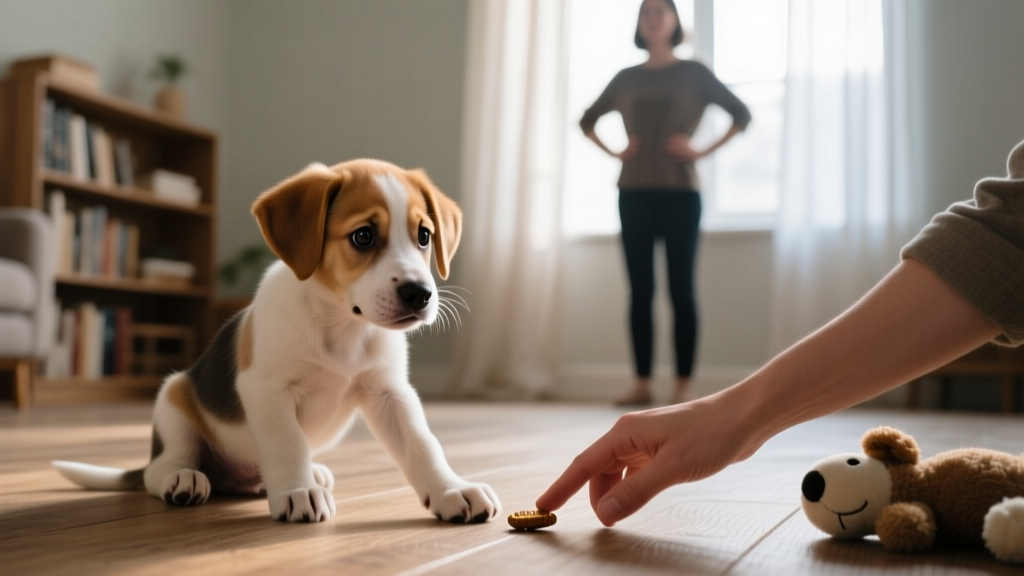
Managing puppy biting and nipping: Puppies bite because it's how they explore and because teething hurts. To stop nipping, use redirection (offer a chew toy when puppy mouths skin), yelp and withdraw attention for 10–15 seconds when bites are too hard (mimicking littermate behavior), and reward gentle mouth contact. Never hold a puppy's mouth shut, hit, or use physical punishment — these methods increase fear and can escalate biting. If biting persists past 6 months or involves aggressive posturing, consult a certified professional dog trainer (CPDT-KA) or veterinary behaviorist.
Crate Training Progression
Crate training supports potty training, prevents destructive chewing (keeping puppies away from dangerous items like pork bones), and gives your puppy a secure den. Here's the progression:
| Age | Max Daytime Crate Time | Max Nighttime Crate Time | Notes |
|---|---|---|---|
| 8–10 weeks | 30–60 minutes | 2–3 hours (expect 1–2 nighttime potty breaks) | Keep crate in bedroom; cover with light blanket |
| 11–14 weeks | 1–2 hours | 3–4 hours | Begin moving crate to permanent location |
| 15–16 weeks | 2–3 hours | 4–5 hours | Nighttime potty breaks may decrease to 0–1 |
| 4–6 months | 3–4 hours | 6–8 hours | Most puppies sleep through the night by 4 months |
| 6+ months | 4–6 hours (with exercise before/after) | 8 hours | Consider leaving crate door open for voluntary use |
Key principles: Never use the crate as punishment. Always pair crating with positive associations (meals fed in crate, special chew toys only available in crate, Kongs stuffed with treats). Exercise your puppy thoroughly before crating. A tired puppy settles; a pent-up puppy protests.
First-Year Cost Breakdown
Budgeting realistically prevents stressful surprises. Here are typical first-year costs for a puppy in the United States (2026 estimates):
| Category | Low Estimate | Medium Estimate | High Estimate |
|---|---|---|---|
| Puppy acquisition (adoption to responsible breeder) | $200 | $1,200 | $3,500+ |
| Veterinary care (vaccines, spay/neuter, wellness exams, heartworm/flea prevention) | $500 | $900 | $1,500 |
| Food (quality puppy food, 12 months) | $300 | $600 | $1,000 |
| Supplies (crate, bed, leash, collar, bowls, toys, chews, gates) | $200 | $400 | $700 |
| Training (puppy class, group classes) | $100 | $300 | $800 |
| Pet insurance (optional but recommended) | $360/year | $600/year | $900/year |
| Emergency fund (GI blockage, injury — highly variable) | $0 | $500 | $5,000+ |
| TOTAL (excluding acquisition) | $1,460 | $3,300 | $9,900+ |
These figures don't include the puppy purchase or adoption fee. Pet insurance is strongly recommended — enrolling during puppyhood ensures pre-existing conditions don't exclude future claims. A single emergency (like surgery for a swallowed pork bone) can exceed $5,000.
Frequently Asked Questions
When should I bring my puppy home?
The ideal age is 8–10 weeks for most breeds. Some breeders of toy breeds (Chihuahuas, Yorkshire Terriers) prefer to keep puppies until 10–12 weeks due to fragility and hypoglycemia risk. Never take a puppy before 8 weeks — the final weeks with the litter are critical for bite inhibition learning and social development.
How often should I feed my puppy at 10 weeks old?
At 10 weeks, feed 4 meals per day spaced roughly 3–4 hours apart (e.g., 7 AM, 11 AM, 3 PM, 7 PM). Consistent meal timing supports predictable potty schedules — puppies typically need to eliminate within 15–30 minutes after eating.
When can my puppy go outside and meet other dogs?
Your puppy can explore your own yard (if no unknown dogs have access) immediately. For public spaces and meeting unfamiliar dogs, wait until 2 weeks after the final DHPP booster — typically around 16–18 weeks of age. However, controlled socialization with known, fully vaccinated adult dogs in private homes is safe and encouraged starting at 8 weeks. Puppy classes that require proof of first vaccination and maintain sanitized facilities are generally considered safe from 10 weeks onward, per the American Veterinary Society of Animal Behavior.
How do I stop puppy biting and nipping?
Use a three-step approach: (1) Redirect to an appropriate chew toy whenever teeth touch skin. (2) If biting continues, emit a high-pitched "ouch!" and withdraw attention for 10–15 seconds — stand up, turn away, or step behind a baby gate. (3) Return and reward calm behavior with attention and treats. This mimics how littermates teach each other bite inhibition. Most puppies significantly reduce mouthing by 5–6 months as adult teeth come in and they learn the rules. Consistency from all household members is essential.
Can puppies eat pork chop bones if they're raw?
No. Raw pork bones carry parasite and bacterial risks (Trichinella, Salmonella) that are particularly dangerous for puppies with immature immune systems. Additionally, pork bones of any kind — raw or cooked — are not structurally ideal for dog chewing compared to raw beef or lamb bones recommended by some raw-feeding veterinarians. Always consult your veterinarian before introducing any bones into your puppy's diet.
What should I do if my puppy swallows a bone whole?
Contact your veterinarian immediately. Do not induce vomiting, as a large bone fragment can lodge in the esophagus during regurgitation. Your vet may recommend monitoring with serial X-rays over 48–72 hours, or in cases of obstruction, endoscopic or surgical removal. Watch for vomiting, retching, drooling, refusal to eat, abdominal pain, or bloody stool — these are emergency signs.
Beth Carrasco
All our authors care for dogs every day — read more of their work on the authors page.