Adorable Lab Puppies: Week-by-Week Care Guide for New Owners
Everything you need to raise adorable Lab puppies: week-by-week milestones, feeding schedules, vaccination timelines, potty training, and first-year costs.

Bringing Home Adorable Lab Puppies: What to Expect
Labrador Retrievers have held the top spot among America's most popular breeds for over three decades, and it's easy to see why. Those otter tails, soft mouths, and eager-to-please personalities make adorable Lab puppies irresistible. But behind those floppy ears and webbed feet is a high-energy, intelligent sporting dog that needs structured guidance from day one.
This guide walks you through every critical stage of your Labrador puppy's first year — from the moment you pick them up at 8 weeks through adolescence. You'll find exact feeding portions, vaccination dates, crate time limits, and realistic timelines so you can plan ahead instead of reacting to crises.
When Should You Bring Your Lab Puppy Home?
The American Kennel Club and most veterinary behaviorists agree: 8 weeks is the earliest acceptable age to separate a Labrador puppy from its littermates and dam. Many responsible Lab breeders now keep puppies until 9 or even 10 weeks to allow additional socialization within the litter.
Here's why timing matters:
- Weeks 5–7: Puppies learn bite inhibition, canine body language, and play boundaries from siblings. Removing them early increases risk of behavioral issues like excessive mouthing and fear-based reactivity.
- Week 7–8: The first fear imprint period (8–11 weeks) begins. Transitioning to a new home during this window means you control the environment — no overwhelming experiences that could create lasting phobias.
- After 10 weeks: The socialization window is already narrowing. Puppies kept in low-stimulation environments past this point may become harder to socialize.
Practical tip: If your breeder offers to keep your Lab pup until 9–10 weeks and is actively socializing them (exposing to surfaces, sounds, handling, novel objects), accept. You'll get a more confident puppy.
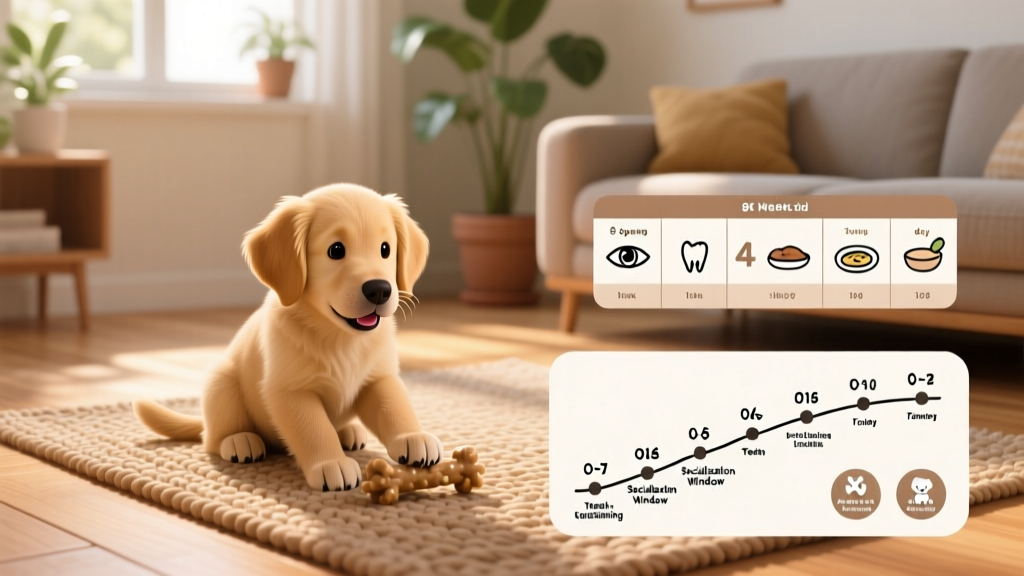
Lab Puppy Milestones: Week by Week
Weeks 4–8 (Still With Breeder)
At this stage your puppy is still with the breeder, but knowing what's happening helps you evaluate their program:
- Week 4: Weaning begins; puppy mush (soaked kibble) introduced. Eyes and ears fully functional.
- Week 5: Play-fighting with littermates peaks — this is where bite inhibition foundations form.
- Week 6: First deworming typically given. Puppies begin exploring beyond the whelping area.
- Week 7: Individual temperament testing often done by breeders (Volhard or similar). First human bonding periods.
- Week 8: First DHPP vaccine administered by breeder's vet. Ready for pickup.
Weeks 8–12 (Settling In)
This is your bonding and foundation window. Expect:
- Sleep: 18–20 hours per day. Yes, really. Lab puppies are energy bursts followed by comas.
- Attention span: 3–5 minutes per training session, max.
- Biting/nipping: Peaks around 9–12 weeks. Normal, not aggression.
- Fear periods: Watch for sudden startle responses to previously neutral stimuli (weeks 8–11).
- House training: Accidents every 1–2 hours. Take out after every nap, meal, and play session.
Weeks 12–16 (Building Skills)
- Teething begins: Baby incisors start loosening around 12–14 weeks. Chewing intensity increases.
- Bladder control improves: Can hold for roughly 1 hour per month of age (so ~3 hours at 12 weeks).
- Training readiness: Can learn sit, down, recall basics with food motivation. Labs are famously food-driven — use this.
- Second fear period: May occur around 14–16 weeks. Avoid traumatic vet or grooming experiences if possible.
Weeks 16–24 (The Teenage Phase Begins)
- Adult teeth: All 42 adult teeth typically in by 6–7 months.
- Energy surge: Your Lab puppy will seem to have endless stamina. Increase structured exercise, not just free play.
- Testing boundaries: Recall may deteriorate. This is normal adolescent regression, not failure.
- Growth plates: Still open. Avoid forced running, jumping from heights, or repetitive fetch on hard surfaces to protect developing joints.
6–12 Months (Adolescence)
- Sexual maturity: Intact females may experience first estrus (heat) around 6–8 months. Males begin marking. Discuss spay/neuter timing with your vet — many orthopedic specialists now recommend waiting until 12–18 months for Labs to allow growth plate closure.
- Adult size: Labs reach ~75% of adult weight by 6 months, ~90% by 9 months.
- Training: Can handle 15–20 minute sessions. Ready for intermediate obedience, intro to scent work, or field conditioning.
Feeding Your Lab Puppy: Schedule and Portions
Labrador Retrievers are notoriously food-motivated and prone to obesity. Establishing measured feeding early — not free-feeding — is one of the most important things you can do for your Lab's long-term joint and metabolic health. According to the Merck Veterinary Manual, large-breed puppies should eat a diet formulated for large-breed growth (calcium restricted to 1.0–1.5% on a dry matter basis) to reduce hip dysplasia risk.
| Age | Meals/Day | Approximate Portion (Large-Breed Puppy Kibble) | Notes |
|---|---|---|---|
| 8–12 weeks | 3–4 | ¾–1 cup total daily (split across meals) | Soak kibble in warm water for first week home if transitioning |
| 3–4 months | 3 | 1–1½ cups total daily | Adjust based on body condition score — ribs should be palpable but not visible |
| 4–6 months | 2–3 | 1½–2½ cups total daily | Transition to 2 meals/day around 5 months |
| 6–12 months | 2 | 2–3 cups total daily | Switch to adult formula around 12 months (or large-breed adult) |
Portion note: These are starting points for a Lab puppy expected to reach 55–75 lb (25–34 kg) adult weight. Caloric density varies by brand. Check your food's feeding chart and adjust based on your puppy's body condition score (BCS). A BCS of 4–5 out of 9 is ideal — you should feel ribs easily without pressing, see a waist from above, and observe an abdominal tuck from the side.
Recommended food criteria for Lab puppies:
- AAFCO statement for "growth" or "all life stages"
- Labeled as large-breed puppy formula
- First ingredient is a named animal protein (chicken, lamb, salmon)
- Calcium content 1.0–1.5% dry matter basis
- Calorie density around 350–400 kcal/cup
Vaccination Schedule for Your Labrador Puppy
Your Lab puppy's vaccination protocol follows guidelines established by the American Veterinary Medical Association and the AAHA Canine Vaccination Guidelines. Here's the standard schedule for a typical Lab puppy in the United States:
| Age | Vaccine | Type | Notes |
|---|---|---|---|
| 6–8 weeks | DHPP (1st) | Core — Distemper, Hepatitis (Adenovirus), Parainfluenza, Parvovirus | Usually given by breeder's vet before pickup |
| 10–12 weeks | DHPP (2nd) | Core | First booster; puppy is NOT fully protected yet |
| 10–12 weeks | Bordetella | Non-core (recommended for Labs attending puppy class) | Intranasal or injectable; required by most training facilities |
| 12–14 weeks | Leptospirosis (1st) | Non-core | Recommended for Labs — they're sporting dogs that may encounter standing water |
| 14–16 weeks | DHPP (3rd) | Core | Final puppy booster; full protection ~2 weeks after this dose |
| 14–16 weeks | Leptospirosis (2nd) | Non-core | Booster 2–4 weeks after first dose |
| 12–16 weeks | Rabies | Core (legally required) | Timing varies by state law; typically 12–16 weeks |
Until your puppy has received their final DHPP booster at 14–16 weeks (plus 2 weeks for immunity to build), avoid dog parks, pet stores, and areas with unknown dog traffic. However, socialization with known, fully-vaccinated dogs in controlled environments (your yard, a friend's home) is safe and critical. Carry your puppy in public spaces for exposure to sights and sounds without ground contact.
The Socialization Window: Weeks 3–14
Canine behaviorists consider weeks 3–14 the primary socialization period — a developmental window during which your Lab puppy's brain is uniquely receptive to new experiences. After week 14, novel stimuli increasingly trigger caution or fear rather than curiosity. Missing this window doesn't mean your dog is doomed, but it does mean significantly more work later.
Lab Puppy Socialization Checklist
Aim for positive (treat-paired) exposure to the following before 14 weeks. Never force — let your puppy approach at their own pace:
| Category | Specific Exposures (Aim for 5+ per category) |
|---|---|
| People | Children, elderly, people in hats/sunglasses, beards, uniforms, wheelchairs, tall/short individuals |
| Surfaces | Gravel, grass, metal grates, wet pavement, carpet, tile, tarps, wobble boards |
| Objects | Umbrellas opening, vacuum cleaners, trash cans, bicycles, strollers, balloons, plastic bags blowing |
| Animals | Fully-vaccinated adult dogs (various sizes), cats (if safe), livestock at a distance |
| Handling | Paw touching, ear inspection, mouth opening, nail handling, collar grabbing, being lifted |
| Sounds | Thunderstorms (recordings at low volume), fireworks, doorbells, clapping, traffic, construction noise |
| Environments | Car rides, vet clinic (happy visits), pet-friendly stores, outdoor seating areas, friends' homes |
Lab-specific socialization priority: Labs are mouth-oriented retrievers. Introduce appropriate carry objects early (soft toys, dummy bumpers) and practice "drop it" and "trade" games during this window. This channels their natural retrieving drive appropriately before they decide your shoes are fetch toys.
Potty Training Your Lab Puppy: Timeline and Troubleshooting
Labrador Retrievers are generally quick to house-train — their food motivation makes them responsive to treat rewards for outdoor elimination. Here's a realistic timeline:
- 8–12 weeks: Accidents every 1–3 hours. You are managing, not training. Take puppy out after every nap, meal, play session, and crate release.
- 3–4 months: Beginning to signal (sniffing, circling, going to door). Accidents drop to 1–2 per week if you're consistent.
- 4–6 months: Most Lab puppies are reliably house-trained with rare accidents. Can hold bladder 4–5 hours during the day.
- 6+ months: Fully reliable for most puppies. Overnight holding (7–8 hours) typically achieved by 5–6 months.
Bladder capacity rule of thumb: A puppy can hold for approximately their age in months plus one hour. So a 3-month-old Lab puppy = roughly 4 hours maximum. This is a ceiling, not a target — more frequent outings accelerate training.
Potty Training Protocol
- Take puppy to the same outdoor spot every time.
- Use a consistent cue word ("go potty," "hurry up") while they're eliminating.
- Reward immediately after finishing — high-value treat + verbal praise within 2 seconds.
- Supervise 100% indoors or confine to crate/pen when you can't watch.
- Interrupt accidents with a neutral "oops" and carry outside to finish. Never punish — this teaches the puppy to hide elimination from you.
- Enzymatic cleaner (Nature's Miracle, Rocco & Roxie) for any indoor accidents. Ammonia-based cleaners attract puppies back to the same spot.
Common Potty Training Setbacks
- Regression at 4–5 months: Often coincides with teething distraction or adolescent boundary-testing. Return to frequent outings and higher-value rewards.
- Submissive/excitement urination: Common in young Labs when greeting. Ignore the puppy for first 2 minutes after arriving home; greet outside.
- UTIs: If previously trained puppy suddenly has accidents, see your vet. Urinary tract infections are common and require antibiotics.
Crate Training Progression and Time Limits
Crating is essential for Labs — they're mouthy, curious, and destructive when unsupervised as puppies. A crate protects your home and keeps your puppy safe from ingesting dangerous objects. Frame the crate as a den, never as punishment.
| Age | Maximum Daytime Crate Time | Overnight |
|---|---|---|
| 8–10 weeks | 1–2 hours | 3–4 hours (expect 1–2 nighttime potty breaks) |
| 10–12 weeks | 2 hours | 4–5 hours |
| 3–4 months | 3 hours | 5–6 hours |
| 4–6 months | 4 hours | 7–8 hours |
| 6+ months | 5–6 hours max | 8 hours |
Crate size for Labs: Purchase a 36-inch or 42-inch wire crate with a divider panel. The crate should allow your puppy to stand, turn around, and lie down — no more. Excess space allows them to eliminate in one corner and sleep in another, undermining house training.
Progression steps:
- Week 1 home: Crate door open, meals fed inside, treats tossed in. Nap in crate with door closed while you sit nearby.
- Week 2: Short absences (5–15 minutes) while puppy is sleepy. Return before whining starts.
- Week 3–4: Build to 30–60 minute absences. Practice leaving and returning calmly — no dramatic greetings.
- Month 2+: Crate for longer periods during day, overnight without potty break as bladder capacity allows.
Teething Timeline and Relief Strategies
Lab puppies are aggressive chewers even by puppy standards. Understanding the teething timeline helps you prepare appropriate outlets:
- 3–4 weeks: Baby (deciduous) teeth erupt — 28 total.
- 12–16 weeks: Baby incisors and canines begin loosening. You may find tiny teeth on the floor.
- 4–6 months: Peak teething discomfort. Premolars and molars erupting. Chewing intensity at maximum.
- 6–7 months: All 42 adult teeth should be in. If baby canines persist alongside adult teeth (retained deciduous teeth), your vet may need to extract them — common in some Lab lines.
Safe Chew Recommendations by Stage
- 8–12 weeks: Soft rubber toys (Kong Puppy), frozen wet washcloth (knot it, soak in water, freeze), Nylabone Puppy chew.
- 3–5 months: Classic Kong stuffed with soaked kibble and frozen, Benebone Puppy, bully sticks (supervised only — remove when small enough to swallow).
- 5–7 months: Kong Classic (red, medium), antler alternatives (not real antlers — too hard for developing teeth), GoughNuts ring.
Avoid: Raw bones that can splinter, ice cubes (can fracture teeth), hard nylon bones not rated for puppies, cooked bones of any kind, and any chew small enough to be a choking hazard for a Lab's enthusiastic gulping style.
Common Lab Puppy Problems and Solutions
How Do I Stop Puppy Biting and Nipping?
Lab puppies use their mouths to explore the world — it's bred into them as retrievers. Biting peaks between 9–16 weeks and gradually diminishes with consistent management:
- Redirect: When puppy mouths skin, immediately offer a chew toy. Praise when they bite the toy instead.
- Reverse time-out: If biting continues after redirect, stand up and leave the area for 15–30 seconds. This removes the social interaction the puppy wants. Return when calm.
- Satisfy the drive: Provide structured retrieval games (toss a soft toy, reward for bringing it back). This channels the mouth-oriented behavior appropriately.
- Never: Hold the mouth shut, yell, or use physical punishment. These damage trust and can create defensive biting.
Most Lab puppies significantly reduce mouthing by 5–6 months as adult teeth come in and they learn appropriate outlets.
Whining in the Crate
Distinguish between protest whining (wanting out to play) and needs-based whining (potty). Take puppy out to potty first. If they eliminate and then whine when returned to crate, wait for 3–5 seconds of silence before releasing. If you release during whining, you've trained them that whining opens the door.
Destructive Chewing
Labs chew into adulthood — it's part of their oral fixation. Management strategies:
- Rotate 5–7 approved chews so novelty is maintained.
- Puppy-proof rooms before giving freedom. Use bitter apple spray on baseboards if needed.
- Increase physical exercise and mental stimulation (snuffle mats, training sessions, food puzzles). A tired Lab is a non-destructive Lab.
First-Year Cost Breakdown for a Labrador Puppy
Budgeting realistically prevents financial stress and ensures your Lab gets proper care. Here's a detailed first-year cost estimate based on 2026 pricing:
| Category | Items | Estimated Cost Range |
|---|---|---|
| Initial veterinary | 3 DHPP boosters, rabies, Bordetella, Lepto, fecal exams, deworming, heartworm test | $300–$600 |
| Spay/neuter | Surgical sterilization (varies by sex, region, clinic) | $250–$700 |
| Preventive medications | Monthly heartworm (Heartgard Plus), flea/tick (NexGard or Simparica Trio) — 12 months | $350–$600/year |
| Food | Large-breed puppy formula, ~25–35 lb/month as puppy grows | $400–$700 |
| Supplies | Crate, bed, leash, collar, harness, bowls, toys, enzymatic cleaner, puppy pads, gate | $200–$400 |
| Training | Puppy kindergarten class (6–8 weeks), intermediate class | $150–$400 |
| Microchip | If not done by breeder | $25–$60 |
| Pet insurance | Optional but recommended for Labs (hip/elbow dysplasia risk) | $40–$80/month ($480–$960/year) |
| Emergency fund | Set aside for foreign body ingestion, ear infections (common in Labs) | $200–$1,000 |
Total first-year estimate: $2,350–$5,420 (excluding insurance) or $2,830–$6,380 with insurance. After the first year, annual costs typically drop to $1,200–$2,500 for a healthy adult Lab.
Frequently Asked Questions About Lab Puppies
How often should I feed my 8-week-old Lab puppy?
Feed 8–12 week old Lab puppies 3–4 meals per day, totaling approximately ¾ to 1 cup of large-breed puppy kibble daily. Divide evenly across meals. Consistent meal timing also helps predict potty timing — puppies typically need to eliminate 15–30 minutes after eating.
When will my Lab puppy be fully potty trained?
Most Labrador puppies are reliably house-trained between 4–6 months with consistent management. Overnight reliability (holding 7–8 hours) typically comes by 5–6 months. Occasional accidents during excitement or illness are normal even in trained dogs.
What vaccines does my Lab puppy need and when?
Core vaccines include DHPP at 6–8, 10–12, and 14–16 weeks, plus rabies at 12–16 weeks. Non-core but recommended for Labs: Bordetella (especially for puppy classes) and Leptospirosis (Labs are at higher exposure risk due to their love of water). Your vet will tailor the protocol based on your region and lifestyle.
How do I stop my Lab puppy from biting everything?
Redirect to appropriate chews, use reverse time-outs (leave the area for 15–30 seconds when biting occurs), and satisfy the oral drive with structured fetch games and food puzzles. Never use physical punishment. Biting naturally decreases by 5–6 months as adult teeth erupt and the puppy learns boundaries.
When can my Lab puppy go to the dog park?
Wait until 2 weeks after the final DHPP booster (typically given at 14–16 weeks), so around 16–18 weeks minimum. Many trainers recommend waiting until 6 months and choosing quieter times. Dog parks carry risks of disease exposure, rough play injuries, and behavioral overwhelm for young puppies.
Should I get pet insurance for my Lab puppy?
Labrador Retrievers are predisposed to hip dysplasia, elbow dysplasia, cruciate ligament tears, and certain cancers — conditions that can cost $2,000–$6,000+ per incident to treat. Enrolling at 8–10 weeks, before any conditions are documented, ensures coverage for future issues. Compare plans from Trupanion, Healthy Paws, and Lemonade for breed-specific coverage.
Raising a Labrador puppy is demanding but deeply rewarding. Their intelligence, loyalty, and joy for life make every 3 a.m. potty break worth it. Stay consistent with your routines, invest in early socialization, and don't hesitate to consult your veterinarian or a certified positive-reinforcement trainer when challenges arise.
Jonas Cole
All our authors care for dogs every day — read more of their work on the authors page.