2026 Joint Care Guide for Service & Working Dogs: Top Picks
Discover the 2026 veterinary protocols for working and service dog joint health, featuring Dasuquin Advanced, PEMF therapy, and SAR mobility routines.
The Biomechanical Toll on Working and Service Dogs
Working dogs and service dogs are the elite athletes of the canine world. Whether they are navigating unstable rubble in Search and Rescue (SAR) operations, guiding visually impaired handlers through busy urban intersections, or performing tactical apprehensions in police K9 units, their musculoskeletal systems endure extreme biomechanical stress. Unlike pet dogs that engage in sporadic play, working dogs perform repetitive, high-impact tasks that place immense strain on their articular cartilage, ligaments, and joint capsules.
As of 2026, veterinary sports medicine has shifted heavily toward proactive joint preservation rather than reactive pain management. According to the American Kennel Club's veterinary guidelines on canine osteoarthritis, early intervention is critical for breeds commonly used in service roles, such as the Belgian Malinois, German Shepherd Dog, and Labrador Retriever. The repetitive hyperextension of the carpus (wrist) during tracking and the sudden deceleration forces on the stifle (knee) and coxofemoral (hip) joints during apprehension work accelerate the natural degradation of synovial fluid and cartilage matrix.
Recognizing Hidden Joint Pain in Stoic Breeds
One of the greatest challenges in managing working dog health is the inherent stoicism of the breeds selected for these roles. A high-drive Malinois or a deeply focused Guide Dog will often mask pain to continue performing their duties. By the time a working dog exhibits overt lameness, significant joint degradation has usually already occurred.
Handlers and veterinary teams in 2026 are trained to look for micro-indicators of joint discomfort. These subtle signs include a slight hesitation before leaping into a K9 unit vehicle, a marginal decrease in the pulling pressure exerted by a guide dog in the harness, or a widened stance during a stationary down-stay. Recognizing these early warnings allows handlers to implement advanced nutraceutical and therapeutic protocols before irreversible osteoarthritis sets in.
2026 Gold-Standard Joint Supplements for Active Duty Dogs
Nutraceuticals form the first line of defense in preserving joint cartilage and managing synovial inflammation. In 2026, the veterinary consensus heavily favors multi-modal joint supplements that combine traditional chondroprotective agents with potent, natural anti-inflammatories. Two products consistently rank at the top of veterinary orthopedic recommendations for high-performance dogs: Dasuquin Advanced for Large Dogs and GlycoFlex Max.
Dasuquin Advanced is particularly noted for its inclusion of ASU (Avocado/Soybean Unsaponifiables) and Boswellia serrata extract, which work synergistically to inhibit cartilage degradation and modulate inflammatory pathways. GlycoFlex Max, on the other hand, relies heavily on New Zealand Green Lipped Mussel (Perna canaliculus), a rich source of omega-3 fatty acids, glycosaminoglycans, and amino acids that support joint lubrication and soft tissue repair.
Supplement Comparison Chart for Working Dogs
| Feature | Dasuquin Advanced (Large Breed) | GlycoFlex Max |
|---|---|---|
| Key Active Ingredients | Glucosamine, Chondroitin, MSM, ASU, Boswellia, Manganese | Green Lipped Mussel, MSM, Glucosamine, DMG, Vitamin C & E |
| Primary Mechanism | Cartilage matrix protection & inflammatory pathway inhibition | Synovial fluid lubrication & antioxidant soft-tissue support |
| Best Use Case | Dogs with high-impact roles (SAR, Police K9, Agility) | Dogs requiring soft-tissue & joint support (Guide Dogs, Therapy) |
| 2026 Avg. Price (60-Day Supply) | $85.00 - $95.00 | $70.00 - $80.00 |
| Palatability | Flavored chewable tablets (high acceptance) | Chicken-flavored bites (excellent acceptance) |
The Role of PEMF Therapy in Field Recovery
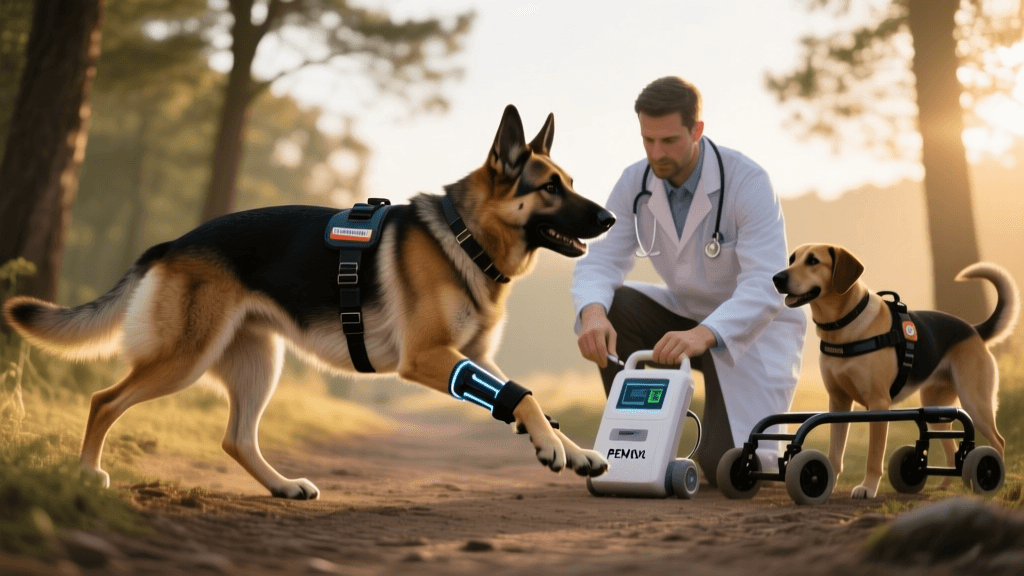
Beyond oral supplements, 2026 has seen a massive integration of bioelectromagnetic therapies in working dog care. Pulsed Electromagnetic Field (PEMF) therapy has become a staple for SAR teams and military working dog units. The Assisi Loop, a non-invasive, portable PEMF device, is frequently deployed in the field to accelerate cellular repair and reduce acute inflammation following strenuous operational deployments.
PEMF therapy works by emitting low-frequency electromagnetic pulses that stimulate cellular metabolism, increase ATP production, and enhance microcirculation in damaged tissues. For a search and rescue dog that has spent eight hours navigating jagged concrete and rebar, applying a PEMF device to the carpal and tarsal joints for 15-minute cycles immediately post-mission helps flush lactic acid and prevents acute swelling from progressing to chronic joint stiffness. Because devices like the Assisi Loop are battery-operated and lightweight, they can be easily integrated into a handler's field kit, ensuring that recovery begins minutes after the dog is released from duty.
Canine Conditioning and Proprioception Protocols
Joint health is not solely about cartilage preservation; it is equally dependent on the muscular scaffolding that supports the joints. A weak core or poor proprioception forces the joints to absorb shock that should be mitigated by muscle. In 2026, certified canine rehabilitation therapists (CCRTs) mandate specific conditioning protocols for all active service dogs.
Key conditioning exercises include:
- Cavaletti Rails: Walking over evenly spaced ground poles forces the dog to consciously lift and place each paw, improving proprioception and engaging the stabilizing muscles of the shoulder and hip joints without high impact.
- Balance Discs and Peanuts: Having a dog perform static holds or weight-shifting exercises on inflatable canine fitness equipment recruits deep core stabilizers and the small intrinsic muscles surrounding the joints.
- Targeted Hydrotherapy: Underwater treadmills remain the gold standard for low-resistance, high-drag muscle building. The buoyancy of the water unloads the joints while the water resistance builds the quadriceps and hamstrings, providing a stronger muscular brace for the stifle joint.
Nutritional and Weight Management Strategies
No supplement or therapy can outwork the physics of excess weight. For working dogs, maintaining an optimal Body Condition Score (BCS) is a non-negotiable aspect of joint preservation. The American College of Veterinary Surgeons emphasizes that even a 5% increase in body weight can exponentially increase the mechanical load on a dog's hips and knees, accelerating the onset of osteoarthritis.
In 2026, working dog nutritionists advocate for a BCS of exactly 4 out of 9 for active duty dogs. This ensures the dog has enough caloric reserve for endurance tasks but remains lean enough that the ribs are easily palpable without a thick fat covering. Diets are now heavily customized using fresh-food formulations or specialized kibble enriched with EPA and DHA (Omega-3 fatty acids) derived from microalgae and wild-caught fish oils, which naturally combat systemic joint inflammation.
When to Consult a Veterinary Orthopedic Specialist
While proactive protocols can significantly extend a working dog's career, the demands of service work sometimes outpace preventative measures. Handlers must know when to transition from field management to clinical intervention. If a working dog exhibits a persistent head bob during a trot, vocalizes when rising from a resting position, or shows a sudden, unexplained drop in operational drive, an immediate referral to a board-certified veterinary orthopedic surgeon or a canine sports medicine specialist is required.
Advanced 2026 diagnostic tools, including weight-bearing pressure mat analysis and high-resolution musculoskeletal ultrasound, allow specialists to pinpoint micro-tears in tendons or early-stage cartilage fibrillation that standard radiographs might miss. By combining elite nutraceuticals like Dasuquin Advanced, cutting-edge PEMF field therapy, and rigorous proprioceptive conditioning, handlers can ensure their canine partners remain sound, comfortable, and operational for years to come.
tom-renshaw
All our authors care for dogs every day — read more of their work on the authors page.