Best Dog Breeds for Remote Workers in 2026: Top Picks
Discover the best dog breeds for remote workers in 2026. Learn how breed psychology, energy levels, and instincts impact your work-from-home productivity.
The Evolution of the Canine Co-Worker
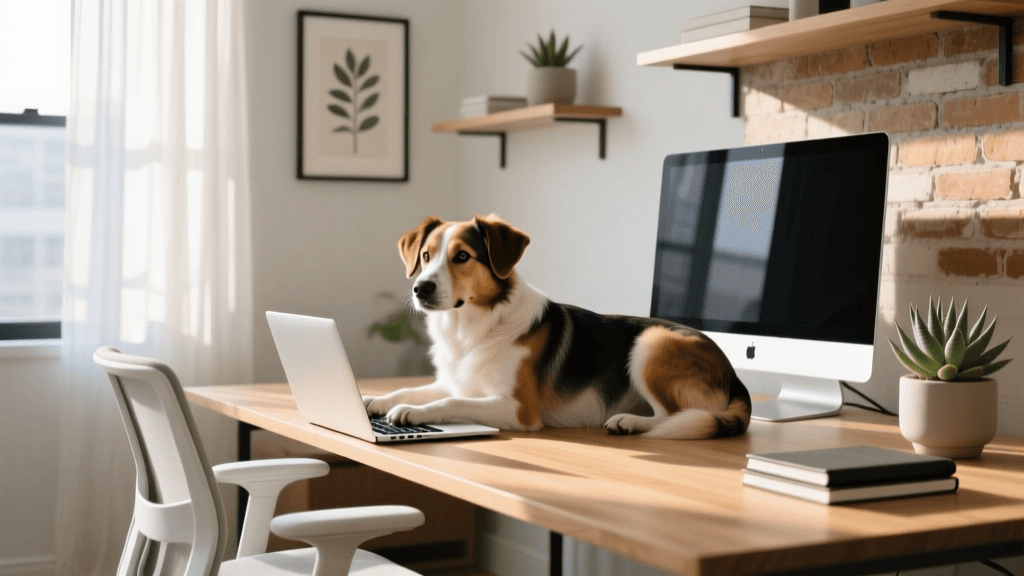
As we navigate the deeply entrenched remote and hybrid work structures of 2026, the home office has evolved from a temporary desk in the corner to a permanent, shared ecosystem. For dog owners, this means our canine companions are no longer just weekend hiking buddies; they are full-time colleagues. However, not every dog is psychologically wired to thrive in a home-office environment. Understanding your dog's breed-specific instincts, arousal thresholds, and social drives is crucial for maintaining both your productivity and your pet's mental well-being.
The intersection of canine psychology and human productivity is a fascinating field. While some dogs view a quiet home office as a sanctuary for napping, others perceive the constant typing, virtual meetings, and shifting seating arrangements as a chaotic environment that triggers their working instincts. In this guide, we break down the best dog breeds for remote workers based on behavioral science and breed history.
The Psychology of the Home Office Ecosystem
To choose the right dog for a work-from-home (WFH) lifestyle, we must first understand the concept of environmental arousal. Arousal refers to a dog's physiological and psychological state of alertness. High-arousal breeds are hyper-vigilant; they react to the sound of a notification ping, a delivery drone outside, or the sudden movement of you standing up from your desk. Low-arousal breeds, conversely, possess a higher threshold for environmental stimuli, allowing them to remain relaxed amidst the daily rhythms of a busy home office.
Furthermore, we must consider the 'Velcro dog' phenomenon. While having a dog constantly by your side seems like the WFH dream, dogs that are overly reliant on continuous physical proximity can develop severe separation anxiety the moment you need to leave for an in-person meeting or run errands. According to the ASPCA, dogs that become overly distressed when separated from their primary attachment figures often exhibit destructive behaviors and vocalization. Therefore, the ideal WFH dog is one that enjoys your presence but is also psychologically capable of independent relaxation.
Top Dog Breeds for the Remote Work Lifestyle
1. The Cavalier King Charles Spaniel: The Empathetic Anchor
Bred for centuries to be royal lap-warmers and empathetic companions, the Cavalier King Charles Spaniel is the quintessential home-office dog. Psychologically, Cavaliers are highly attuned to human emotional states but possess a remarkably low prey drive and reactivity threshold. They do not feel the need to 'patrol' the home office or alert you to every passing car. Instead, their instinct is to mirror your energy. If you are stressed and typing furiously, a well-socialized Cavalier will typically sigh, tuck their nose under their paws, and offer silent, grounding support. Their moderate energy levels mean a brisk morning walk is usually sufficient to settle them into a long day of napping under your desk.
2. The Greyhound: The 45-MPH Couch Potato
It may seem counterintuitive to recommend a racing breed for a sedentary home-office lifestyle, but the Greyhound's physiology dictates their WFH suitability. Greyhounds are sprinters, not marathon runners. Their muscles are composed primarily of fast-twitch fibers, meaning they expend their energy in short, intense bursts and then require extensive recovery periods. In a home-office setting, a Greyhound will typically sleep for 18 to 20 hours a day. They are notoriously quiet, rarely barking at virtual doorbells or notification chimes, making them the perfect background presence for professionals who spend their days on Zoom calls.
3. The Basset Hound: The Low-Decibel Colleague
Basset Hounds are scent hounds, meaning they process the world primarily through their olfactory senses rather than auditory or visual triggers. While they can be vocal when on a scent trail, in the confined, familiar environment of a home office, they are remarkably docile and low-energy. Their stubborn, independent nature means they do not suffer from the 'Velcro' syndrome that plagues many companion breeds. A Basset Hound is perfectly content to chew on a long-lasting enrichment toy in the corner of the room without demanding your constant attention, allowing you to engage in deep work without interruption.
4. The Pug: The Attentive but Quiet Companion
Pugs were specifically bred to be companions to Chinese emperors, meaning their psychological baseline is centered around human companionship without the working drive of terriers or herding dogs. They are highly expressive and entertaining, providing necessary dopamine hits during stressful workdays. However, unlike high-energy toy breeds (such as Jack Russell Terriers), Pugs have a physical and psychological 'off switch.' Their brachycephalic (flat-faced) structure also naturally limits their endurance, ensuring they are ready for a nap shortly after their morning walk.
Breeds to Approach with Caution: The High-Drive Dilemma
While every dog is an individual, certain breed groups possess instincts that directly conflict with the modern home-office environment. Herding breeds, such as the Border Collie, Australian Shepherd, and Belgian Malinois, have been genetically selected for high environmental arousal, constant vigilance, and a compulsion to control movement.
In a WFH setting, these instincts can manifest in problematic ways. The movement of your rolling office chair, the rapid motion of your hands on a keyboard, or even the animated gestures of your colleagues on a video call can trigger a herding dog's prey and working drives. Without a dedicated 'job' to do, these dogs often create their own, which may include nipping at your ankles, barking at the screen, or pacing obsessively. If you are committed to a high-drive breed while working remotely, you must invest heavily in 2026's advanced canine enrichment technologies and dedicate significant time to structured mental conditioning before your workday begins.
WFH Breed Comparison Chart
| Breed | Energy Level | Vocalization | Office Clinginess | Best WFH Style |
|---|---|---|---|---|
| Cavalier King Charles | Low-Medium | Very Low | High | Lap-sitting during light admin work |
| Greyhound | Low (Sprinter) | Low | Low | Sleeping on a nearby mat all day |
| Basset Hound | Low | Medium | Low | Independent chewing and napping |
| Pug | Medium | Low-Medium | High | Companionship with frequent short breaks |
| Border Collie (Caution) | Very High | High | Medium | Requires active jobs; poor for desk work |
Behavioral Management: Training the 'Office Settle'
Even the most genetically predisposed WFH dog requires behavioral conditioning to understand the boundaries of your workspace. In 2026, the gold standard for home-office canine management is the 'Place' command combined with Capturing Calmness.
The 'Place' command teaches your dog to go to a specific mat or bed and remain there until released. This creates a psychological boundary that prevents them from wandering under your desk and chewing on cables. To train this, use high-value, slow-release enrichment tools. Modern smart-home integrations now allow automated treat dispensers to sync with your digital calendar; when your calendar blocks out 'Deep Work,' the dispenser can initiate a slow-release protocol on your dog's place mat, reinforcing their decision to stay settled.
Furthermore, the American Kennel Club (AKC) emphasizes the importance of preventing over-attachment, even when you are home all day. It is vital to practice 'micro-separations' throughout your workday. Use baby gates to separate your workspace from your dog's relaxation zone for an hour at a time. This ensures your dog maintains the psychological resilience to self-soothe and prevents the onset of separation anxiety when you eventually need to leave the house. By aligning your dog's natural breed instincts with structured behavioral routines, you can cultivate a harmonious, productive home-office environment for both you and your canine colleague.
jonas-cole
All our authors care for dogs every day — read more of their work on the authors page.