2026 Guide: Moving Cross-Country With Anxious Dogs
Relocating in 2026? Discover expert behavioral tips, travel hacks, and safe-room setups to help your anxious dog survive a cross-country move stress-free.
The Psychology of Territorial Displacement
For a dog, a home is not merely a shelter; it is a meticulously mapped territory defined by familiar scents, predictable routines, and established boundaries. When you undertake a cross-country move, you are subjecting your dog to severe territorial displacement. As of 2026, veterinary behaviorists emphasize that canine anxiety during major life transitions is often misinterpreted as disobedience or sudden aggression. In reality, it is a profound psychological response to the loss of environmental predictability.
With the 2026 surge in remote-work relocations and interstate migrations, understanding the psychology behind your dog's stress is the first step toward a successful transition. Dogs rely heavily on their olfactory environment to feel secure. Packing up your home strips away the scent markers that tell your dog they are safe. The goal of any life transition protocol is not to eliminate stress entirely—which is biologically impossible—but to manage cortisol levels and provide a scaffolding of security that your dog can rely on when their physical world is turned upside down.
Recognizing Subtle Stress Signals Before the Move
Long before the moving truck arrives, your dog will sense the shift in your household's energy. According to the American Kennel Club, dogs exhibit a hierarchy of stress signals, starting with subtle calming signals and escalating to overt panic if the stressor is not addressed. Recognizing these early indicators is crucial for intervening before your dog enters a state of chronic anxiety.
- Whale Eye: Showing the whites of their eyes while keeping their head turned away, often seen when you bring out packing tape or suitcases.
- Lip Licking and Yawning: When not related to food or sleep, these are classic displacement behaviors indicating mild to moderate nervous system arousal.
- Shedding Spikes: Sudden, excessive shedding is a physiological response to adrenaline and cortisol release.
- Shadowing: An anxious dog may suddenly refuse to let you out of their sight, following you from room to room as they sense the impending disruption of their territory.
By identifying these signals early, you can implement desensitization protocols weeks before the actual moving day, preventing the compounding of fear.
Pre-Move Desensitization Protocol
Week 4: The Cardboard Introduction
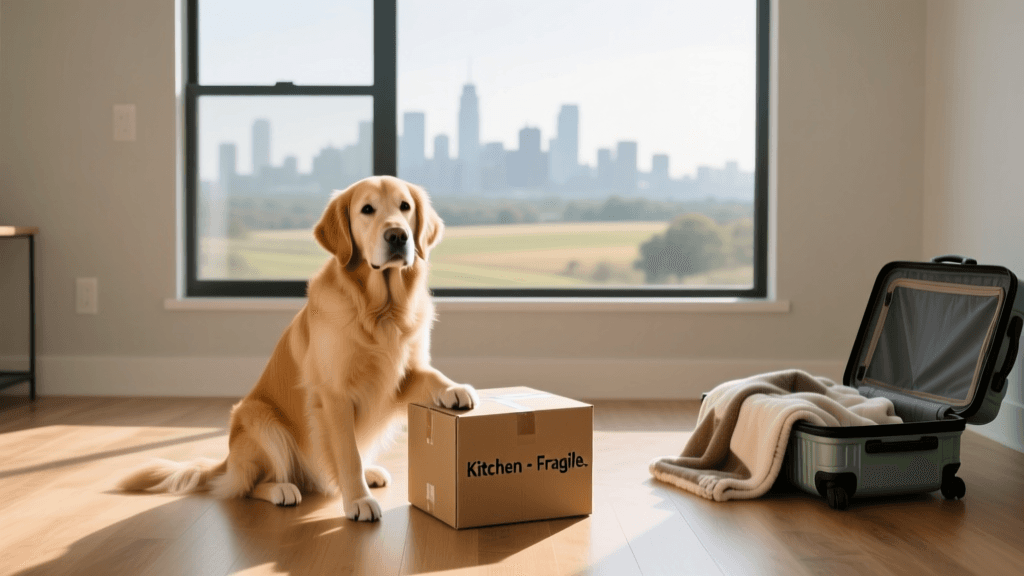
Do not wait until the week of the move to bring out boxes. Four weeks prior, introduce empty cardboard boxes into your home as neutral or positive objects. Feed your dog their meals near the boxes, or hide high-value treats inside them. This rewires the dog's associative memory, linking the visual of moving supplies with positive outcomes rather than the impending loss of their territory.
Week 3: Pheromones and 2026 Nutraceuticals
Chemical communication is a powerful tool in canine psychology. Plug in Adaptil Optimum diffusers in the rooms where your dog spends the most time. The 2026 veterinary consensus strongly supports the use of synthetic dog-appeasing pheromones (DAP) to lower baseline anxiety levels during environmental shifts. Additionally, consult your veterinarian about starting a daily nutraceutical supplement, such as Zylkene or Solliquin, at least three weeks before the move. These supplements utilize milk-derived bioactive peptides and L-theanine to promote GABA receptor activity in the brain, naturally blunting the cortisol spike associated with packing and chaos.
Travel Day: Managing Cortisol Spikes
The day of the move is the most volatile period in the transition. The ASPCA recommends keeping your dog's routine as normal as possible for as long as possible on moving day. If you are hiring movers, your dog should be safely secured in a quiet room with a white noise machine, or ideally, boarded at a trusted facility for the day to prevent escape attempts and sensory overload.
For the cross-country journey itself, safety and containment are paramount. If driving, utilize a crash-tested kennel, such as the Gunner G1, which meets 2026 safety standards for high-speed impacts. A secured crate not only protects your dog in the event of an accident but also provides a den-like sanctuary that limits visual overstimulation from passing scenery. Covering the crate with a breathable, light-blocking cover can significantly reduce motion sickness and visual anxiety. Plan your route to include quiet, low-traffic rest stops every four hours for hydration and sniffing, which helps dogs process new environments and burn off nervous energy.
The 72-Hour Safe Room Strategy
Upon arriving at your new home, resist the urge to give your dog a grand tour of the entire empty house. An empty, echoing house with unfamiliar scents is deeply overwhelming to an anxious dog. Instead, implement the 72-Hour Safe Room Strategy.
- Select the Room: Choose a quiet bedroom or study that is furthest from the front door and street noise.
- Scent Transfer: Before moving day, rub a clean cotton t-shirt on your dog's cheeks and shoulders to collect their facial pheromones. Wipe this shirt along the baseboards and furniture in the new safe room to instantly make the space smell familiar.
- Familiar Setup: Set up their exact bed, water bowl, and favorite toys in the same spatial arrangement they had in your old home.
- Decompression Time: Keep your dog confined to this room (with you present) for the first 72 hours while the rest of the house is unpacked. This limits their territory to a manageable, secure size while the chaotic unpacking process occurs outside the door.
"A dog's confidence is built on predictability. By shrinking their world down to a single, highly predictable safe room during the initial chaos of a move, you give their nervous system the permission it needs to finally decompress." — Principles of Canine Behavioral Modification, 2026 Edition
2026 Moving Timeline Checklist for Anxious Dogs
| Timeframe | Action Item | Behavioral Goal |
|---|---|---|
| 4 Weeks Out | Introduce moving boxes as neutral objects; hide treats inside them. | Prevent territorial fear of changing environment and packing supplies. |
| 3 Weeks Out | Begin daily nutraceuticals (e.g., Zylkene) and plug in Adaptil diffusers. | Lower baseline cortisol and promote GABA receptor activity. |
| 1 Week Out | Collect facial pheromones on a cloth; freeze the cloth in a sealed bag. | Preserve familiar scents for the new home's safe room. |
| Moving Day | Secure dog in a quiet space or boarding; use a crash-tested crate for travel. | Prevent escape, limit sensory overload, and ensure physical safety. |
| Arrival Day | Set up the 72-Hour Safe Room using the pheromone cloth and familiar bed. | Provide immediate olfactory security and limit overwhelming spatial exploration. |
| Week 1 Post-Move | Establish rigid feeding and walking schedules; use snuffle mats for meals. | Rebuild predictability and encourage natural foraging behaviors to reduce stress. |
Post-Move Decompression and Routine Building
Once the 72-hour safe room period is over and the house is mostly unpacked, you can begin to gradually expand your dog's access to the rest of the home. Do this one room at a time, using high-value treats and interactive puzzle toys, like the Kong Wobbler, to create positive associations with each new space.
The most critical factor in post-move decompression is the immediate establishment of a rigid routine. Dogs thrive on temporal predictability. Feed them at the exact same times, walk them on the exact same schedule, and initiate training sessions at the same time each day. As noted by the Humane Society of the United States, maintaining your dog's pre-move routine anchors them during the transition, signaling that while the physical location has changed, the fundamental rules and security of their life remain intact.
Expect a period of behavioral regression. Your dog may exhibit temporary house-soiling, increased vocalization, or clinginess. Respond with patience and positive reinforcement rather than punishment. By understanding the profound psychological impact of territorial displacement and proactively managing your dog's environment, you can transform a potentially traumatic cross-country move into a manageable life transition, ultimately strengthening the bond of trust between you and your canine companion.
anouk-beaumont
All our authors care for dogs every day — read more of their work on the authors page.