Decoding the Viral Dog Button Trend: Canine Cognition
Discover the science behind the viral dog button trend. Learn how AAC boards work, canine cognition, and how to teach your dog to communicate.
The Viral Phenomenon: Dogs 'Talking' on Social Media
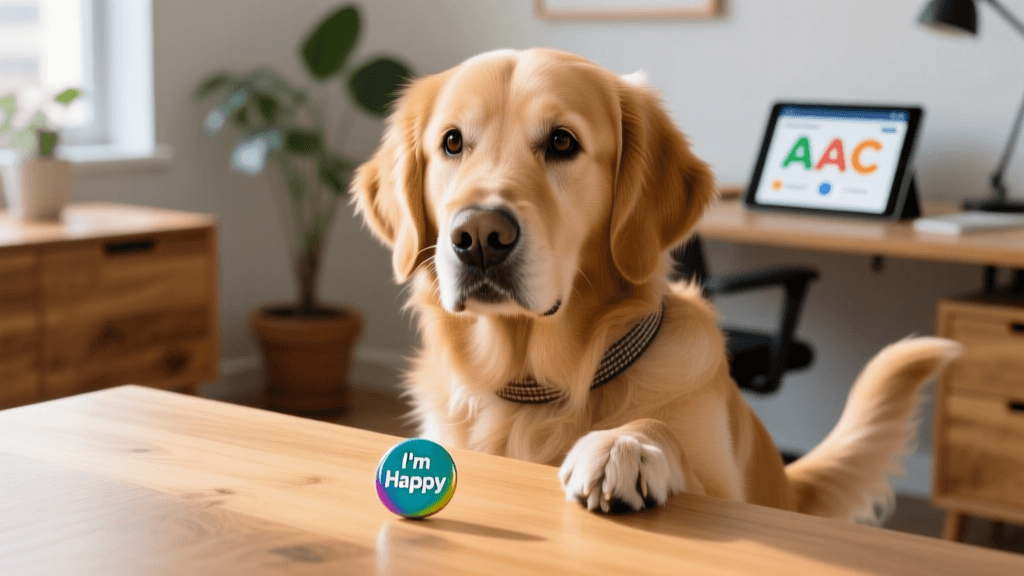
If you have spent any time on TikTok or Instagram over the past few years, you have likely encountered the viral dog button trend. From Bunny the Sheepadoodle debating the existential dread of squirrels to Stella the Catahoula mix expressing her frustration about the vacuum cleaner, dogs across the globe are seemingly 'talking' using Augmentative and Alternative Communication (AAC) soundboards. While these viral videos are undeniably entertaining, they raise a profound question for canine behaviorists and pet owners alike: Are dogs actually using language, or are they simply performing highly complex associative learning tricks?
Understanding the psychology behind this trend requires diving deep into canine cognition, operant conditioning, and the fascinating ways our pets perceive the world. At paws-tales, we believe that moving beyond the viral spectacle to understand the underlying behavioral science is the key to building a deeper, more communicative bond with your dog.
The Science: Operant Conditioning vs. True Language
To understand what happens when a dog presses a button labeled 'Outside,' we must look at the intersection of human speech therapy and animal cognition. AAC devices were originally developed for non-verbal humans, allowing them to pair symbolic representations (words or icons) with vocal output. When applied to dogs, the premise is that canines possess the cognitive capacity to associate a specific auditory output and physical action with a distinct environmental outcome.
However, canine cognitive scientists are careful to distinguish between associative learning and semantic understanding. When a dog presses the 'Play' button and their owner throws a toy, the dog has successfully linked a physical action (pawing the button) with a desired outcome (fetch). This is classic operant conditioning, heavily reliant on positive reinforcement.
But do dogs understand the concept of the word? The TheyCanTalk research project, led by cognitive scientist Federico Rossano at UC San Diego, is currently conducting the largest observational study on this very topic. Preliminary data suggests that some dogs may be moving beyond simple associations and are beginning to combine buttons in novel ways to express abstract concepts, such as 'Stranger' + 'Paw' to indicate a physical discomfort caused by an unknown person. While the scientific jury is still out on whether this constitutes true 'language' as humans define it, it undeniably showcases a level of symbolic reasoning and intentional communication previously underappreciated in canine psychology.
Spatial Memory vs. Semantic Mapping
One of the most critical insights from the Barnard College Dog Cognition Lab, directed by Dr. Alexandra Horowitz, is the profound reliance dogs have on spatial memory. Dogs are olfactory and spatial creatures; they remember where things happen just as much as what happens.
This has massive implications for button training. If you place the 'Outside' button on the far left of your board, and then rearrange the board, your dog may continue to press the empty space on the far left. They have memorized the spatial coordinates of the reward, not necessarily the semantic meaning of the button itself. Understanding this psychological quirk is vital for owners: it means you must periodically rearrange your dog's board to ensure they are reading the buttons rather than just performing a choreographed paw-dance based on muscle memory.
Getting Started: Gear, Costs, and Setup
If you want to tap into your dog's cognitive potential, you need the right equipment. The market leader in this viral space is FluentPet, a company that designed hexagonal tiles specifically to fit together like a honeycomb, allowing for easy rearrangement and spatial mapping.
What You Will Need and What It Costs
- Starter Kit (1 Button + Hex Tile): Approximately $30. Best for testing your dog's aptitude for target training.
- Core Kit (6-8 Buttons + Tiles): Approximately $120 - $160. Includes essential concepts like 'Outside,' 'Play,' 'Water,' 'All Done,' and 'Help.'
- Replacement Recordable Devices: $15 each. The internal mechanisms are battery-operated and occasionally wear out from heavy paw strikes.
Placement Strategy: Place the board in a high-traffic, neutral area of your home, such as the living room or kitchen. Do not place the 'Outside' button right next to the back door, or you will reinforce spatial mapping over symbolic learning. The board should be a dedicated communication hub, not a doorbell.
Step-by-Step Button Training Protocol
Teaching your dog to use AAC boards requires patience, high-value treats (like boiled chicken or freeze-dried liver), and a solid foundation in marker training (using a clicker or a consistent verbal marker like 'Yes!').
Phase 1: Targeting (Weeks 1-2)
Before introducing the sound button, teach your dog to target a lid or a small plastic disc with their nose or paw. Hold the target out, mark the exact moment they touch it, and reward. Once they are reliably targeting the object for a treat, place it on the floor and continue rewarding touches. This builds the physical mechanics required to press a button without the distraction of the sound.
Phase 2: Molding and Pairing (Weeks 3-4)
Insert the sound button into the hexagonal tile. Record your voice saying the target word clearly and calmly (e.g., 'Outside'). Now, wait for your dog to target the button. The moment their paw activates the sound, mark with your clicker, say 'Yes! Outside!', and immediately fulfill the request. If they press 'Outside,' you must put the leash on and go outside, even if it is just for two minutes. Consistency in this phase is what bridges the gap between a random paw swipe and intentional communication.
Phase 3: Shaping and Generalization (Months 2+)
Begin adding a second button (e.g., 'Play'). You will likely experience a period of 'button spamming,' where your dog presses every button available. Reward the correct button heavily, and offer a lower-value reward or a gentle 'Try again' for incorrect buttons. Over time, shape their behavior by only rewarding the specific button that matches the current context.
Market Comparison: Which Button System is Best?
| Brand | Price Range | Button Mechanism | Best For |
|---|---|---|---|
| FluentPet | $30 - $160+ | Hexagonal interlocking tiles, push-in recordable buttons | Serious trainers, spatial rearrangement, multi-dog homes |
| Hunger for Words | $40 - $120 | Standalone round mats, built-in recordable buttons | Beginners, smaller spaces, budget-conscious owners |
| Generic USB Buttons | $15 - $30 | Flat, non-slip base, basic recording chip | Testing the waters, DIY board builders |
Managing Expectations: The Extinction Burst
What the viral, highly-edited TikTok videos rarely show is the frustrating reality of the Extinction Burst. In behavioral psychology, an extinction burst occurs when a previously reinforced behavior suddenly stops yielding a reward, causing the subject to perform the behavior with increased intensity, frequency, and duration before eventually giving up.
Imagine this scenario: Your dog has learned that pressing 'Play' results in a game of tug. One evening, you are working on your laptop and ignore the button press. Your dog does not simply walk away. Instead, they will likely press the button repeatedly, paw at it aggressively, bark at the board, and perhaps even press 'Outside' or 'Water' in a desperate attempt to trigger any response from you.
If you give in and play tug during the 15th frantic button press, you have just taught your dog a dangerous psychological lesson: 'The button is broken, and I need to press it 15 times to get what I want.' You have inadvertently reinforced the spamming behavior. To combat this, owners must establish 'All Done' routines. Teaching your dog the 'All Done' button—and respecting it yourself by putting the toys away and disengaging—is crucial for maintaining a healthy, sane household. It gives the dog a sense of closure and prevents the anxiety that leads to extinction bursts.
Final Thoughts on Canine Communication
The viral dog button trend is more than just a fleeting internet fad; it is a gateway to a deeper understanding of canine psychology. While your dog may not be debating philosophy anytime soon, providing them with an AAC board respects their intelligence, reduces frustration, and offers a unique window into their inner world. By approaching the training with an understanding of operant conditioning, spatial memory, and behavioral extinction, you can transform a viral trick into a meaningful, lifelong communication tool.
aaron-whyte
All our authors care for dogs every day — read more of their work on the authors page.