DIY Scent and Puzzle Games to Decode Canine Behavior
Discover how DIY scent and puzzle games can help you decode your dog's behavior, instincts, and stress signals using simple homemade setups.
The Psychology of Play: Why DIY Beats Store-Bought
Understanding your dog goes far beyond teaching them to sit or stay. It requires a deep dive into their cognitive processes, sensory dominance, and emotional regulation. While the pet industry is flooded with expensive plastic puzzle toys, homemade setups often provide a superior window into your dog's psyche. By building DIY cognitive and scent games, you control the variables, allowing you to observe raw behavioral responses, instinctual drives, and subtle stress signals that commercial toys might mask.
Commercial toys often follow a one-size-fits-all approach, which can lead to boredom or unnecessary anxiety if the difficulty level does not match your dog's specific cognitive baseline. Homemade setups, however, allow for real-time adjustments. You can make a puzzle easier or harder in seconds based on your dog's immediate body language, creating a customized feedback loop that accelerates your understanding of their mental thresholds.
According to researchers at the Horowitz Dog Cognition Lab, canine intelligence is not a single metric but a complex web of spatial reasoning, memory, and olfactory processing. When you create homemade enrichment setups, you are essentially building a behavioral laboratory in your living room. This guide will walk you through three specific DIY games designed to decode your dog's learning style, sensory reliance, and frustration tolerance.
Game 1: The Muffin Tin Shell Game (Testing Sensory Dominance)
Does your dog rely more on their eyes or their nose? This classic setup helps you determine your dog's primary sensory input when solving problems.
- Materials: 1 standard 12-cup muffin tin, 12 tennis balls, high-value treats (like freeze-dried liver).
- Cost: Under $5.
- Time: 5 minutes.
Setup: Place a treat in three random cups. Cover all 12 cups with tennis balls.
Observation Points: Watch how your dog approaches the tin. If they watch your hands intently and immediately knock the ball off the correct cup, they are highly visually dominant and possess strong working memory. If they ignore your hand movements and instead sweep their nose over the entire tin before selecting a cup, they are olfactory dominant.
Behavioral Insight: Dogs that frantically knock over every single ball without sniffing may struggle with impulse control or rely on brute-force problem-solving rather than strategic thinking. This is crucial information for future training sessions, indicating a need for impulse control exercises before introducing complex commands.
Game 2: The Deep-Dive Snuffle Box (Olfactory Processing and Calming)
A dog's sense of smell is their primary way of interpreting the world. The American Kennel Club notes that dogs possess up to 300 million olfactory receptors in their noses, compared to our mere six million. Engaging this sense is not just a game; it is a neurological event that lowers heart rate and promotes a state of calm.
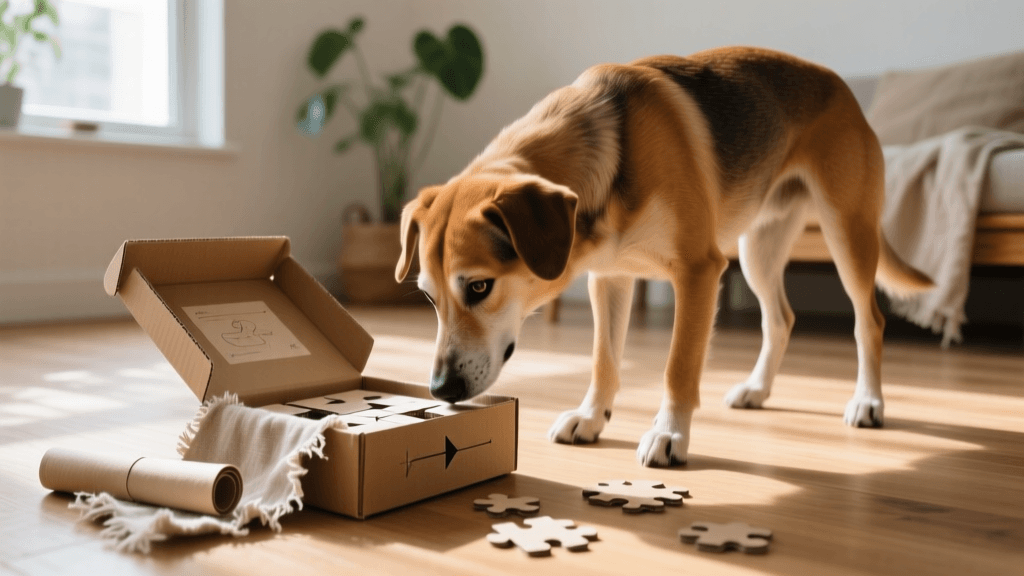
- Materials: 1 heavy-duty cardboard box (18x18 inches), 30-40 strips of fleece fabric (2 inches wide, 8 inches long), daily kibble ration.
- Cost: $0 (upcycled materials).
- Time: 10 minutes.
Setup: Punch holes in the bottom of the box and thread the fleece strips through, tying them loosely so they stand up like a shag carpet. Scatter the kibble deep within the fleece strips.
Observation Points: Observe your dog's physical posture. A dog engaged in deep scent work will exhibit a relaxed spine, soft facial muscles, and slow, deliberate movements. You may notice them sneezing or exhaling heavily; this is a mechanism to clear the nasal passages and draw in new scent particles.
Behavioral Insight: If your dog attempts to dig aggressively with their front paws rather than using their nose, they may be displaying displacement behavior or a lack of understanding of how to engage their olfactory system. Gently guide their nose to the kibble to encourage sniffing over scratching. As noted by Fear Free Happy Homes, encouraging nose-work over pawing reduces anxiety and builds confidence in reactive or nervous dogs.
Game 3: The Cardboard Foraging Castle (Assessing Frustration Tolerance)
Frustration tolerance is a key indicator of your dog's emotional regulation. How do they react when a reward is accessible but requires effort and problem-solving to extract?
- Materials: 3 empty shoe boxes, 6 toilet paper tubes, crumpled plain paper, strong-smelling treats.
- Cost: $0.
- Time: 10-15 minutes.
Setup: Place treats inside the toilet paper tubes, then fold the ends of the tubes inward. Place the tubes inside the shoe boxes, surround them with crumpled paper, and put the lids on the boxes. Arrange the boxes in a triangle.
Observation Points: This setup requires multiple steps: removing the lid, pushing past paper, extracting the tube, and unfolding the ends. Watch your dog's progression. Do they methodically dismantle the castle layer by layer? Or do they bite through the cardboard, whine, or give up after the first lid?
Behavioral Insight: A dog that methodically uses their paws and nose to extract the tubes demonstrates high frustration tolerance and cognitive persistence. Conversely, a dog that destroys the boxes aggressively or vocalizes (whining, barking) is exhibiting low frustration tolerance. This tells you that your dog becomes easily overwhelmed when the path to a reward is not immediately clear. For these dogs, you must break training tasks down into much smaller, micro-steps to prevent emotional shutdown.
Decoding Body Language: A Behavioral Observation Chart
While your dog is interacting with these DIY setups, their body language will broadcast their internal emotional state. Use this chart to decode their signals and adjust the difficulty of your homemade games accordingly.
| Canine Signal | Psychological Meaning | Handler Action Required |
|---|---|---|
| Lip Licking / Yawning | Mild stress or a calming signal indicating cognitive overload. | Pause the game. Toss a treat on the floor to reset their brain. |
| Frantic Pawing / Scratching | Frustration, lack of strategy, or displacement behavior. | Intervene gently. Lift the obstacle slightly to show them the mechanism. |
| Relaxed Open Mouth, Soft Eyes | Flow state, deep engagement, and positive emotional regulation. | Step back and remain silent. Allow them to work through the puzzle. |
| Whale Eye (Half-Moon Eye) | Anxiety, conflict, or feeling trapped by the difficulty level. | End the session immediately. The game is too hard; simplify it next time. |
| Sneezing / Snorting | Clearing nasal passages during intense olfactory processing. | No action needed. This is a sign of excellent scent engagement. |
Safety Protocols and Session Timing
When utilizing DIY enrichment, safety and timing are paramount. Unlike heavy-duty commercial rubber toys, homemade cardboard and fleece setups are not designed for aggressive chewers. Always supervise your dog during these cognitive exercises. If your dog begins to ingest cardboard or fleece, calmly interrupt the behavior and swap the homemade puzzle for a safe, edible chew.
It is also vital to consider the caloric intake when using food-based DIY puzzles. If you are using your dog's daily kibble ration in the Snuffle Box or Foraging Castle, subtract that amount from their regular meal to prevent unwanted weight gain. For high-value treats like freeze-dried liver or boiled chicken, use pieces no larger than a pea. The goal of cognitive enrichment is the mental stimulation of the hunt, not the volume of the reward. Dogs are perfectly capable of feeling satisfied by finding ten tiny crumbs scattered in a fleece box.
Furthermore, keep sessions short. Cognitive work burns significantly more energy than physical exercise. A 10-minute session of deep scent work or puzzle-solving can leave your dog as fatigued as a two-mile run. End the session while your dog is still eager to play, ensuring they retain a positive emotional association with problem-solving.
Conclusion
By shifting your perspective from simply entertaining your dog to actively observing them, you unlock a deeper understanding of their unique psychological profile. These DIY setups cost almost nothing but yield invaluable data about how your dog perceives, processes, and interacts with their environment. The next time you reach for a store-bought toy, consider grabbing a cardboard box instead, and watch what your dog's behavior reveals.
priya-sutaria
All our authors care for dogs every day — read more of their work on the authors page.