Is Viral Dog Button Training Real? A Complete FluentPet Guide
Discover if viral dog button training works. Learn how to teach your dog to speak using FluentPet soundboards with costs, timing, and expert tips.
The TikTok Phenomenon: Dogs That Talk
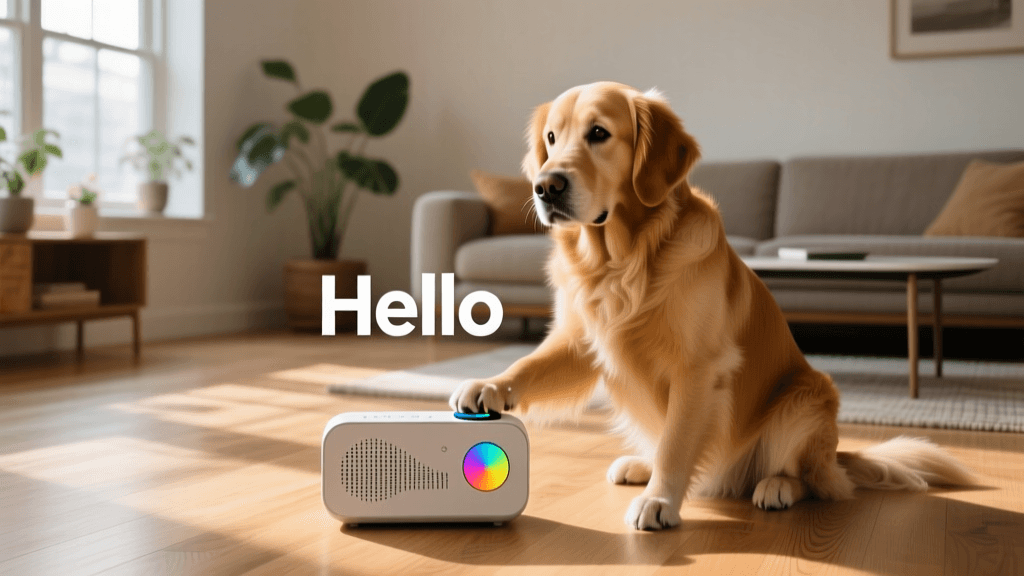
If you have spent any time on TikTok, Instagram, or YouTube Shorts over the last few years, you have likely seen videos of dogs seemingly talking to their owners using soundboards. Viral sensations like Bunny the Sheepadoodle and Stella the Blue Heeler have amassed millions of followers by pressing hexagonal buttons that play pre-recorded words like 'outside,' 'play,' and even 'love you.' But as a dog owner, you might be wondering: is this just a clever trick for social media clout, or is there real cognitive science behind viral dog button training?
In this comprehensive guide, we will break down the trending phenomenon of cognitive canine soundboard training. We will explore the science, the actual costs involved, the best products on the market, and a step-by-step methodology to teach your dog to use a soundboard, complete with timing metrics and troubleshooting tips.
The Science: Operant Conditioning or True Language?
To understand button training, we must separate viral hype from peer-reviewed science. At its core, pressing a button to receive a treat or a walk is a form of operant conditioning. The dog learns that a specific action (pressing the 'outside' button) yields a specific, desirable outcome (going to the yard).
However, researchers are investigating whether dogs can actually combine words to express novel thoughts. The TheyCanTalk research project, led by cognitive scientist Dr. Federico Rossano at the University of California, San Diego, is the largest ongoing study of animal communication using soundboards. According to their preliminary data, many dogs are not just memorizing routines; they are demonstrating spatial memory, combining words to ask questions (like 'who outside?'), and even showing signs of episodic memory.
While the scientific community is still debating whether dogs possess true language syntax, the consensus among veterinary behaviorists is clear: soundboard training provides exceptional mental enrichment. As noted by the American Kennel Club, mental stimulation tires a dog out just as effectively as physical exercise, reducing anxiety and destructive behaviors in the home.
What You Need: Costs, Products, and Setup
Before you start, you need the right equipment. The viral trend is dominated by one major brand, but there are alternatives depending on your budget. The most critical factor in soundboard training is spatial memory. Dogs remember where a button is located on the floor just as much as they remember the sound it makes. Therefore, a system that locks buttons together in a consistent grid is vastly superior to loose, recordable buzzers that slide across the hardwood floor.
Product Comparison Chart
| Product Type | Brand / Example | Estimated Cost | Pros | Cons |
|---|---|---|---|---|
| Hex-Tile Soundboard | FluentPet Starter Kit | $149.95 | Locks together, spatial memory support, durable. | Higher upfront cost. |
| Recordable Buzzers | Generic Amazon Buzzers | $25.00 (Pack of 4) | Very cheap, easy to record. | Slides on floors, no grid system, easily chewed. |
| RFID Smart Tags | Custom DIY Setup | $80.00+ | Infinite vocabulary, tracks data. | Requires heavy tech setup, not portable. |
For serious training, the FluentPet Starter Kit is the gold standard. It includes a hexagonal tile mat, six recordable buttons, and a guide to target training. The tiles are designed based on the FitzGerald hex-grid system, which allows you to expand the board infinitely while keeping the spatial layout consistent for your dog's cognitive mapping.
Step-by-Step: Teaching Your First Buttons
Do not simply place a board in front of your dog and expect them to start talking. You must build a foundation using positive reinforcement. Here is the exact protocol used by professional trainers to introduce the first two buttons: 'Outside' and 'Play.'
Step 1: Target Training (Days 1 to 7)
Before introducing words, your dog must learn to press the physical tile. Place a single, unrecorded hex tile on the floor. The moment your dog sniffs or paws at it, click a clicker (or say 'Yes!') and give a high-value treat. Repeat this until your dog reliably boops the tile with their nose or paw on command. This usually takes about 3 to 7 days of short, daily sessions.
Step 2: Modeling the Behavior (Days 8 to 14)
Now, introduce the recorded word. Let us use 'Outside.' Keep the button right next to the door you use for potty breaks. Every single time you take the dog outside, point to the button, press it yourself so the dog hears the word 'Outside,' and immediately open the door. You are modeling the connection between the sound, the action, and the reward. Do not force the dog's paw onto the button; this causes frustration and aversion.
Step 3: Capturing and Shaping (Days 15+)
Once the dog understands the routine, wait for them to initiate. Stand by the door. If they look at the button, wait. If they sniff it, wait. The second they press it, celebrate wildly, say 'Yes! Outside!' and open the door. Consistency is paramount. You must honor the button press every single time during the learning phase, even if they just went out ten minutes ago.
Timing, Treats, and Metrics
Success in button training relies heavily on timing and reward value. Here are the specific metrics you should aim for during the conditioning phase:
- Session Length: Keep training sessions to exactly 5 to 10 minutes. Dogs experience cognitive fatigue quickly when learning a new modality of communication.
- Frequency: 3 to 4 sessions per day, spaced out by at least two hours to allow for memory consolidation during rest.
- Reward Value: Ditch the dry kibble. Use soft, high-value treats that can be consumed in under two seconds. Zuke's Mini Naturals (costing roughly $6 per 6oz bag) or boiled chicken breast are ideal because they do not require excessive chewing, which breaks the dog's focus and disrupts the operant conditioning loop.
- Latency: When modeling, press the button and initiate the action within 0.5 seconds. Any longer, and the dog may not associate the auditory cue with the environmental change.
Common Pitfalls and Troubleshooting
As with any viral trend, many owners buy the gear, fail to see results in a week, and abandon the project. Here is how to avoid the most common pitfalls:
Moving the Buttons: Remember spatial memory. If you vacuum and move the soundboard three inches to the left, your dog will press the empty floor where the button used to be. Always use a non-slip mat or painter's tape to mark the exact footprint of the soundboard.
Over-Prompting: Staring at your dog, pointing at the button, and repeatedly saying 'press it' creates prompt dependency. The dog learns to wait for your cue rather than initiating communication. Model the behavior, then step back and look away. Give them the agency to choose.
The Extinction Burst: If you decide to stop honoring a button (for example, they press 'play' at 3:00 AM and you ignore it), the dog will likely press it harder, faster, and more frantically before giving up. This is called an extinction burst. You must remain completely neutral and ignore the behavior during this phase, or you will accidentally reinforce the frantic button-mashing.
Button Stacking: If your dog learns 'outside' and 'play,' they might start pressing both rapidly. This is not them saying 'I want to play outside.' It is simply them hedging their bets, pressing every known button to see which one yields a reward. To fix this, only honor the specific button pressed, and if they mash multiple, wait for a clear, single press before reacting.
Final Thoughts on the Viral Trend
Is viral dog button training real? Yes, but perhaps not in the deeply philosophical way social media captions imply. Your dog is not necessarily pondering the existential dread of the mailman; they are utilizing a highly sophisticated form of operant conditioning to communicate their desires and access the resources they value.
However, dismissing it as a mere trick does a disservice to the profound cognitive benefits it offers. Soundboard training bridges the interspecies communication gap, reduces behavioral issues born from frustration, and provides a level of mental enrichment that a simple walk around the block cannot match. If you have the patience, the high-value treats, and the consistency to model the behavior, your dog might just have a lot more to say than you ever imagined.
jonas-cole
All our authors care for dogs every day — read more of their work on the authors page.