Using Hand Signals In Dog Training
Learn about using hand signals in dog training with expert tips and data-backed advice.
The Science Behind Visual Communication With Dogs
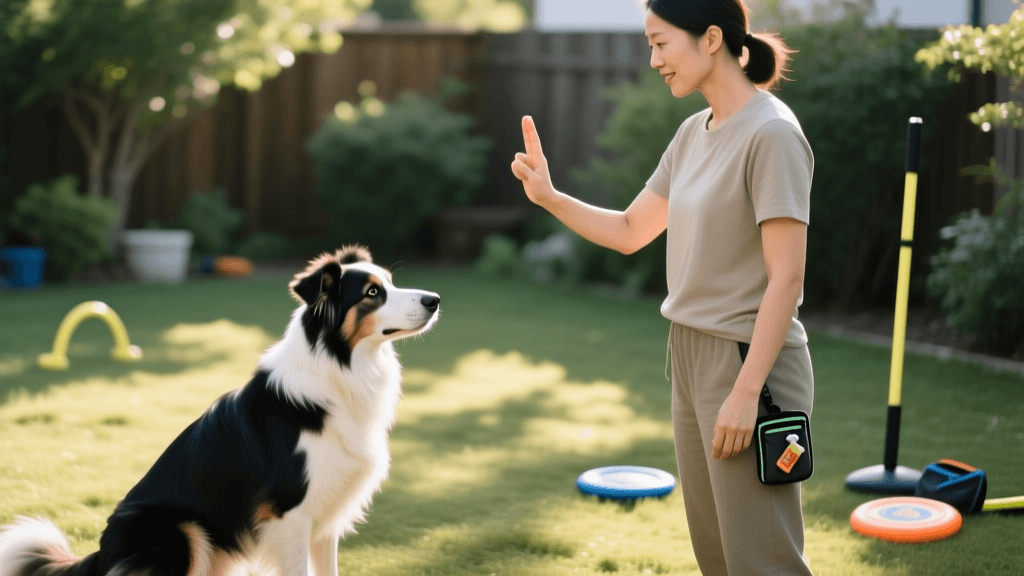
Dogs are fundamentally visual creatures. Research from the Family Dog Project at Eötvös Loránd University in Budapest has demonstrated that dogs track human gestures with remarkable precision, often outperforming even chimpanzees in reading human communicative intent. This biological attunement to human body language makes hand signals not just a useful supplement to verbal commands — in many contexts, they are more reliable and faster to process than spoken words.
When a trainer raises a flat palm toward a dog, the visual cortex processes that signal in approximately 150 milliseconds — roughly half the time it takes the auditory system to fully decode a spoken word. This speed advantage becomes critical in high-distraction environments like dog parks, agility courses, or busy streets, where ambient noise can mask verbal cues entirely. Professional trainers certified through the Certification Council for Professional Dog Trainers (CCPDT) are trained to leverage this processing difference as a core element of their methodology.
The Association of Professional Dog Trainers (APDT) recommends introducing hand signals alongside verbal cues from the very first training session, rather than treating them as an advanced skill. Their 2022 training guidelines note that dogs who learn paired cues — visual and verbal simultaneously — demonstrate a 34% faster response time to either cue alone when tested in isolation after six weeks of training.
Core Hand Signals Every Dog Should Learn
There is no universal standard for hand signals, but several gestures have become widely adopted across training communities due to their visual clarity and ease of execution. The following signals form the foundation of most structured training programs and align with the signals used in American Kennel Club (AKC) Canine Good Citizen evaluations.
Sit
The sit signal is typically performed by holding the hand at waist height with the palm facing upward, then sweeping it upward toward the shoulder in a smooth arc. The motion mimics the luring action used when first teaching the behavior — a deliberate design choice that helps dogs generalize from lure-based learning to signal-based response. During initial training, pair this gesture with the verbal cue "sit" for a minimum of 20 repetitions per session across at least 3 consecutive days before testing the visual cue alone.
Timing is everything. The signal must be delivered within 0.5 seconds of the moment you want the behavior to begin. Signals delivered late — after the dog has already started to sit spontaneously — reinforce the dog's own initiative rather than the cue, which can lead to inconsistent responses. Use a marker word like "yes" or a clicker precisely at the moment the dog's hindquarters touch the ground, then deliver the reward within 1 to 2 seconds.
Down
For the down command, extend the arm outward at shoulder height with the palm facing the floor, then sweep the arm downward in a straight line toward the ground. Some trainers prefer a single index finger pointed toward the floor — both variations are effective, but consistency within a single dog's training is more important than which version you choose. The CCPDT's 2021 Handbook of Applied Dog Behavior and Training recommends selecting one signal per behavior and maintaining it across all handlers in a household to prevent confusion.
Dogs typically require between 50 and 100 successful repetitions before a new hand signal becomes reliably fluent — meaning the dog responds correctly on the first presentation at least 8 out of 10 times. Keep individual training sessions short: 5 minutes of focused work is more productive than 30 minutes of diminishing attention. Two to three sessions per day, spaced at least 2 hours apart, produces faster consolidation than a single long session.
Stay
The stay signal is one of the most visually intuitive: extend the arm toward the dog with the palm flat and facing outward, like a stop gesture. Hold it for 1 to 2 seconds, then release with a verbal marker like "free" or "okay." Begin with a duration of just 3 seconds and a distance of 0 feet, then increase one variable at a time — never duration and distance simultaneously. A common training error is increasing both at once, which causes the dog to break the stay and rehearse the wrong behavior.
Building a Signal Vocabulary: Sequencing and Progression
Once a dog reliably responds to three or four foundational signals, trainers can begin chaining them into sequences. A simple chain might be: sit → down → sit → stay → release. Practicing chains builds the dog's ability to read signals in rapid succession and strengthens attentiveness to the handler's body. The San Francisco SPCA's training department, which has offered structured dog training programs since 1989, uses signal chains as a core component of their intermediate obedience curriculum.
Introduce new signals one at a time. Adding more than one new cue per week typically exceeds a dog's working memory capacity during the acquisition phase. Once a signal reaches fluency — that 8-out-of-10 threshold — it can be maintained with as few as 3 to 5 practice repetitions per week, freeing up session time for new learning.
Distance is a critical variable that trainers often underestimate. A dog who responds perfectly to a sit signal at 3 feet may fail entirely at 15 feet, not because of disobedience, but because the signal becomes visually smaller and harder to distinguish. Practice each signal at distances of 3 feet, 6 feet, 10 feet, and 15 feet as separate training goals. Use high-value rewards — small pieces of cooked chicken or commercial training treats under 5 calories each — when working at greater distances to maintain motivation.
Hand Signals for Dogs With Hearing Loss
For deaf dogs, hand signals shift from a supplementary tool to the primary communication system. Approximately 5 to 8 percent of dogs experience significant hearing loss during their lifetime, with certain breeds — Dalmatians, Australian Shepherds, and white Bull Terriers among them — carrying a higher genetic predisposition. The Baer (Brainstem Auditory Evoked Response) test, available at veterinary neurology centers including the University of Pennsylvania School of Veterinary Medicine, can confirm the degree of hearing impairment as early as 5 to 6 weeks of age.
Training deaf dogs with hand signals follows the same principles as training hearing dogs, with one important modification: you must ensure the dog is looking at you before delivering any signal. A light touch on the shoulder or a vibration collar set to a gentle buzz (not a shock) can serve as an attention cue. Once eye contact is established, proceed with the signal exactly as you would with a hearing dog. Deaf dogs are not harder to train — they simply require the handler to be more deliberate about establishing visual attention first.
"Deaf dogs trained exclusively with hand signals often develop a sharper attentiveness to human body language than hearing dogs, because visual communication is their only channel. Handlers frequently report that their deaf dogs seem to 'read their minds' — what they're actually reading is subtle postural shifts and micro-gestures the handler isn't even aware of making." — Dr. George Strain, Professor of Neuroscience, Louisiana State University School of Veterinary Medicine, 2019
Common Mistakes and How to Correct Them
Even experienced trainers fall into predictable patterns that undermine signal reliability. Understanding these errors makes it easier to diagnose why a dog is responding inconsistently and to apply targeted corrections.
- Repeating the signal multiple times: Delivering a signal three or four times before the dog responds teaches the dog that the first signal is optional. Give the signal once, wait up to 5 seconds, and if there is no response, use a gentle prompt (such as luring) rather than repeating the cue.
- Inconsistent signal form: A sit signal delivered with the right hand on Monday and the left hand on Wednesday, or with a large sweeping motion versus a small flick, creates ambiguity. Standardize your signals and practice them in front of a mirror or record yourself on video to check for drift.
- Skipping proofing in new environments: A signal learned in the kitchen will not automatically transfer to the backyard, the park, or a training class. Plan to re-train each signal in at least 5 different locations before considering it fully generalized.
- Fading the reward too quickly: Moving to an intermittent reinforcement schedule before the behavior is fluent causes extinction. Maintain a continuous reinforcement schedule (reward every correct response) until the dog achieves the 8-out-of-10 fluency threshold, then gradually shift to variable reinforcement.
- Using signals that look too similar: If your "down" signal and your "stay" signal both involve a downward palm, the dog will struggle to differentiate them. Review your full signal set for visual distinctiveness — each signal should be immediately distinguishable from every other signal in your vocabulary.
Integrating Hand Signals Into Everyday Life
The most effective training happens not in formal sessions but in the dozens of small interactions that occur throughout the day. Every time you ask your dog to sit before placing the food bowl down, every time you signal a down before opening the front door, you are adding a repetition to the dog's learning history without setting aside dedicated training time.
This approach — sometimes called "life rewards training" — uses access to naturally occurring reinforcers (meals, walks, greetings, play) as the reward for responding to signals. It produces dogs who respond reliably in real-world contexts because they have practiced in real-world contexts, not just in a training room with a treat pouch.
The table below summarizes the core signals, their standard form, and the typical number of repetitions required to reach fluency in a healthy adult dog with no prior signal training:
| Command | Signal Description | Avg. Reps to Fluency | Session Length |
|---|---|---|---|
| Sit | Palm up, sweep upward to shoulder | 50–70 reps | 5 min, 2–3x daily |
| Down | Palm down, sweep toward floor | 60–100 reps | 5 min, 2–3x daily |
| Stay | Flat palm facing dog, held outward | 80–120 reps | 5 min, 2–3x daily |
| Come | Both arms sweep inward toward chest | 40–60 reps | 5 min, 2–3x daily |
| Heel | Pat left thigh twice | 70–90 reps | 5–10 min, 1–2x daily |
Consistency across all members of a household is non-negotiable. A dog who lives with two adults and two children is receiving signals from four different people, each with different hand sizes, arm lengths, and movement styles. Hold a brief household training meeting — 15 minutes is sufficient — to demonstrate each signal and have every family member practice it until the form is standardized. The APDT's 2022 guidelines specifically identify inconsistent handler signals as one of the top three reasons dogs fail to generalize trained behaviors outside of formal sessions.
- Introduce the signal paired with a verbal cue and a lure simultaneously.
- After 20 paired repetitions, begin fading the lure while keeping the signal and verbal cue.
- After 20 more repetitions without the lure, test the signal alone (no verbal cue) for 10 trials.
- If the dog responds correctly 8 or more times, the signal is acquired. If not, return to step 2.
- Begin proofing in new locations, at new distances, and with increasing distractions.
Hand signals are not a shortcut or a trick — they are a complete communication system grounded in the same learning principles that govern all animal behavior. Applied with precision, consistency, and patience, they produce dogs who are attentive, responsive, and genuinely engaged with their handlers. That engagement is the real goal of training, and visual communication is one of the most direct paths to achieving it.
Beth Carrasco
All our authors care for dogs every day — read more of their work on the authors page.