Understanding Dog Anxiety: Best Calming Products Guide
Discover how to read canine stress signals and choose the best calming products, from pheromone diffusers to compression wraps, for your anxious dog.
Decoding Canine Stress: Why Your Dog Needs Calming Aids
As dog owners, we often misinterpret our pets' body language, assuming that a wagging tail always means happiness or that a dog hiding under the bed is just being quirky. In reality, canine anxiety is a complex psychological state driven by the autonomic nervous system. When a dog perceives a threat—whether it is a thunderstorm, fireworks, or the jingle of your car keys signaling your departure—their brain triggers a fight-or-flight response. Cortisol and adrenaline flood their system, leading to visible stress signals such as lip licking, yawning, 'whale eye' (showing the whites of their eyes), pacing, panting, and destructive behavior.
According to the ASPCA, separation anxiety and noise phobias are among the most common behavioral issues reported by veterinarians. Understanding the root cause of your dog's stress is the first step toward helping them. However, behavioral modification takes time. In the interim, scientifically backed calming products can help lower your dog's baseline arousal levels, making them more receptive to training and providing immediate relief from acute panic. This buyer's guide bridges the gap between canine psychology and practical product solutions, helping you choose the right tools to soothe your anxious companion.
The Science of Dog Appeasing Pheromones (DAP)
Pheromones are chemical signals that animals use to communicate with one another. In the canine world, a nursing mother releases a specific pheromone to reassure her puppies that they are safe, warm, and cared for. Synthetic versions of this chemical, known as Dog Appeasing Pheromones (DAP), have been engineered to trigger that same innate sense of security in adult dogs.
Top Pick: Adaptil Calm Home Diffuser
The Adaptil Calm Home Diffuser is the gold standard for environmental anxiety management. It plugs directly into a standard wall outlet and heats a liquid refill, dispersing synthetic pheromones into the air. Coverage and Cost: A single diffuser covers up to 700 square feet and lasts for 30 days. The starter kit typically costs between $25 and $30, with refills running about $15 to $20.
Psychological Application: Pheromones do not sedate your dog; they simply alter their emotional perception of the environment. For dogs with mild to moderate separation anxiety, plugging the diffuser into the room where your dog spends the most time can significantly reduce pacing and vocalization. The VCA Hospitals note that while pheromones are highly effective for environmental stressors, they work best when paired with a structured desensitization training program.
Pro Tip: Never plug the diffuser in behind furniture or near an open window, as this restricts airflow and dissipates the pheromones before they can effectively blanket the room.
Compression Wraps: The Psychology of Gentle Pressure
The concept of using deep pressure therapy to calm the nervous system is not unique to dogs; it is widely used in human psychology, notably popularized by Dr. Temple Grandin's 'hug machine' for individuals with autism. Gentle, constant pressure stimulates the release of endorphins and oxytocin while simultaneously lowering the heart rate and reducing cortisol levels.
Top Pick: The Thundershirt
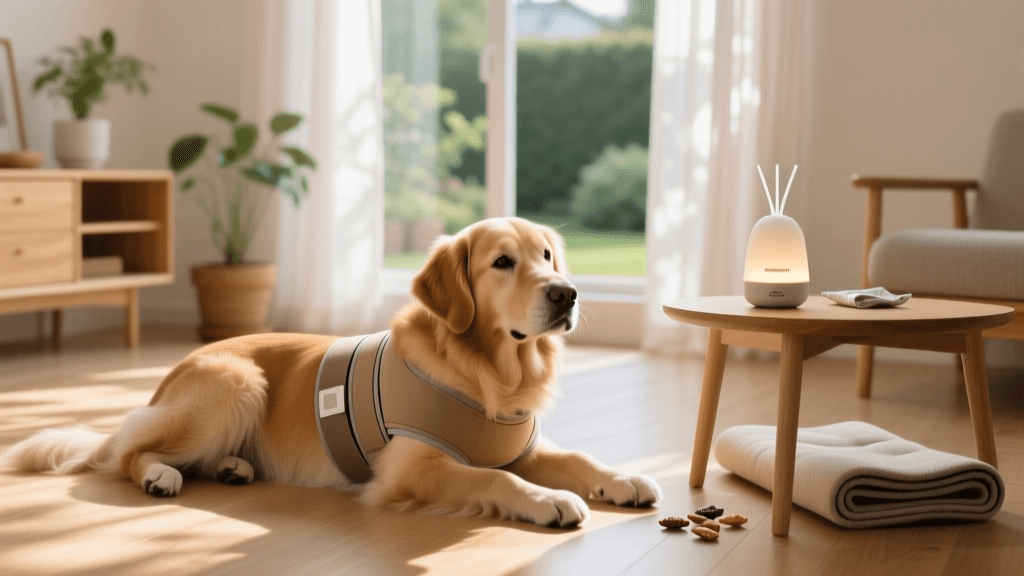
The Thundershirt is a patented compression wrap designed to apply a gentle, constant hugging pressure to a dog's torso. Sizing and Cost: To ensure the psychological benefit of the wrap, the fit must be snug but not restrictive. You must measure your dog's chest girth at the widest part just behind their front legs. Prices range from $40 to $50 depending on the size and material (cotton for breathability, polyester for durability).
Psychological Application: Compression wraps are exceptionally effective for acute noise phobias (thunderstorms, fireworks) and travel anxiety. However, a common mistake owners make is only bringing out the Thundershirt when the dog is already terrified. This creates a negative classical conditioning loop where the shirt becomes a predictor of trauma. To avoid this, put the Thundershirt on your dog during highly positive, low-stress activities—like eating a high-value meal or playing in the yard—for several days before introducing it during a stressful event.
Foraging and Licking: Tapping into Instinctual Calm
Dogs are natural foragers and scavengers. In the wild, they spend up to 80% of their waking hours searching for and consuming food. Modern domestic life often reduces this to a two-minute kibble drop in a stainless steel bowl, leaving a massive psychological void that often manifests as anxiety, hyperactivity, or destructive chewing.
Top Pick: LickiMat and Snuffle Mats
Licking and sniffing are inherently self-soothing behaviors for dogs. The repetitive motion of licking stimulates the canine brain to release endorphins, acting as a natural tranquilizer. Similarly, engaging the olfactory system (sniffing) requires intense mental focus, which tires the brain out faster than physical exercise and lowers overall arousal levels.
- LickiMat (Soother or Buddy models): Made from non-toxic, food-grade TPR, these mats feature textured surfaces designed to hold soft foods like plain pumpkin puree, xylitol-free peanut butter, or plain Greek yogurt. Cost: $10 to $15. Actionable Advice: Spread the food thinly and freeze the mat for two hours. This extends the licking session from 5 minutes to over 20 minutes, providing a crucial window of calm during your departure routine.
- Snuffle Mats: These are fabric mats with hundreds of fleece strips that mimic a grassy field. You hide dry kibble or small training treats deep within the strips, forcing your dog to use their nose to forage. Cost: $20 to $35. Actionable Advice: Use a snuffle mat for 15 minutes before a known stressor (like guests arriving) to shift your dog's brain from an anxious state to a focused, problem-solving state.
Buyer's Comparison Chart: Top Calming Products
Choosing the right product depends heavily on your dog's specific triggers and the nature of their anxiety. Use the table below to compare the top behavioral aids on the market.
| Product Name | Product Type | Best Used For | Estimated Price | Time to See Results |
|---|---|---|---|---|
| Adaptil Calm Diffuser | Synthetic Pheromone | General home anxiety, mild separation stress, new environment adjustment | $25 - $30 | 7 to 14 days of continuous use |
| Thundershirt | Compression Wrap | Acute noise phobias (fireworks, thunder), veterinary visits, car travel | $40 - $50 | Immediate (if properly conditioned) |
| LickiMat Soother | Behavioral Enrichment | Departure routine distraction, post-surgery confinement, crate training | $10 - $15 | Immediate (during use) |
| Snuffle Mat | Olfactory Enrichment | Hyperactivity, pre-guest arrival focus, general mental fatigue | $20 - $35 | Immediate (during use) |
| Calming Chews (e.g., Zesty Paws) | Nutritional Supplement | Mild situational stress, travel, grooming appointments | $25 - $30 | 30 to 45 minutes post-ingestion |
Implementation: Timing and Routine are Everything
Understanding your dog's psychology means recognizing that they are associative learners. If you only utilize calming products during moments of peak terror, the products themselves will become tainted by the negative experience. The American Kennel Club (AKC) emphasizes that creating a 'safe space' or a 'calm zone' is vital for anxious dogs. This zone should be equipped with your Adaptil diffuser, a comfortable bed, and a LickiMat, and it must be accessible to your dog at all times, not just when they are scared.
Furthermore, consider the timing of your own behavior. Dogs are incredibly adept at reading human micro-expressions and body tension. If you anxiously rush to give your dog a Thundershirt and a calming chew while frantically checking the weather radar for a thunderstorm, your dog will mirror your panic. Practice your calming product routines on sunny, quiet days. Keep your voice low, your movements slow, and your breathing deep. Your calm energy, combined with the right behavioral tools, is the most powerful anxiety-reducing product you possess.
When Products Aren't Enough: Seeking Professional Help
While over-the-counter calming aids, pheromones, and enrichment tools are fantastic for mild to moderate stress, they are not a cure-all for severe clinical anxiety. If your dog is exhibiting self-mutilation, severe aggression born of fear, or refusing to eat for days due to separation distress, it is time to look beyond the pet store aisle.
In these cases, consult a Veterinary Behaviorist (a DACVB diplomate) or a certified applied animal behaviorist (CAAB). Severe anxiety often requires a combination of prescription psychotropic medications (such as fluoxetine or clomipramine) alongside rigorous, professional behavior modification protocols. Calming products can still be used in conjunction with veterinary treatment, but they should be viewed as supportive tools rather than primary medical interventions. By understanding the depth of your dog's emotional experience and providing them with scientifically backed support, you can help your canine companion navigate a stressful world with confidence and peace.
anouk-beaumont
All our authors care for dogs every day — read more of their work on the authors page.