Why Dogs Chew: Canine Psychology and Home Dog-Proofing
Discover the psychology behind destructive chewing and learn actionable, room-by-room dog-proofing strategies to protect your home and your dog.
The Intersection of Canine Psychology and Home Environment
Every dog owner has experienced the sinking feeling of walking into a room to find a favorite pair of shoes destroyed or the corner of a drywall partition chewed away. While it is easy to attribute this behavior to a dog being 'naughty' or 'spiteful,' modern canine behavioral science tells a vastly different story. Destructive chewing is rarely an act of malice; rather, it is a symptom of an unmet psychological need, a natural developmental stage, or an environmental trigger that conflicts with a dog's innate instincts.
To successfully dog-proof your home, you must first understand why your dog is compelled to destroy it. By aligning your home environment with your dog's psychological needs, you can prevent property damage, protect your pet from toxic ingestion, and foster a calmer, happier household. This guide explores the root causes of destructive chewing and provides a comprehensive, room-by-room dog-proofing strategy complete with specific product recommendations and measurements.
The Psychology Behind Why Dogs Chew
Chewing is a fundamental, hardwired behavior in dogs. In the wild, canines use their mouths to explore their environment, carry food, and maintain dental health. In a domestic setting, however, the items they choose to chew often clash with human living spaces. According to the American Kennel Club (AKC), understanding the specific motivation behind the chewing is the first step toward effective management.
1. Puppy Teething and Oral Exploration
Between the ages of three and six months, puppies lose their deciduous (baby) teeth and grow their adult teeth. This process causes significant gum inflammation and discomfort. Puppies chew to soothe their aching gums. Furthermore, puppies lack hands; they use their mouths as tactile sensors to understand the texture, taste, and structural integrity of objects in their environment.
2. Boredom and Excess Energy
Dogs are intelligent, active animals bred for specific jobs—herding, retrieving, guarding, or hunting. When a dog is left alone for long periods without mental stimulation or adequate physical exercise, they accumulate excess kinetic energy. Chewing releases endorphins in a dog's brain, providing a self-soothing mechanism to cope with the frustration of under-stimulation.
3. Separation Anxiety and Stress Relief
If your dog's chewing is concentrated around exit points (door frames, window sills) or items heavily scented with your odor (shoes, worn clothing, remote controls), the root cause is often separation anxiety. The repetitive motion of chewing acts as a coping mechanism for severe psychological distress. In these cases, dog-proofing is a safety measure, but behavioral modification and veterinary intervention are required to address the underlying panic.
The Myth of Spite: Dogs do not possess the complex cognitive ability to feel 'spite' or plot revenge. When a dog chews your favorite belongings while you are away, they are reacting to anxiety, boredom, or instinct, not trying to punish you for leaving. Scolding a dog hours after the fact only creates fear, not understanding.
Room-by-Room Dog-Proofing Strategy
Effective dog-proofing requires a proactive approach to environmental management. By removing temptations and securing hazards, you set your dog up for success. Here is how to secure the most critical areas of your home.
The Living Room: High Traffic and High Temptation
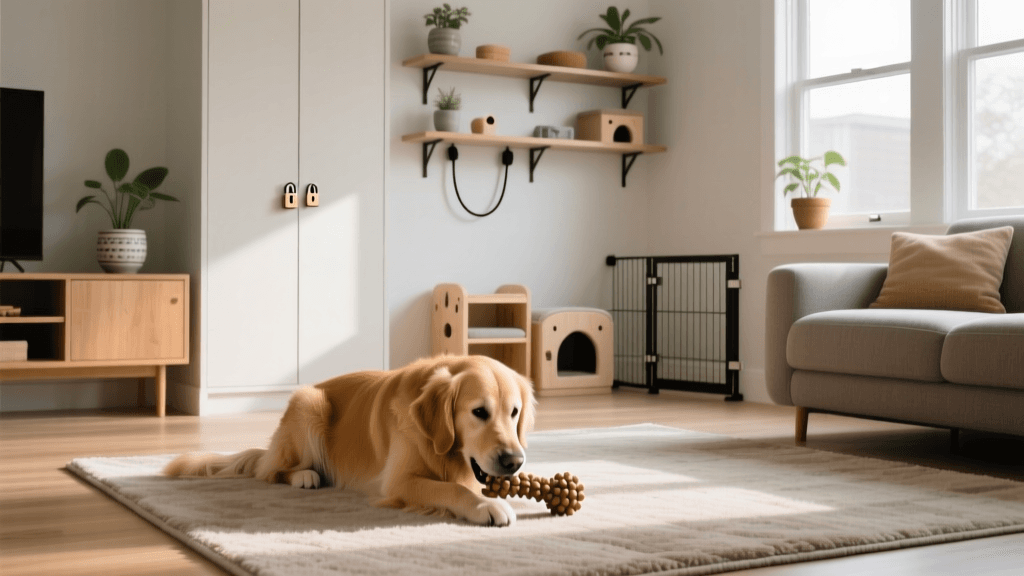
The living room is filled with electrical cords, upholstered furniture, and small decorative items. Electrical cords are particularly dangerous; a single bite can cause severe oral burns or fatal electrocution.
- Cord Management: Never leave cords exposed. Use 1/2-inch split loom wire tubing (Cost: ~$15 for 10 feet) to encase power strips and television cables. The hard, corrugated plastic is highly unappealing to chew and prevents teeth from reaching the wires.
- Furniture Protection: If your dog targets the wooden legs of coffee tables, apply a physical barrier. Products like the CLAWGUARD Furniture Protector (Cost: ~$25) wrap around table legs. Alternatively, use double-sided training tape on the edges of fabric sofas; dogs despise the sticky sensation on their paws and snouts.
- Remote Controls and Glasses: Items that smell like you or are made of soft plastics are prime targets. Use a multi-compartment caddy on the coffee table to store remotes and reading glasses out of reach but within your sight.
The Kitchen: Toxic Hazards and Scavenging
Kitchens contain numerous items toxic to dogs, including xylitol (found in sugar-free gums), chocolate, onions, and grapes. The Pet Poison Helpline reports that kitchen scavenging is one of the leading causes of canine toxicological emergencies.
- Cabinet Security: Install magnetic childproof latches (Cost: ~$20 for a 12-pack) on lower cabinets containing cleaning supplies or human medications. Dogs with high intelligence and dexterity, like Poodles or Huskies, can easily learn to nudge open standard lever handles.
- Trash Can Solutions: Do not rely on a dog's 'good behavior' around an open trash can. Invest in a heavy-duty, step-operated trash can like the simplehuman 50-Liter Semi-Round Kitchen Step Can (Cost: ~$120). The weighted base prevents tipping, and the step-latch mechanism is impossible for a dog to trigger with their paws or snout.
The Bedroom: Scent-Heavy Sanctuary
Your bedroom smells intensely of you, making it a magnet for dogs seeking comfort or experiencing separation anxiety.
- Footwear and Clothing: Never leave shoes, socks, or laundry on the floor. Use a hamper with a secure, locking lid and store shoes on a closet shelf at least 36 inches off the ground. Ingested socks can cause life-threatening intestinal blockages requiring emergency surgery costing upwards of $3,000.
- Door Frame Protection: If your dog scratches and chews the bedroom door when shut out, install an acrylic scratch shield like the K9 Shield Door Protector (Cost: ~$35). This smooth surface prevents them from gaining the traction needed to chew or splinter the wood.
Essential Dog-Proofing Products & Behavioral Interventions
Dog-proofing is only half the equation. You must simultaneously provide appropriate outlets for your dog's chewing instincts. The table below outlines specific triggers, their psychological roots, and the combined environmental and behavioral solutions.
| Chewing Trigger | Psychological Root | Dog-Proofing Solution | Behavioral Intervention |
|---|---|---|---|
| Baseboards & Drywall | Boredom, Teething, or Pica | Apply Grannick's Bitter Apple Spray (~$12) to baseboards daily for two weeks. | Provide a KONG Classic stuffed with frozen peanut butter to redirect oral fixation. |
| Couch Cushions & Fabric | Nesting instinct, Anxiety, or Prey drive (shredding) | Use Carlson Pet Products Extra Tall Walk-Thru Gate (36" high, ~$50) to restrict access when unsupervised. | Introduce 'Snuffle Mats' and puzzle toys to satisfy foraging and shredding instincts safely. |
| Door Frames & Window Sills | Separation Anxiety, Barrier Frustration | Install Acrylic Door Scratch Shields to prevent wood splintering and ingestion. | Implement desensitization training for departures; consult a veterinary behaviorist for anti-anxiety medication if needed. |
| Shoes & Personal Items | Scent-seeking, Comfort, Teething | Store all items in closed closets or hampers. Use baby gates to block bedroom access. | Trade inappropriate items for high-value chews like Bully Sticks or Yak Cheese Chews. |
Managing the Environment vs. Punishing the Dog
A common mistake among new dog owners is relying on punishment to stop destructive behavior. According to the ASPCA, dogs live in the moment. If you come home to a destroyed sofa and scold your dog, they do not associate your anger with the chewing that happened three hours ago. Instead, they associate your anger with your arrival, which can exacerbate separation anxiety and lead to submissive urination or fearful aggression.
Environmental management—commonly known as dog-proofing—is a humane, stress-free alternative to punishment. By using baby gates, crate training, and physical barriers, you remove the dog's ability to practice the unwanted behavior. Every time a dog successfully chews an inappropriate item, the behavior is self-rewarding and becomes more deeply ingrained in their neural pathways. Dog-proofing breaks this cycle.
The Importance of Appropriate Chew Alternatives
You cannot simply tell a dog not to chew; you must tell them what to chew. A well-dog-proofed home must be stocked with a variety of textures to satisfy different chewing moods:
- For Aggressive Chewers: Nylon bones (e.g., Benebone Wishbone, Cost: ~$18) or natural antlers. Ensure the chew is larger than the dog's muzzle to prevent choking.
- For Mental Stimulation: Rubber puzzle toys (e.g., West Paw Toppl, Cost: ~$22) that can be interlocked and frozen with low-sodium chicken broth.
- For Edible Chewing: Digestible options like collagen sticks or sweet potato chews, which satisfy the urge to consume while being gentle on the digestive tract.
Conclusion: A Proactive Approach to Canine Co-Habitation
Understanding your dog's psychology is the foundation of a harmonious home environment. Destructive chewing is a communication tool—a signal that your dog is teething, bored, anxious, or simply acting on millennia of breed-specific instincts. By implementing strategic, room-by-room dog-proofing measures, utilizing the right physical barriers, and providing abundant, appropriate chewing outlets, you protect both your property and your pet's well-being. Remember, a well-managed environment is the kindest and most effective form of training you can offer your canine companion.
aaron-whyte
All our authors care for dogs every day — read more of their work on the authors page.