Border Collie vs. Australian Shepherd: Breed Selection Guide
Border Collie vs. Australian Shepherd: Compare their instincts, energy needs, and psychology to choose the right herding breed for your active lifestyle.
The Psychology of Herding Breeds
Choosing a dog is a monumental decision, but selecting a herding breed requires a deep understanding of canine psychology and instinctual behavior. Herding dogs are not merely energetic; they are hardwired with a modified predatory motor sequence. In a wild canine, this sequence follows a strict pattern: eye, stalk, chase, grab, bite, kill, and consume. Through centuries of selective breeding, herding breeds have been genetically engineered to amplify the 'eye,' 'stalk,' and 'chase' phases while heavily suppressing the 'grab' and 'kill' phases. This results in a dog that is intensely focused on movement, capable of controlling livestock (or children, cats, and bicycles) with sheer psychological pressure.
For prospective owners caught between the two most popular herding breeds in the world, the decision often comes down to the Border Collie versus the Australian Shepherd. While they may look similar to the untrained eye and share a reputation for high intelligence, their behavioral profiles, body language, and psychological needs differ significantly. Understanding these nuances is critical to preventing behavioral issues such as neurosis, reactivity, and destructive anxiety.
The Border Collie: The Intense Workaholic
Instincts and Body Language
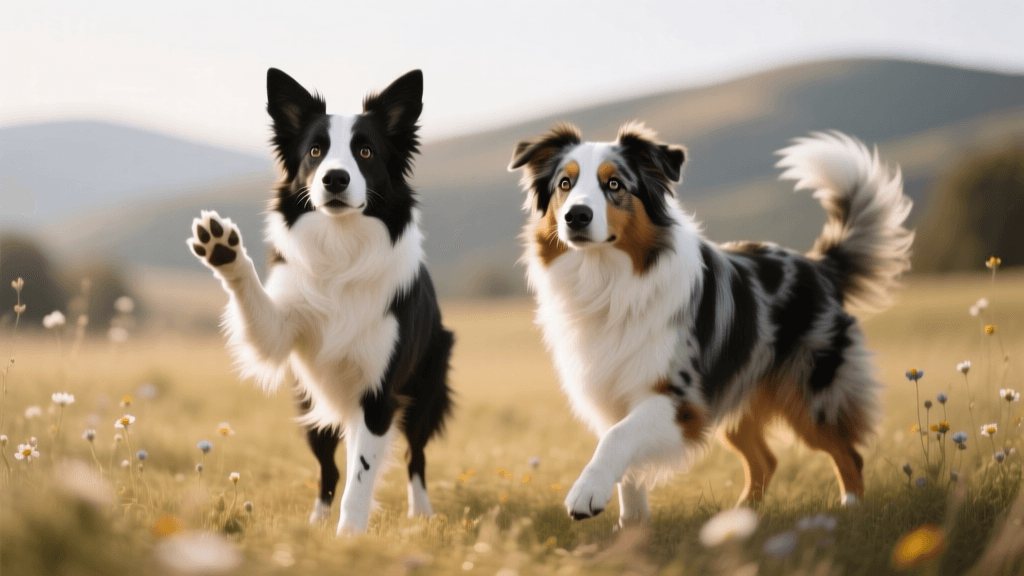
The Border Collie is widely considered the most intelligent dog breed, but their genius is highly specialized. According to the American Kennel Club (AKC), the Border Collie is the quintessential 'strong-eyed' herder. This means they control livestock using an intense, unblinking stare combined with a low, predatory crouch. When observing a Border Collie in a park, you will notice this same body language directed at squirrels, tennis balls, or even running children. Their ears typically drop forward, their tail is held low or straight out for balance, and their weight is shifted to their hindquarters, ready to sprint at a moment's notice.
Psychological Vulnerabilities
Because their brains are wired to detect micro-movements, Border Collies are highly susceptible to visual overstimulation. Without proper psychological management, they can develop obsessive-compulsive behaviors such as shadow chasing, light fixation, or fly snapping. They are sensitive to their owner's emotional state and thrive on clear, consistent, and positive reinforcement training. They do not just want to exercise; they need a 'job' that requires complex problem-solving.
The Australian Shepherd: The Versatile Athlete
Instincts and Body Language
Despite their name, the Australian Shepherd was developed in the American West. Unlike the Border Collie, the Aussie is a 'loose-eyed' herder. They work in a more upright posture, using their physical presence, barking, and occasional nipping to move stubborn livestock over long distances. The AKC breed standard highlights their versatility and protective nature. Aussies are generally more vocal than Border Collies and possess a stronger guarding instinct, making them naturally more wary of strangers and more protective of their home and family.
Psychological Vulnerabilities
Australian Shepherds are deeply bonded to their 'flock' (their human family) and are prone to separation anxiety if left alone for long periods without adequate mental enrichment. Their body language is highly expressive; an alert Aussie will have pricked or semi-pricked ears, a swishing tail (even if they have a natural bobtail), and a bouncy, energetic gait. When stressed or under-stimulated, they are more likely to become vocal, pace relentlessly, or engage in destructive chewing compared to the visual obsessions of the Border Collie.
Head-to-Head Breed Comparison
To help you visualize the differences, here is a structured comparison of their physical and psychological traits:
| Feature | Border Collie | Australian Shepherd |
|---|---|---|
| Herding Style | Strong-Eye / Crouching | Loose-Eye / Upright & Vocal |
| Average Weight | 30 - 55 lbs | 40 - 65 lbs |
| Energy Level | Extremely High (Endurance) | Very High (Athletic & Bouncy) |
| Stranger Danger | Low to Moderate (Aloof) | Moderate to High (Protective) |
| Vocalization | Low (Mostly silent workers) | High (Bark to alert and herd) |
| Grooming Needs | Moderate (Weekly brushing) | High (Heavy shedding seasons) |
| Primary Stress Response | Visual obsessions, hiding | Pacing, vocalizing, chewing |
Practical Selection: Time, Costs, and Environment
Selecting between these two breeds requires an honest audit of your lifestyle, budget, and living environment. Both breeds require a minimum of two to three hours of dedicated, active engagement daily. A simple 30-minute walk around the block will result in severe behavioral deterioration in both breeds.
Financial Commitment
Owning a high-drive herding dog is a significant financial investment. Expect to pay between $1,500 and $2,500 for a puppy from a reputable, health-testing breeder. Annual veterinary care, including joint supplements and preventative medications, will cost roughly $600 to $900. High-quality kibble or raw diets tailored for active breeds will run about $700 to $1,000 annually. Furthermore, you must budget for ongoing training. Enrolling in agility, herding trials, or advanced obedience classes typically costs $150 to $300 per session. The American Veterinary Medical Association (AVMA) emphasizes that proactive healthcare and behavioral training are essential for preventing costly emergency interventions later in a dog's life.
Environmental Needs
While both breeds can adapt to apartment living if the owner is an elite athlete dedicated to daily excursions, they truly thrive in homes with securely fenced yards. A fence should be at least six feet high, as Australian Shepherds are notorious jumpers and climbers. Border Collies, on the other hand, are escape artists who will dig under or find structural weaknesses in a fence if they are bored.
Essential Enrichment Tools and Products
Physical exercise alone will not tire out a herding dog; you must exhaust their brain. To successfully manage these breeds, you need specific enrichment tools:
- Snuffle Mats and Lick Mats: Brands like Outward Hound or Hyper Pet offer snuffle mats that force the dog to use their nose to forage for kibble, simulating the mental effort of tracking and searching.
- Puzzle Feeders: The Kong Wobbler or Nina Ottosson Dog Brick puzzles require the dog to manipulate objects with their paws and snout to release food, engaging their problem-solving skills.
- Flirt Poles: A durable flirt pole (such as the Outward Hound TailTeaser) allows you to simulate the 'chase' and 'stalk' sequence safely in a small yard, satisfying their predatory drive without encouraging them to chase cars or children.
- GPS Tracking Collars: Because herding dogs are prone to bolting after wildlife, a GPS tracker like the Whistle Go or Fi Smart Collar is a non-negotiable safety investment for off-leash hikes.
Making the Final Decision
Ultimately, the choice between a Border Collie and an Australian Shepherd comes down to your personality and household dynamics. If you are a quiet, highly focused individual who enjoys solo sports like running or cycling, and you want a deeply sensitive, silent partner who lives to anticipate your next move, the Border Collie is your ideal match.
Conversely, if you have a lively household, enjoy outdoor family adventures, want a dog that will playfully interact with guests, and appreciate a more expressive, vocal, and physically robust companion, the Australian Shepherd will seamlessly integrate into your life. By respecting their genetic blueprints and committing to their profound psychological needs, you will unlock the unparalleled loyalty and brilliance that only a herding breed can offer.
marcus-aldridge
All our authors care for dogs every day — read more of their work on the authors page.