The Ultimate Daily Routine for Dog Weight Management
Discover a practical daily routine for dog weight management. Learn portion control, low-calorie treat swaps, and exercise tips.
The Hidden Epidemic of Canine Obesity
Sharing your life with a dog means sharing your daily routines, your home, and inevitably, your food. However, this close bond has led to a severe health crisis. According to the Association for Pet Obesity Prevention, over 50% of dogs in the United States are classified as overweight or obese. This extra weight is not just a cosmetic issue; it drastically reduces a dog's lifespan and increases the risk of osteoarthritis, diabetes, and cardiovascular disease. Managing your dog's weight is not about short-term dieting; it is about implementing a sustainable, lifelong daily routine that balances nutrition, mental enrichment, and physical activity.
Step 1: Assess and Calculate the Mathematics of Weight Loss
Before changing your dog's daily routine, you must understand their specific caloric needs. Guesswork is the enemy of weight management. The World Small Animal Veterinary Association (WSAVA) recommends using a Body Condition Score (BCS) chart to evaluate your dog. A dog at an ideal weight should have a visible waist when viewed from above, and you should be able to feel their ribs without pressing hard, much like running your fingers over the back of your hand.
Once you and your veterinarian determine your dog's target weight, you must calculate their Resting Energy Requirement (RER) and Maintenance Energy Requirement (MER). Here is the exact formula used by veterinary nutritionists:
- RER = 70 x (Target Body Weight in kg)^0.75
- Weight Loss MER = RER x 0.8 (for a neutered adult dog)
Practical Example: Let us look at a 60-pound (27.2 kg) Labrador Retriever whose ideal target weight is 50 pounds (22.7 kg).
Target weight in kg = 22.7 kg.
RER = 70 x (22.7)^0.75 = 726 kcal/day.
Weight Loss MER = 726 x 0.8 = 580 kcal/day.
This means the dog must consume exactly 580 calories per day from all sources, including meals, treats, and dental chews, to safely lose weight.
Step 2: Ditch the Scoop and Upgrade Your Tools
Experts at the Tufts University Cummings Veterinary Medical Center have highlighted a massive flaw in how owners feed their pets: the measuring cup. Studies show that owners using standard measuring cups can over-pour kibble by up to 80% depending on the angle of the scoop and the size of the kibble pieces. An extra quarter-cup of premium kibble a day can result in a dog gaining several pounds over a year.
The Solution: Invest in a digital kitchen scale. A basic model like the OXO Good Grips 11-Pound Stainless Steel Scale costs around $25 and is a non-negotiable tool for weight management. You must weigh your dog's food in grams. Check the caloric density on your dog food bag (e.g., 350 kcal/cup) and the specific weight of one cup (e.g., 110 grams). If your dog needs 400 kcal for breakfast, you will weigh out exactly 125 grams of kibble. This eliminates human error entirely.
Step 3: The Daily Weight Management Schedule
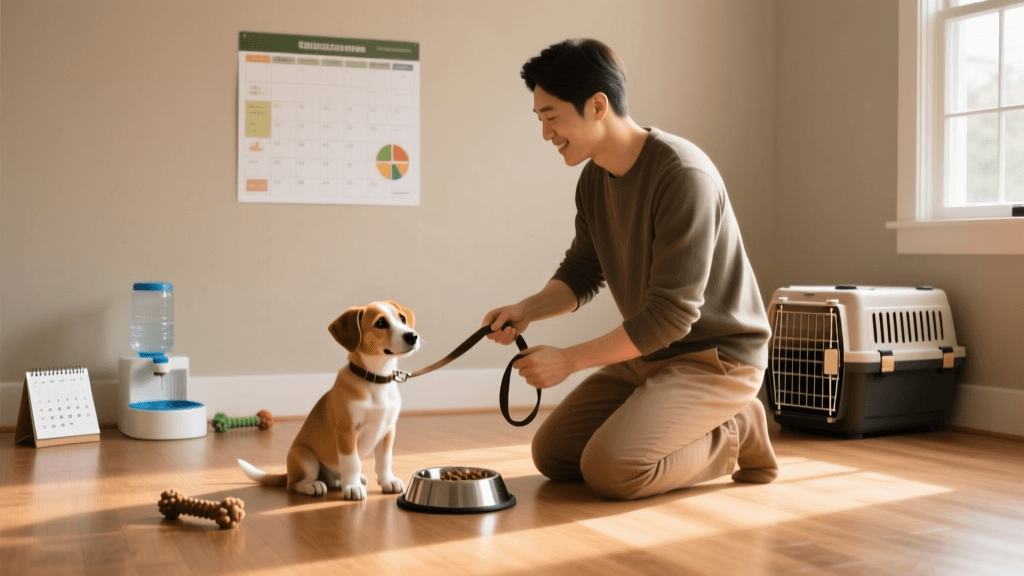
Implementing a structured daily routine removes the emotional guesswork from feeding and exercising. Here is a blueprint for a working owner managing a dog's weight loss:
7:00 AM - The Enriched Breakfast
Do not feed your dog from a standard bowl. Use a slow feeder, such as the Outward Hound Fun Feeder Slo-Bowl ($12), or a snuffle mat. This forces the dog to forage for their precisely weighed morning kibble, extending a 30-second meal into a 10-minute mental workout. Mental stimulation burns calories and reduces the anxiety that often leads to begging.
12:00 PM - The Midday Distraction
Dogs often beg or act lethargic midday out of boredom, not hunger. Prepare a KONG Classic toy stuffed with low-calorie, high-fiber foods. Mix 2 tablespoons of plain canned pumpkin (not pie filling) with a handful of thawed frozen green beans, and freeze it overnight. This provides a 45-minute licking session that costs less than $1 in ingredients and contains fewer than 30 calories.
5:30 PM - The 'Sniffari' Walk
Instead of a brisk, 20-minute leash walk focused on distance, take your dog on a 'Sniffari'. Allow them to lead the walk and sniff every bush, tree, and fire hydrant. Sniffing lowers a dog's heart rate, provides immense mental enrichment, and tires them out just as effectively as physical running, making it ideal for overweight dogs whose joints cannot handle high-impact jogging.
7:00 PM - The Dinner Puzzle
Serve the evening weighed portion of kibble inside a puzzle toy like the KONG Wobbler or a Bob-A-Lot. This engages their natural prey drive and ensures they are working for their daily caloric allotment.
Step 4: Smart Treat Swaps and Caloric Accounting
Treats should never exceed 10% of your dog's daily caloric intake. For a dog on a 580 kcal/day diet, that leaves only 58 calories for treats, training rewards, and chews. Traditional commercial biscuits will ruin this budget instantly. Below is a comparison chart to help you make better choices for your daily routine.
| Treat Option | Calories per Piece | Approx. Cost per Pound | Prep Time | Best Used For |
|---|---|---|---|---|
| Milk-Bone Original Biscuits | 40 kcal | $3.50 | None | Avoid during weight loss |
| Zuke's Mini Naturals | 3 kcal | $12.00 | None | High-repetition training |
| Baby Carrots (Raw) | 4 kcal | $1.50 | Wash | Crunchy chewing satisfaction |
| Canned Green Beans (No Salt) | 2 kcal | $1.20 | Rinse | Bulk meal toppers |
| Fresh Blueberries | 1 kcal | $6.00 | Wash | High-value scatter rewards |
Pro-Tip: If you use kibble for training throughout the day, simply subtract those pieces from your dog's digital scale measurement at breakfast and dinner. You are not adding calories; you are reallocating them.
Step 5: Retraining the Begging Behavior
A major hurdle in the daily routine of weight management is the guilt owners feel when their dog begs. Dogs beg because they have been intermittently reinforced for doing so in the past. To break this cycle, you must decouple human mealtimes from canine rewards.
Teach your dog the 'Place' command. Invest in a raised, comfortable dog cot (like the Coolaroo Elevated Pet Bed, approx. $35) and place it in the same room as your dining table. When you sit down to eat, direct your dog to their cot and provide them with a safe, low-calorie chew, such as a Whimzees dental chew approved by the Veterinary Oral Health Council (VOHC). This gives them a 'job' to do during your meal and redirects their focus away from your plate.
The Financial Reality of Weight Management
Many owners hesitate to buy premium low-calorie foods or enrichment toys due to upfront costs. However, weight management is a financial investment that yields massive long-term savings. An overweight dog is highly susceptible to cranial cruciate ligament (CCL) tears, which require surgery costing between $2,500 and $5,000 per knee. Furthermore, managing canine diabetes requires daily insulin injections, specialized prescription diets, and frequent blood glucose monitoring, easily exceeding $1,500 annually.
By spending $25 on a digital scale, $15 on a slow feeder, and $5 a week on fresh vegetables for treats, you are actively preventing thousands of dollars in future veterinary bills. More importantly, you are buying your dog extra years of active, pain-free life. Sharing your life with a dog is a profound responsibility, and mastering their daily nutritional and physical routine is the ultimate expression of that love.
anouk-beaumont
All our authors care for dogs every day — read more of their work on the authors page.