First-Time Owner Guide: Mastering Your Dog's Routine
Master your new dog's daily routine with our first-time owner guide. Learn feeding schedules, potty timelines, and essential tips for success.
Welcome Home: Why a Routine Matters for First-Time Owners
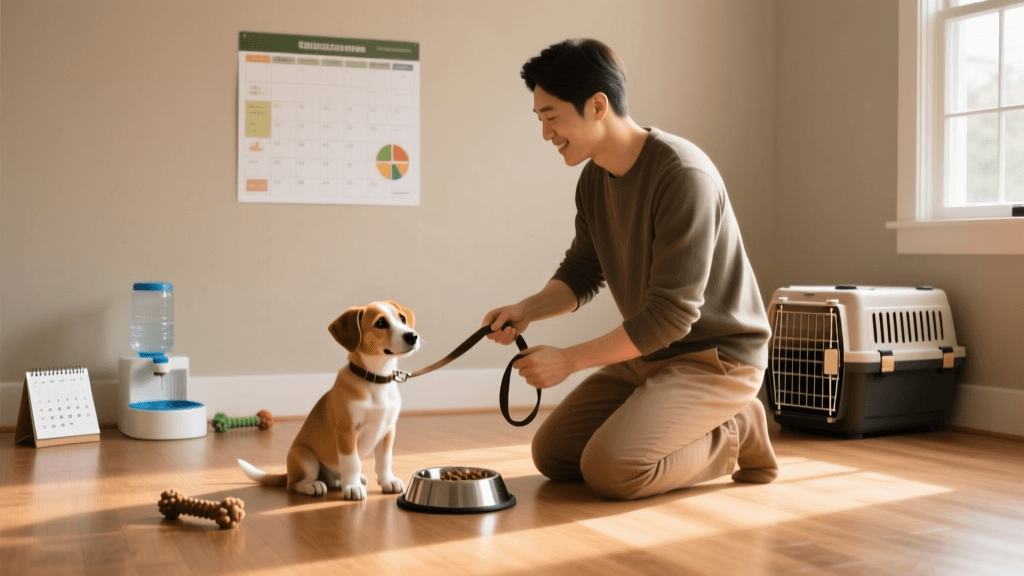
Bringing a new dog or puppy into your home is one of life's most rewarding experiences, but it can also be incredibly overwhelming. Many first-time owners experience what is commonly known as the 'puppy blues'—a feeling of deep regret or anxiety stemming from the sudden disruption to your household's peace. The antidote to this chaos is a structured, predictable daily routine. Dogs are creatures of habit, and they thrive when they know exactly what to expect next. According to the ASPCA's Puppy Care guidelines, establishing a consistent schedule for feeding, potty breaks, playtime, and sleep is the foundation of successful behavioral development and house training.
For a first-time owner, a routine isn't just about keeping the dog alive; it is about preserving your own sanity while building a bond of trust. When your dog learns that you are the reliable provider of their daily needs, their anxiety decreases, and their ability to learn new commands increases exponentially.
The 24-Hour Puppy Schedule: A Minute-by-Minute Breakdown
Puppies, particularly those between 8 and 16 weeks of age, require a highly structured day. Their bladders are tiny, their energy comes in intense bursts, and they require up to 18 to 20 hours of sleep per day. Below is a practical, actionable schedule designed for a 12-week-old puppy. You can adjust the wake and sleep times to fit your personal work schedule, but the intervals should remain consistent.
| Time | Activity | First-Time Owner Pro-Tips & Products |
|---|---|---|
| 7:00 AM | Wake Up & Immediate Potty | Carry the puppy outside to prevent accidents. Use a 6-foot leather leash (approx. $25) for boundary training. |
| 7:15 AM | Breakfast & Hydration | Serve measured kibble. Remove water bowl 2 hours before crating to manage bladder capacity. |
| 7:45 AM | Potty Break & Active Play | 15 minutes of fetch or tug. Use a flirt pole to save your back and build prey-drive focus. |
| 8:15 AM | Morning Nap (Crate) | Puppies tire quickly. Enforce a crate nap in a quiet, dimly lit room. |
| 10:15 AM | Potty, Training & Socialization | 5-10 minutes of clicker training. Use high-value treats like Zuke's Mini Naturals (approx. $6/bag). |
| 11:00 AM | Mid-Day Nap | Back in the crate. Cover with a breathable blanket to reduce visual stimulation. |
| 1:00 PM | Potty & Lunch | Second meal of the day. Follow immediately with a potty break. |
| 1:30 PM | Independent Enrichment | Provide a frozen KONG Classic (approx. $15) stuffed with plain pumpkin puree and kibble. |
| 2:00 PM | Afternoon Nap | Longest nap of the day while you work or run errands. |
| 5:00 PM | Potty, Dinner & Family Time | Final meal. Allow the puppy to roam in a puppy-proofed pen while family eats dinner. |
| 6:00 PM | Evening Walk & Exploration | Sniffari walk. Let the dog dictate the pace to provide mental fatigue. |
| 7:30 PM | Wind Down & Water Fasting | Pick up the water bowl. Offer a chew toy like a Benebone (approx. $14) to soothe teething gums. |
| 9:00 PM | Final Potty & Bedtime | Keep lights low and voices quiet. Set an alarm for 2:00 AM or 3:00 AM for a midnight potty break. |
Feeding and Hydration: Timing and Measurements
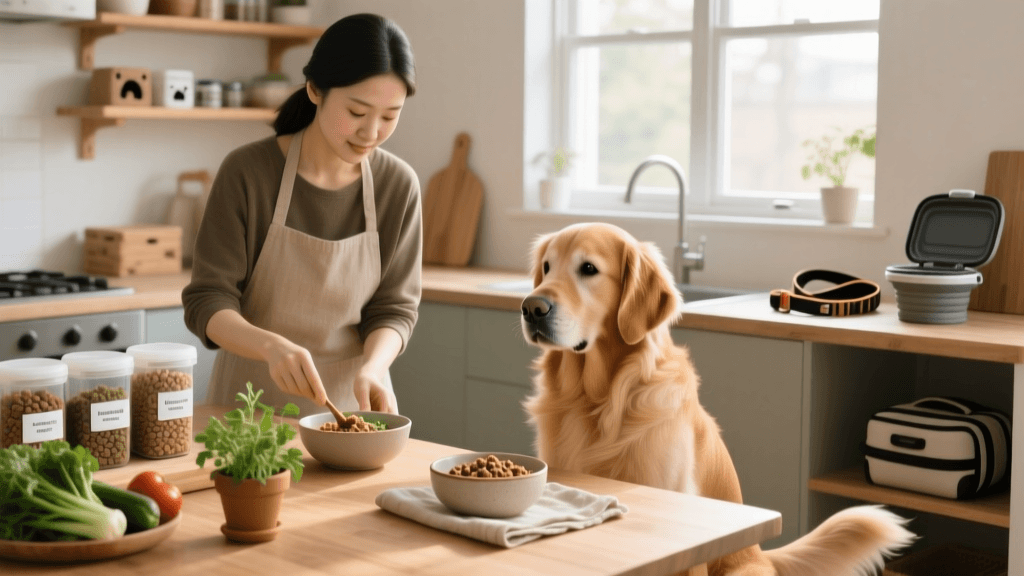
One of the most common mistakes first-time owners make is free-feeding (leaving a bowl of food out all day). Free-feeding destroys your ability to predict when your dog will need to eliminate, making potty training nearly impossible. Instead, opt for scheduled meals.
Portion Control and Costs
Consult your veterinarian for exact caloric needs, but as a general benchmark, a puppy expected to reach an adult weight of 30 pounds requires roughly 1.5 to 2 cups of high-quality puppy kibble per day, divided into three meals. Premium brands like Purina Pro Plan Puppy or Hill's Science Diet typically cost between $45 and $60 for a 15-pound bag, which should last a small-to-medium breed puppy about a month. Always use a standard measuring cup or a digital kitchen scale ($15) to ensure accuracy, as overfeeding can lead to rapid growth and orthopedic issues in large breeds.
The Hydration Strategy
While fresh water must be available during active hours, managing water intake in the evening is a game-changer for sleep. The Humane Society of the United States recommends picking up your puppy's water bowl approximately two to two-and-a-half hours before bedtime. If bedtime is 9:00 PM, remove the water at 6:30 PM. This allows the puppy to fully empty their bladder during the final evening potty breaks, significantly reducing the likelihood of a 3:00 AM wake-up call.
Potty Training Logistics: The Bladder Math
House training requires patience, supervision, and an understanding of canine biology. The golden rule of puppy bladders is the 'month-plus-one' rule: a puppy can hold their bladder for roughly one hour per month of age, plus one. Therefore, a 3-month-old puppy can physically hold it for about 4 hours max, but only while resting. During active play, they may need to go every 20 minutes.
Essential Cleanup Products
Accidents will happen. When they do, never use ammonia-based cleaners, as ammonia smells like urine to a dog and will encourage them to mark the same spot again. You must use an enzymatic cleaner that breaks down the uric acid crystals. Nature's Miracle Advanced Stain and Odor Eliminator (approx. $12 for a 32oz bottle) is an industry standard. Saturate the area, let it sit for 10 minutes, and blot dry. According to the American Veterinary Medical Association (AVMA), consistent positive reinforcement when the puppy eliminates outside is the most effective method for long-term house training success.
Sleep and Crate Training: Setting Up the Night Shift
Puppies are essentially toddlers; they do not know when they are tired and will often become hyperactive or bitey when overtired. Enforced naps in a crate are non-negotiable for a first-time owner's survival.
Selecting the Right Crate
Invest in a wire crate with a divider panel, such as the MidWest Homes for Pets iCrate (approx. $50 to $70 depending on size). The divider allows you to expand the space as your dog grows. The crate should be just large enough for the dog to stand up, turn around, and lie down comfortably. If it is too large, the puppy may use one corner as a bathroom and sleep in the other, completely undermining your potty training efforts.
Place the crate in your bedroom for the first few weeks. The sound of your breathing and your scent will reduce separation anxiety. When the puppy whines at night, wait a moment to see if they settle. If the whining persists, take them outside on a leash, stand in one boring spot for 3 minutes, and return them to the crate immediately if they do not eliminate. Do not engage in play or cuddling during night shifts.
Mental Stimulation: Tiring Out the Brain
A common misconception among new owners is that physical exercise is the only way to tire out a dog. In reality, 15 minutes of mental enrichment can be as exhausting as an hour of physical running. Mental stimulation builds confidence and prevents destructive behaviors born from boredom.
- Snuffle Mats ($20 - $30): Hide dry kibble in the fabric strips of a snuffle mat. This engages the dog's powerful olfactory system and slows down fast eaters.
- Lick Mats ($8 - $12): Spread plain, xylitol-free Greek yogurt or pureed pumpkin on a textured silicone mat and freeze it. Licking releases endorphins in a dog's brain, making this an excellent tool for calming them down during bath time or nail trims.
- Flirt Poles ($25): A fantastic alternative to long runs for young puppies whose growth plates are still developing. It allows you to control the movement and practice impulse control commands like 'drop it' and 'wait'.
Adjusting the Routine as Your Dog Grows
As your puppy transitions into adolescence (around 6 to 9 months), their stamina will increase, and their sleep requirements will drop to about 12 to 14 hours a day. You will naturally transition from three meals a day to two, and the midnight potty breaks will become a distant memory. However, the core framework of the routine—predictable feeding, structured walks, and dedicated enrichment time—should remain a permanent fixture in your household.
'Dogs thrive on predictability. A well-structured routine doesn't stifle a dog's life; rather, it provides the secure boundaries they need to relax and truly enjoy their time with you.' — Canine Behavioral Experts
Embrace the initial friction of setting a strict schedule. Within a few weeks, your dog will internalize the rhythm of your home, and you will transition from a stressed first-time owner to a confident, capable pack leader.
hannah-wickes
All our authors care for dogs every day — read more of their work on the authors page.