Strategic Treat Tiers and Meal Timing for Dog Training
Discover how strategic meal timing and a tiered treat system can skyrocket your dog's training focus, motivation, and long-term obedience retention.

The Currency of Canine Compliance
When it comes to dog training, food is not merely a snack; it is the ultimate currency of compliance. Many dog owners struggle with obedience training because they treat food rewards as an afterthought, offering the same dry biscuit for a complex recall command as they do for a simple 'sit' in an empty living room. To truly unlock your dog's potential, you must approach nutrition and feeding strategies with the precision of a behavioral economist. By strategically manipulating treat values and meal timing, you can harness your dog's natural hunger drive, maximize their focus, and accelerate the learning curve for both basic manners and advanced behavioral conditioning.
According to the American Veterinary Medical Association (AVMA), reward-based training is the most effective and humane method for modifying canine behavior. However, the efficacy of this method relies entirely on how the rewards are deployed. A reward is only valuable if the dog perceives it as worth working for. This perception fluctuates based on environmental distractions, the difficulty of the task, and the dog's current state of satiation. Let us break down how to build a strategic feeding and rewarding framework that guarantees results.
Building Your Treat Hierarchy
Professional dog trainers utilize a concept known as the 'Treat Hierarchy.' This involves categorizing food rewards into three distinct tiers based on their palatability, smell, and moisture content. By matching the tier of the treat to the difficulty of the training environment, you ensure that your dog remains adequately motivated without overfeeding them high-calorie junk.
Low-Value Treats: The Everyday Currency
Low-value treats are your dog's standard, everyday meals or generic dry biscuits. These are best used for practicing known commands in low-distraction environments, such as your living room or backyard. Examples: Your dog's standard dry kibble, generic hard milk-bone style biscuits, or small pieces of dry carrot. Cost & Prep: Practically free if using daily kibble. No prep required. Use these for 'maintenance' training and rapid-fire repetition drills where you might dispense 20 to 30 rewards in a five-minute session.
Medium-Value Treats: The Learning Catalyst
Medium-value treats are soft, smelly, and highly palatable. They are the workhorses of dog training, perfect for teaching new tricks, introducing mild distractions, or practicing loose-leash walking in a quiet neighborhood. Examples: Zuke's Mini Naturals (the Raspberry & Apple or Salmon recipes are highly rated), Blue Buffalo Blue Bits, or small cubes of string cheese. Cost & Prep: A 16oz bag of Zuke's costs approximately $8.00 to $10.00. You must cut or break these into pea-sized pieces. A single training session should utilize pieces no larger than a green pea to prevent the dog from getting full and to keep the caloric cost around $0.05 per reward.
High-Value Treats: The Heavy Artillery
High-value treats are reserved for high-stakes situations: emergency recalls, counter-conditioning fear responses (like fireworks or stranger danger), or training in highly distracting environments like a busy dog park. These treats must be pungent, moist, and irresistible. Examples: Boiled, unseasoned chicken breast, Stewart Pro-Treat Freeze-Dried Beef Liver, or small dabs of plain peanut butter on a lick mat. Cost & Prep: Freeze-dried liver tins cost around $15.00 for 5.5oz. Boiled chicken requires 15 minutes of prep time. The cost per reward is higher (approx. $0.15 to $0.20), but the behavioral payout is immense.
The Treat Value Comparison Chart
Use the following chart to quickly reference which treat tier to deploy based on your current training scenario.
| Treat Tier | Prime Examples | Best Use Case | Est. Cost Per Reward | Prep Time |
|---|---|---|---|---|
| Low-Value | Daily Kibble, Dry Biscuits | Known commands, indoor drills, rapid repetition | $0.01 - $0.02 | None |
| Medium-Value | Zuke's Mini Naturals, String Cheese | Learning new tricks, mild outdoor distractions | $0.04 - $0.06 | 1-2 mins (cutting) |
| High-Value | Boiled Chicken, Freeze-Dried Liver | Emergency recall, fear counter-conditioning, high distraction | $0.15 - $0.25 | 10-15 mins (cooking) |
Strategic Meal Timing: Harnessing the Hunger Drive
The most meticulously planned treat hierarchy will fail if your dog is completely full. A satiated dog has no biological drive to work for food. Conversely, a starving dog will be too frantic and stressed to process new information. The sweet spot for optimal training focus lies in the 'Hunger Drive Window.'
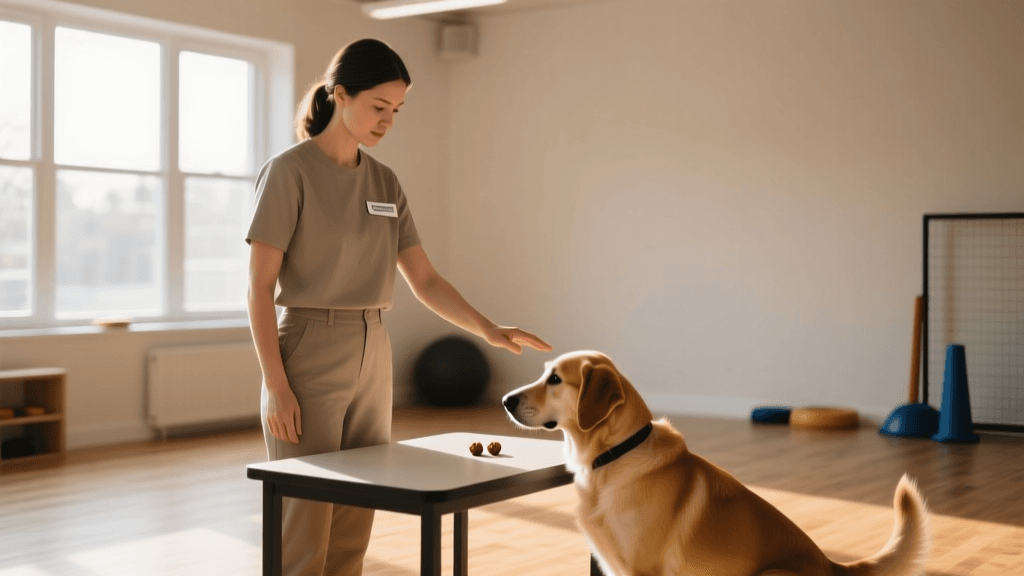
Always schedule your most intensive training sessions 1 to 2 hours before your dog's scheduled meal. During this window, the dog's blood sugar has stabilized from the last meal, and their natural biological anticipation for the next meal is peaking. This mild state of hunger sharpens their focus, making them highly receptive to operant conditioning. If you feed your dog twice a day (e.g., 7:00 AM and 6:00 PM), your optimal training windows are between 5:00 PM and 6:00 PM, or mid-morning around 10:00 AM.
If your dog is a 'free feeder' (meaning you leave a bowl of kibble out all day for them to graze on), you will likely struggle with food motivation. Transitioning to scheduled, portion-controlled meals is a critical first step in establishing a successful training routine. By controlling the food, you control the motivation.
The Art of Hand-Feeding for Focus
For puppies, rescue dogs with poor impulse control, or dogs that suffer from resource guarding, the food bowl is an unnecessary obstacle. Instead of feeding your dog from a bowl, utilize the 'Nothing In Life Is Free' (NILIF) protocol by hand-feeding their entire daily kibble allotment during training sessions.
By making your dog work for every single piece of their daily meal, you accomplish three things simultaneously:
- Building Focus: The dog learns that looking at you and engaging with you is the only way to access their primary resource.
- Impulse Control: You can practice 'wait,' 'leave it,' and 'take it' commands using their actual dinner, reinforcing calm behavior before consumption.
- Bonding: Hand-feeding builds a deep psychological association between your presence and positive outcomes, which is especially vital for building trust with newly adopted rescue dogs.
If you have a 50-pound Labrador that requires 3 cups of kibble a day, simply measure out those 3 cups in the morning, place them in a training treat pouch, and use them as your low-to-medium value rewards throughout the day. Whatever is left in the pouch by dinner time is simply placed in their bowl.
Managing Daily Caloric Intake and Safety
One of the most common pitfalls in food-based training is accidental obesity. It is incredibly easy to overestimate how many calories you are dispensing during a 30-minute walk. The U.S. Food and Drug Administration (FDA) and veterinary nutritionists universally recommend the '10% Rule': treats and training rewards should never constitute more than 10% of your dog's total daily caloric intake.
Let us look at the math for an average 40-pound, moderately active dog. This dog requires roughly 800 calories per day to maintain a healthy weight. Therefore, a maximum of 80 calories can come from training treats. If you are using a medium-value treat that contains 3 calories per piece, you have a daily budget of roughly 26 treats. If you need to do more repetitions, you must either switch to lower-calorie treats (like pieces of green beans or low-calorie kibble) or, most importantly, subtract those 80 calories from their dinner bowl. Never add training calories on top of a full daily meal ration.
Additionally, be mindful of treat ingredients. Dogs with sensitive stomachs or food allergies may experience gastrointestinal upset if bombarded with rich, novel proteins during a training session. In these cases, single-ingredient treats like Native Pet Yak Chews (shaved into small pieces) or using their prescribed hypoallergenic kibble as the sole reward is the safest strategy.
Fading the Lure: Moving Beyond Bribery
As noted by the Humane Society of the United States, while food is essential for teaching a behavior, it should not become a permanent crutch. Once your dog reliably performs a command (e.g., sitting 9 out of 10 times when asked), you must transition from a 'continuous reinforcement schedule' (rewarding every single time) to a 'variable ratio schedule.'
This is the same psychological mechanism that makes slot machines addictive to humans. Begin rewarding the behavior randomly—perhaps on the 1st, 3rd, 4th, and 7th repetition. Intermix low-value and high-value treats unpredictably. This keeps the dog guessing and working harder, hoping for the 'jackpot' high-value reward. Concurrently, begin replacing food rewards with life rewards, such as throwing a tennis ball, opening the door for a walk, or offering vigorous chest scratches. By strategically managing the timing, value, and caloric impact of your dog's nutrition, you transform feeding time from a mundane daily chore into a powerful, relationship-building training tool.
hannah-wickes
All our authors care for dogs every day — read more of their work on the authors page.