Training Treats and Canine Nutrition: Balancing Focus and Weight
Learn how to balance high-value training treats with your dog's daily nutrition to maintain focus during sessions without risking canine obesity.
The Intersection of Behavioral Conditioning and Canine Nutrition
When embarking on a journey of obedience training, behavioral conditioning, or socialization, food is often the most powerful tool in a dog owner's arsenal. Positive reinforcement relies heavily on motivating rewards to shape desired behaviors. However, a critical yet frequently overlooked aspect of this process is the nutritional impact of training treats. As a senior dog care writer for Paws-Tales, I frequently see well-intentioned owners inadvertently compromise their dog's physical health in the pursuit of mental stimulation and obedience.
Understanding the delicate balance between providing high-value motivation and maintaining a healthy body condition score (BCS) is essential for the longevity and well-being of your canine companion. This deep dive explores the science of food motivation, the hidden caloric dangers of training sessions, and actionable strategies to optimize your dog's nutrition without sacrificing training efficacy.
The Science of Food Motivation and Learning
During the acquisition phase of learning a new behavior, dogs require rapid, high-value feedback. When a dog performs a desired action—such as making eye contact in the presence of a trigger or executing a swift recall—the brain releases dopamine. This neurotransmitter reinforces the neural pathway associated with the behavior. High-value treats, typically those rich in protein and fat, trigger a more robust dopamine response than standard kibble.
According to training experts at the American Kennel Club (AKC), matching the value of the treat to the difficulty of the task and the level of environmental distraction is paramount for successful behavioral conditioning.
However, this biological mechanism creates a dilemma. The most motivating foods are often the most calorically dense, leading to the 'training treat trap' where dogs consume far more energy than they expend during a session.
The Hidden Danger: The Training Treat Trap
Canine obesity is a growing epidemic. The Association for Pet Obesity Prevention (APOP) reports that over 50% of dogs in the United States are classified as overweight or obese. Excess weight places severe stress on a dog's joints, exacerbates conditions like osteoarthritis, and significantly shortens their lifespan. Many owners do not realize that a 15-minute intensive training session in the living room does not burn enough calories to justify a handful of high-fat training treats. A typical 30-minute obedience session might burn only 10 to 15 calories for a medium-sized dog, yet the treats consumed could easily exceed 150 calories.
The 10% Rule: Calculating Daily Caloric Intake
To prevent training-induced weight gain, veterinary nutritionists universally recommend the '10% Rule'. The Tufts Cummings School of Veterinary Medicine emphasizes that treats, chews, and table scraps should never constitute more than 10% of a dog's total daily caloric intake. The remaining 90% must come from a complete and balanced commercial diet or a veterinary-approved home-cooked recipe.
Practical Caloric Math for a 50-Pound Dog
Let us break down the math for a moderately active 50-pound dog (such as a medium-sized Labrador Retriever or Boxer). This dog requires approximately 1,100 kilocalories (kcal) per day to maintain a healthy weight.
- Total Daily Calories: 1,100 kcal
- Maximum Treat Allowance (10%): 110 kcal
- Meal Allowance (90%): 990 kcal
If you are using a standard commercial training treat that contains 5 kcal per piece, your dog can safely consume a maximum of 22 treats per day across all training sessions. If you are doing three 10-minute sessions a day, that is roughly 7 treats per session. For complex trick teaching or reactive dog socialization, this limit can be reached in mere minutes.
The Training Treat Hierarchy: Nutrition and Caloric Breakdown
To manage the 10% limit while maintaining high motivation, you must strategically select your rewards based on the training environment. Below is a structured comparison of treat types, their nutritional profiles, and estimated costs.
| Value Level | Best Use Case | Example Products | Calories per Unit | Cost Estimate |
|---|---|---|---|---|
| Low Value | Basic obedience in low-distraction environments (home). | Dog's regular kibble, baby carrots, green beans. | 1 - 3 kcal | $0.05 - $0.10 per serving |
| Medium Value | Leash walking, mild distractions, trick teaching. | Zuke's Mini Naturals, Wellness Soft Puppy Bites. | 3 - 5 kcal | $6.00 - $8.00 per 6oz bag |
| High Value | Reactive dog conditioning, high-distraction parks, vet visits. | Stella & Chewy's Freeze-Dried Beef Liver, boiled chicken breast. | 5 - 15 kcal | $10.00 - $14.00 per 3oz bag |
| Duration/Enrichment | Place command, grooming desensitization, crate training. | Kong Easy Treat, plain non-fat Greek yogurt, canned pumpkin. | 15 - 30 kcal per serving | $5.00 - $9.00 per container |
Actionable Strategies for Nutrient-Dense Training Sessions
How do we reconcile the need for high-value rewards with strict caloric limits? Here are three actionable strategies utilized by professional behaviorists and canine nutritionists.
1. The 'Meal Deduction' Method
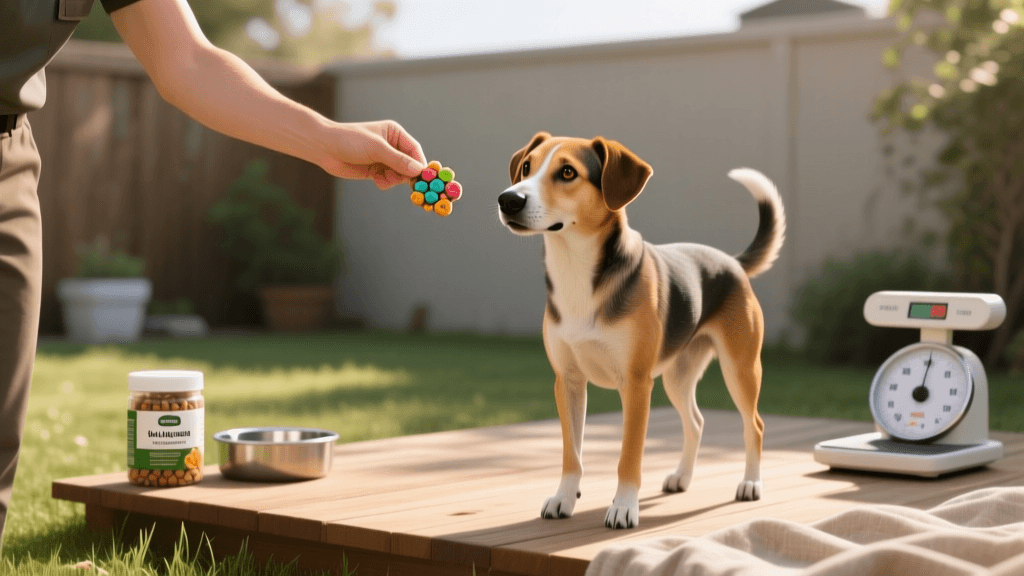
Before you pour your dog's morning or evening meal into their bowl, weigh the total portion using a digital kitchen scale. Remove 10% to 20% of that kibble and place it in your training treat pouch. For dogs that are highly food-motivated by their standard diet, their own kibble is an excellent, perfectly balanced, low-calorie reward. This method guarantees you will never overfeed your dog, as the treats are simply a reallocation of their daily nutritional requirement.
2. High-Value, Low-Volume Rewards (The Pea-Sized Rule)
Dogs do not care about the size of the treat; they care about the taste and the speed of consumption. A common mistake is giving a dog a massive biscuit for a simple 'sit'. Instead, use single-ingredient, highly aromatic foods like freeze-dried beef liver or boiled chicken breast, but cut them into pieces no larger than a green pea. A single Stella & Chewy's freeze-dried liver treat can be broken into four or five micro-rewards, each delivering a potent scent and taste profile while keeping the caloric footprint negligible.
3. Utilizing Lick Mats for Duration Training
When teaching duration-based commands like 'stay' or 'place', or when conditioning a dog to tolerate nail trimming, rapid-fire treat delivery is less effective than prolonged engagement. Smear a lick mat with plain, non-fat Greek yogurt or 100% pure pumpkin puree (ensure it is not pie filling). Freeze the mat for two hours. This provides a low-calorie, high-dopamine activity that keeps the dog anchored to their mat for 10 to 15 minutes, costing less than 20 calories.
Fading the Lure: Transitioning to Intermittent Reinforcement
From a behavioral conditioning standpoint, continuous reinforcement (rewarding every single successful repetition) is only necessary during the initial acquisition phase of a behavior. Once a dog reliably understands the cue, you must transition to a variable ratio schedule of reinforcement—essentially, a slot-machine effect. Reward the fastest, most enthusiastic responses with a high-value treat, while offering verbal praise, life rewards (like opening the door for a walk), or a simple piece of kibble for average responses. This not only drastically reduces your dog's daily caloric intake from treats but also strengthens the behavior, making it more resistant to extinction.
Conclusion
Effective dog training should never come at the expense of your dog's physical health. By understanding the nutritional impact of positive reinforcement, adhering to the 10% rule, and strategically utilizing the treat hierarchy, you can build a brilliant, obedient canine athlete without contributing to the pet obesity epidemic. Remember, the best training tool is not an endless supply of high-fat biscuits, but a strategic, mindful approach to your dog's daily diet and behavioral conditioning.
jonas-cole
All our authors care for dogs every day — read more of their work on the authors page.