Training Large Breed Puppies With Genetic Joint Risks
Learn how to safely train large breed puppies prone to genetic hip dysplasia. Discover low-impact obedience routines and joint-safe exercises.

The Genetic Reality of Large Breed Joint Health
Welcoming a large or giant breed puppy into your home is an exhilarating experience. Breeds like the German Shepherd, Golden Retriever, Rottweiler, and Bernese Mountain Dog are renowned for their intelligence, loyalty, and eagerness to work. However, alongside their impressive stature comes a well-documented genetic vulnerability: hip and elbow dysplasia. According to the Orthopedic Foundation for Animals (OFA), hip dysplasia is a polygenic condition, meaning it is controlled by multiple genes. While genetics load the gun, environmental factors—specifically diet, weight management, and physical stress during growth—pull the trigger.
As a responsible owner and trainer, your goal during the first 18 months of your dog's life is to build a rock-solid foundation of obedience without exacerbating genetic joint laxity. Training a large breed puppy requires a fundamental shift in perspective: we must prioritize low-impact mental stimulation and joint-safe mechanics over repetitive physical drills. This comprehensive guide will show you how to navigate the critical growth phases, select the right equipment, and teach essential obedience while protecting your puppy's genetic joint health.
Understanding Growth Plates and Training Timelines
Before designing a training curriculum, you must understand canine skeletal development. Large breed puppies possess growth plates (epiphyseal plates) at the ends of their long bones. These plates are made of soft, rapidly dividing cartilage that eventually calcifies into solid bone. The American Kennel Club (AKC) notes that in large and giant breeds, these growth plates may not fully close until the dog is between 14 and 18 months of age.
When a puppy performs high-impact activities—such as jumping for a frisbee, weaving through agility poles, or slipping on hardwood floors—the sheer force can cause micro-fractures in the soft cartilage. The body repairs these micro-fractures with bone, which can lead to abnormal joint conformation, worsening any underlying genetic predisposition to dysplasia. Therefore, your training timeline must be strictly segmented by age and skeletal maturity.
High-Impact vs. Low-Impact Training Exercises
To protect your puppy's developing joints, you must categorize training exercises by their impact level. Below is a structured comparison to help you design safe training sessions.
| High-Impact (Avoid Until 18+ Months) | Low-Impact (Safe for Puppies) |
|---|---|
| Jumping into vehicles or over hurdles | Targeting (touching a mat or hand) |
| Playing tug-of-war with jerking motions | Stationary impulse control (Sit, Down, Stay) |
| Catching flying discs or high tennis balls | Scent work and nose games on flat ground |
| Running alongside a bicycle or jogger | Loose-leash walking on soft surfaces |
| Agility weave poles or A-frame obstacles | The "Bow" (stretching front legs forward) |
Joint-Safe Training Equipment and Costs
The right equipment can prevent sudden, jarring movements that damage soft tissue. Investing in joint-safe gear is a non-negotiable aspect of large breed training.
- Interlocking Foam Mats ($30 - $50): Hardwood and tile floors are incredibly slippery. When a puppy attempts to "sit" or "down" on a slick surface, their legs can splay out, putting immense torque on the hip and knee joints. Lay down interlocking EVA foam mats in your primary training area to provide a high-traction, forgiving surface.
- Front-Clip Harness ($35 - $45): Avoid attaching a leash to a flat collar, which can cause tracheal damage and encourage pulling. A well-fitted front-clip harness, such as the Ruffwear Front Range, gently redirects the puppy's center of gravity toward you without putting strain on the cervical spine or shoulder joints.
- Biothane Long Line ($25 - $40): For recall training, avoid heavy nylon leashes that drag on the ground and snap taut. A lightweight, waterproof Biothane long line (15 to 30 feet) allows you to practice emergency recalls in open, grassy areas without the jarring stop of a short leash.
Phase 1: Foundational Obedience (8 to 16 Weeks)
During the earliest weeks, your puppy's skeletal structure is highly fragile. Training should focus entirely on impulse control, name recognition, and handling. Keep sessions under 5 minutes to prevent physical fatigue and mental frustration.
Teaching a Joint-Safe "Sit" and "Down"
Many large breed puppies develop a "puppy sit" or "lazy sit," where their hips roll out to the side. While common in young puppies, consistently allowing this can fail to build the core and glute strength needed to support genetically weak hips. Use high-value treats (like boiled chicken or freeze-dried liver) to lure your puppy into a "tuck sit," where the hind legs fold neatly underneath the body. Reward heavily for square, aligned sits. If your puppy struggles, practice on your foam mats to ensure they have the grip needed to tuck their hindquarters properly.
Phase 2: Leash Manners and Loose-Leash Walking (4 to 12 Months)
As your puppy enters adolescence, their energy levels will skyrocket. However, you still cannot rely on long-distance running to tire them out. Forced exercise (like jogging) is strictly prohibited until growth plates close. Instead, focus on the mechanics of loose-leash walking.
Practice the "U-Turn" game. Walk forward in a straight line on a flat, grassy surface. The moment your puppy reaches the end of the leash, say "Let's go," pivot smoothly, and walk the other way, rewarding them when they catch up to your side. This teaches them to pay attention to your body language without requiring them to make sharp, high-speed, joint-wrenching pivots. Keep your walking pace steady and avoid sudden stops that force the puppy to skid.
Phase 3: Mental Enrichment Over Physical Exhaustion
A common mistake owners make is trying to physically exhaust a large breed puppy to prevent destructive behavior. This is a fast track to joint deterioration. Instead, leverage canine genetics: dogs are hardwired to use their noses and solve problems. Fifteen minutes of intense mental stimulation can tire a puppy out as much as an hour of physical running.
- Snuffle Mats ($15 - $25): Scatter your puppy's daily kibble ration into a fabric snuffle mat. This forces them to forage and use their olfactory senses, burning mental energy while remaining completely stationary.
- Frozen Lick Mats ($10 - $15): Spread plain pumpkin puree or xylitol-free peanut butter on a textured silicone lick mat and freeze it. Licking releases endorphins in a dog's brain, soothing anxiety and promoting calmness without physical exertion.
- Hide and Seek: Have a family member hold the puppy in one room while you hide in another. Call your puppy's name and reward them with a high-value treat when they find you. This builds a rock-solid recall while keeping physical impact to a minimum.
Tricks to Avoid and Safe Alternatives
Trick training is a fantastic way to bond with your dog, but certain viral tricks are disastrous for large breed genetics.
Avoid: "Sit Pretty" (Begging)
Teaching a dog to balance on its hind legs puts the entire body weight on the lumbar spine and hip joints. For a breed genetically predisposed to hip dysplasia or lumbosacral stenosis, this trick can accelerate joint degradation and cause chronic pain.
Safe Alternative: The "Bow" (Stretch)
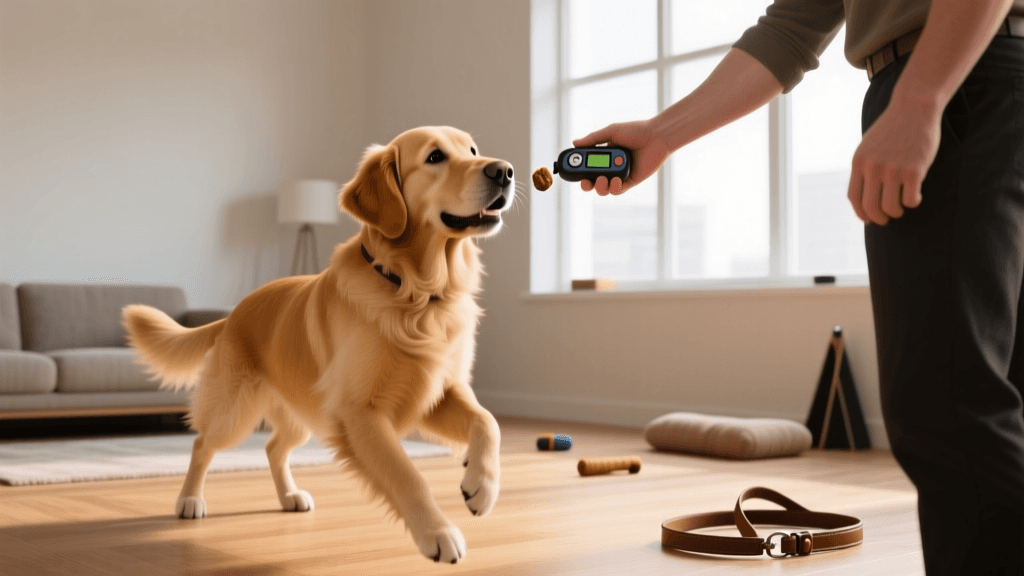
The "Bow" is an excellent, joint-safe trick that actually promotes spinal flexibility and front-end core strength. Start with your puppy in a standing position on your foam mat. Hold a treat at their nose and slowly lure it downward and slightly back between their front paws. As their front elbows drop to the mat, keep their hind end up in a standing position. Mark the behavior with a clicker or a "Yes!" and reward. This mimics the natural "play bow" and provides a gentle, active stretch for the shoulders and chest.
Monitoring and Veterinary Checkpoints
Training must be paired with proactive veterinary monitoring. If your breed is at high risk for hip dysplasia, consult your veterinarian about the PennHIP evaluation method. Unlike traditional OFA x-rays which require the dog to be fully mature (24 months), PennHIP can be performed as early as 16 weeks of age. This early genetic screening measures joint laxity and allows you to make informed decisions about your puppy's training intensity, weight management, and potential early interventions like juvenile pubic symphysiodesis (JPS) if severe laxity is detected.
Additionally, watch for "red flag" behaviors during training that may indicate early joint discomfort. If your puppy becomes reluctant to sit squarely, exhibits a "bunny hopping" gait when running, or suddenly refuses to engage with a previously loved training game, stop immediately and consult your veterinarian. Incorporating a veterinary-approved joint supplement containing glucosamine, chondroitin, and omega-3 fatty acids (such as Dasuquin or Cosequin, typically costing around $50 to $70 for a supply) can also provide nutritional support for developing cartilage, though it should never replace careful training mechanics.
Conclusion
Training a large breed puppy with genetic joint risks requires patience, foresight, and a commitment to long-term health over short-term thrills. By respecting the biological timeline of growth plates, utilizing low-impact mental enrichment, and strictly avoiding high-impact tricks, you can cultivate a highly obedient, well-mannered dog without compromising their physical foundation. Remember that the ultimate goal of training is to build a harmonious life with your dog—a life that is only possible if they are physically sound and pain-free well into their senior years.
jonas-cole
All our authors care for dogs every day — read more of their work on the authors page.