Training Your Dog to Respect Toddler Boundaries Safely
Learn how to train your dog to respect toddler boundaries using safe zones, positive reinforcement, and family rules for a harmonious home.

Why Toddler-Dog Safety Training is Crucial for Families
Bringing a toddler and a family dog together is a beautiful milestone, but it requires careful management, proactive training, and constant supervision. Toddlers are naturally curious, uncoordinated, and prone to sudden, high-pitched outbursts. To a dog, these erratic behaviors can be confusing, overstimulating, or even threatening. According to the American Veterinary Medical Association (AVMA), children are the most frequent victims of dog bites, with the highest incidence occurring among toddlers and preschoolers who are interacting with familiar family pets.
The goal of family-centric dog training is not merely to teach the dog obedience commands, but to establish clear, stress-free boundaries that keep both your child and your dog safe. By utilizing positive reinforcement, creating designated safe zones, and teaching your dog impulse control, you can foster a harmonious environment where your toddler and dog can safely coexist.
Understanding the Dog-Toddler Dynamic
Before diving into specific commands, it is essential to understand why toddlers trigger stress in dogs. Toddlers move unpredictably, often stumbling, falling, or darting across the room. They also explore the world with their hands, frequently reaching for a dog’s ears, tail, or fur. Furthermore, toddlers lack the cognitive ability to read canine body language.
As a parent and dog owner, you must become the translator. Learn to recognize early signs of canine stress, which include:
- Whale Eye: When the dog turns its head away but keeps its eyes fixed on the toddler, showing the whites of its eyes.
- Lip Licking and Yawning: Frequent, out-of-context yawning or licking of the lips when the toddler is nearby.
- Freezing: The dog becomes completely stiff and still when touched or approached.
- Turning Away: The dog actively tries to create distance by leaning away or walking off.
If you notice any of these signs, immediately intervene by redirecting your toddler and giving your dog space. Never force a dog to accept physical affection from a child.
Step 1: Establishing "Safe Zones" with Mat Training
Every dog needs a sanctuary—a place where they can retreat when they feel overwhelmed, and where the toddler is strictly forbidden to go. Mat training (or "Go to Place") is one of the most valuable tools for families.
Choosing the Right Equipment
Invest in a durable, elevated dog bed or a heavy-duty, non-slip training mat. Elevated beds, such as the Kuranda Chewproof Dog Bed (approximately $130 to $160), are excellent because they provide a clear physical boundary. Alternatively, a thick, washable Snuggle Pad ($30 to $50) works well for smaller spaces. Place this mat in a high-traffic area where the family gathers, but out of the main "toddler play zone."
The Training Protocol
- Lure and Reward: With your dog on a standard 6-foot nylon leash, toss a high-value treat (like Zuke’s Mini Naturals, roughly $6 per bag) onto the mat. The moment all four paws are on the mat, use a clicker or a verbal marker like "Yes!" and reward them.
- Add the Cue: Once your dog is reliably stepping onto the mat for treats, add the verbal cue "Go to Place" just before they step on.
- Build Duration: Ask your dog to stay on the mat for 3 to 5 seconds before rewarding. Gradually increase this to 1 minute, then 5 minutes, dropping treats onto the mat intermittently to reinforce that staying put is highly rewarding.
- Toddler Proofing: Teach your toddler that the mat is the dog’s "sleeping castle." Make a family rule that no toys or hands are allowed on the mat. If your dog is on the mat, they are invisible and untouchable.
Step 2: Mastering "Leave It" and "Drop It"
Toddlers are notorious for dropping snacks, small toys, and crayons on the floor. A dog with a strong "Leave It" and "Drop It" command will ignore these hazards rather than snatching them up, which prevents choking hazards and resource guarding incidents.
Teaching "Leave It"
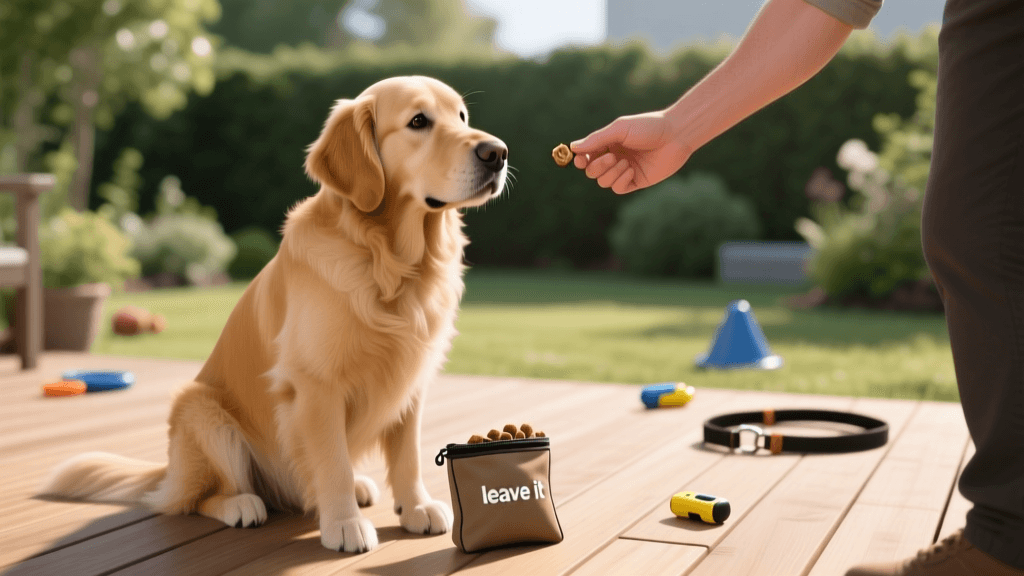
Start with a low-value item in a closed fist. When your dog sniffs or paws at your hand, wait. The exact second they pull their nose away, mark with "Yes!" and give them a different, higher-value treat from your other hand. Once mastered, practice with toddler toys on the floor. Cover the toy with your foot if the dog lunges, and reward them for making eye contact with you instead of the toy. The ASPCA highly recommends practicing these impulse-control exercises well before a child becomes mobile to ensure the dog defaults to looking at the owner when something falls.
Teaching "Drop It"
Never chase a dog to take something out of their mouth; this turns it into a game of keep-away or triggers defensive aggression. Instead, play a structured game of tug with a durable toy like the Kong Classic ($15 to $20). While the dog is holding the toy, present a incredibly smelly, high-value treat (like freeze-dried liver or string cheese) right to their nose. The dog will naturally open their mouth to eat the treat. Say "Drop It" as they release the toy. Repeat this 10 to 15 times per session, keeping sessions under 5 minutes to prevent frustration.
Step 3: Desensitizing Your Dog to Toddler Chaos
Dogs that are sensitive to noise can become highly stressed by a toddler’s crying, screaming, or laughing. You can proactively desensitize your dog to these sounds using audio tracks.
Search for "baby sounds" or "toddler crying" on YouTube or Spotify. Play the audio at a very low volume—so low that your dog notices it but remains relaxed. Feed your dog their favorite meal or a long-lasting chew, like a bully stick ($8 to $12 each), while the audio plays. After a few days, gradually increase the volume by 10%. If your dog shows signs of stress (panting, pacing, hiding), lower the volume immediately. This classical conditioning technique teaches the dog that chaotic toddler noises predict wonderful things, rather than danger.
Age-Appropriate Dog Training Tasks for Kids
While adults must handle the heavy lifting of boundary training and behavioral conditioning, older children can be involved in the process. Involving kids in safe, structured training builds empathy and strengthens the bond between child and pet. Below is a guide to age-appropriate tasks.
| Child's Age | Appropriate Training Tasks | Safety Rules & Supervision |
|---|---|---|
| 1 - 3 Years | Observing, learning to "blow kisses" to the dog, practicing gentle petting on a stuffed animal. | 100% adult physical supervision. No direct dog training. Toddlers should never hold treats near the dog's face. |
| 4 - 6 Years | Tossing treats on the floor for "Sit" or "Go to Place," helping to fill Kong toys with peanut butter. | Adult must hold the treat bag and dispense treats to the child. Child should not approach a dog that is eating or sleeping. |
| 7 - 10 Years | Practicing "Leave It" with low-value items, walking the dog in a fenced yard, learning to read canine body language. | Adult supervision required. Child should not walk the dog alone in public or near busy streets. |
| 11+ Years | Clicker training new tricks, practicing leash walking, managing the dog's feeding schedule and puzzle toys. | Can take on more responsibility, but adults must still monitor interactions and enforce household safety rules. |
Supervision and Setting Unbreakable Family Rules
Training is only half the equation; management is the other. The Humane Society of the United States emphasizes that no matter how well-trained a dog is, infants and toddlers should never be left alone with a pet, even for a few seconds. A dog’s patience can snap in an instant if a toddler accidentally pokes them in the eye or pulls their tail while the adult is looking away.
Implement physical barriers in your home. Use baby gates to create dog-free zones and toddler-free zones. A tall, hardware-mounted baby gate (costing around $40 to $70) allows the dog to see the family without being trapped in the middle of a chaotic play session. Additionally, establish a strict "no hugging" rule. While humans view hugging as a sign of affection, most dogs view being wrapped in arms as a restrictive, threatening gesture.
Conclusion
Training your dog to respect toddler boundaries is an ongoing process that requires patience, consistency, and a deep understanding of canine behavior. By establishing safe zones, mastering impulse control commands like "Leave It," and desensitizing your dog to the unpredictable nature of childhood, you are setting your family up for success. Remember that supervision is your ultimate safety net. With proactive management and positive reinforcement, your dog and toddler can grow up together in a safe, loving, and mutually respectful environment.
aaron-whyte
All our authors care for dogs every day — read more of their work on the authors page.