A Parent's Guide to Dog Body Language and Safe Zones
Learn how to teach your children canine body language and set up effective safe zones to ensure a harmonious home for kids and dogs.

Building a Harmonious Home: Kids and Dogs
Growing up with a family dog is one of the most magical experiences a child can have. Dogs teach empathy, responsibility, and provide unconditional love. However, sharing your living space with a toddler and a canine requires more than just hope and good intentions; it requires proactive management, education, and environmental design. According to the American Veterinary Medical Association (AVMA), millions of dog bites occur annually, and children are among the most frequent victims. The vast majority of these incidents are preventable and stem from a fundamental misunderstanding of canine communication and a lack of safe retreat spaces for the dog.
As parents, it is our responsibility to act as the translators and guardians for both our children and our pets. This guide will walk you through actionable strategies to teach your kids canine body language, establish physical boundaries, and foster a lifelong bond built on mutual respect.
The 'Traffic Light' System for Canine Body Language
Children, especially those under the age of seven, struggle to read subtle non-verbal cues. To bridge this gap, translate your dog's body language into a simple 'Traffic Light' system. This visual framework helps kids quickly assess whether it is safe to approach or interact with the dog.
Green Light: Happy and Relaxed
When a dog displays 'green light' behavior, they are open to gentle interaction. Teach your kids to look for:
- Soft, relaxed eyes: The dog's face looks calm, without tension around the brows.
- Loose, wiggly body: A full-body wiggle or a relaxed, sweeping tail wag (often at mid-height) indicates joy.
- Open, relaxed mouth: A slightly open mouth with a relaxed tongue, often resembling a 'smile,' means the dog is comfortable.
Yellow Light: Stressed or Overwhelmed
This is the most critical zone for parents to monitor. Dogs often give 'yellow light' warnings long before they escalate to a growl or snap. The ASPCA's guide to canine body language highlights several subtle stress signals that kids must learn to recognize as a 'stop and back away' sign:
- Whale Eye: When the dog turns its head away but keeps its eyes fixed on the child, showing the whites of the eyes (sclera).
- Lip Licking and Yawning: If the dog isn't tired or eating, repetitive yawning or licking of the lips is a primary calming signal indicating anxiety.
- Freezing or Stiffening: A sudden halt in movement, especially when a child is hugging or leaning over the dog, is a major red flag disguised as a yellow one.
- Tucked Tail or Pinned Ears: The dog is trying to make itself smaller and is asking for space.
Red Light: Warning and Do Not Approach
Red light behaviors mean the dog has reached its threshold. Interaction must cease immediately, and the child must be removed from the area.
- Hard Stare: A fixed, unblinking gaze directed at the child.
- Raised Hackles: The hair along the spine stands up, indicating high arousal or defensiveness.
- Growling, Snapping, or Baring Teeth: These are last-resort distance-increasing behaviors. Never punish a dog for growling, as this suppresses the warning system and can lead to a bite without prior notice.
Designing the Ultimate 'Dog-Only' Safe Zone
A dog cannot be expected to tolerate the unpredictable movements, loud noises, and sticky hands of toddlers 24/7. Every multi-species household must have a designated 'Dog-Only' safe zone. This is a sanctuary where the dog can retreat to decompress, and where children are strictly forbidden to enter or reach into.
Choosing the Right Location and Barriers
Select a low-traffic area of your home, such as a corner of the home office, a quiet den, or a sectioned-off part of the living room. To enforce this boundary, you need physical barriers that match your child's mobility level.
- For Crawlers and Early Walkers (6 months - 2 years): Install a hardware-mounted baby gate. Avoid pressure-mounted gates, as a determined toddler or a large dog can dislodge them. The Regalo Easy Step Extra Tall Walk-Thru Gate (priced around $45-$55, standing 36 inches high) is an excellent choice because it features a dual-locking mechanism that is easy for adults to operate one-handed but impossible for toddlers to figure out.
- For Preschoolers (Ages 3-5): At this age, kids can open standard gates. You may need to upgrade to a gate with a complex dual-action latch, or utilize a freestanding indoor dog playpen (like the IRIS USA 4-Panel Pet Playpen, approx. $60) placed in the corner of a room to create a physical wall.
Outfitting the Sanctuary
The safe zone should be associated exclusively with positive, calming experiences. Equip the space with:
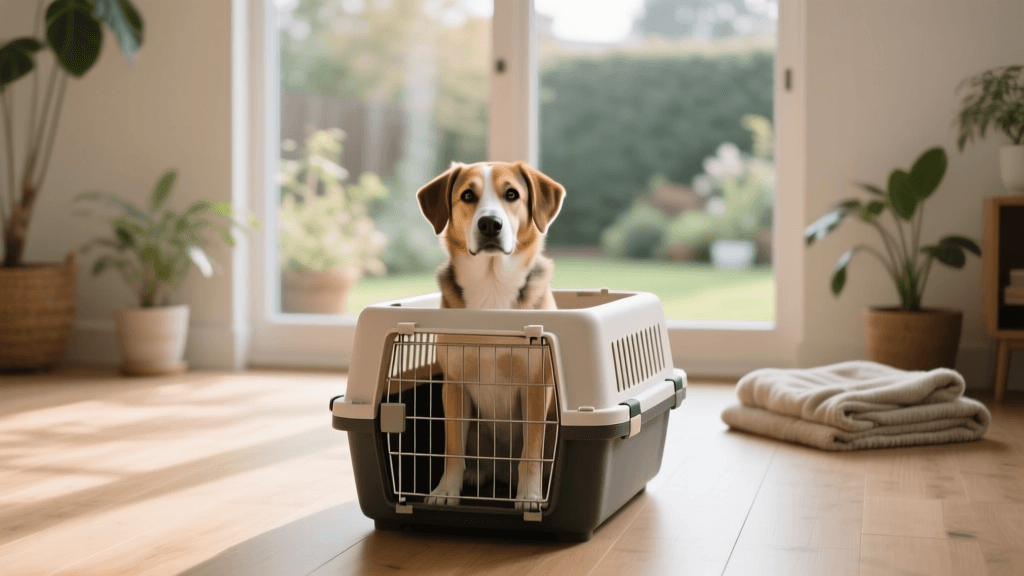
- Elevated or Covered Bedding: An elevated cot like the Coolaroo Steel-Framed Elevated Pet Bed (approx. $35) keeps the dog off cold floors and provides airflow. Alternatively, a covered 'cave' bed or a properly crate-trained wire crate draped with a breathable blanket provides a den-like security.
- Long-Lasting Chews: Reserve high-value items exclusively for the safe zone. When your dog enters the zone, provide a frozen Kong stuffed with plain pumpkin and dog-safe peanut butter, or a yak milk chew. This builds a positive association with retreating to their space.
- Water Station: Always ensure a spill-proof water bowl (such as the Ray Allen Buddy Bowl, around $30) is available so the dog never has to leave the safe zone thirsty.
The 3-Second Consent Test for Petting
Many children believe that if a dog is in the room, it wants to be petted. We must teach kids the concept of canine consent using the '3-Second Rule'.
- Ask the Human: If it is not your family dog, always ask the owner first.
- Invite, Don't Invade: Teach your child to stand sideways (a non-threatening posture) and gently pat their leg or offer an open, relaxed hand at the dog's chest level. Never allow a child to reach over the dog's head or hug the dog's neck.
- The 3-Second Pet: If the dog approaches, the child may gently stroke the dog's chest or shoulder for exactly three seconds.
- Stop and Observe: The child must stop petting and pull their hand away. If the dog leans in, nudges the hand, or steps closer, the dog is consenting to more affection. If the dog turns away, licks its lips, or stays still, the interaction is over.
Using low-calorie training treats like Zuke's Mini Naturals (under 3 calories each) can help parents reward both the dog for calm behavior and the child for executing the 3-second rule correctly.
Interaction Comparison Chart: Safe vs. Unsafe Behaviors
Print this table and post it on your refrigerator to help reinforce daily rules for your children.
| Child's Common Action | How the Dog Perceives It | Safer Alternative to Teach |
|---|---|---|
| Hugging the dog tightly around the neck | Feeling trapped, restrained, and threatened (primates hug; canines do not). | Petting the chest or scratching behind the ears while standing side-by-side. |
| Running and screaming near the dog | Triggering prey drive or causing severe sensory overload and anxiety. | Playing 'statue' or walking calmly when the dog is in the same room. |
| Approaching the dog while it is eating or sleeping | Resource guarding trigger or a startle response leading to a reflexive bite. | 'Let sleeping dogs lie' and never approaching the dog's food bowl or safe zone. |
| Staring directly into the dog's eyes | Perceived as a challenge, threat, or act of aggression. | Looking at the dog's paws or blinking softly while interacting. |
Active vs. Passive Supervision
The final pillar of a safe household is understanding supervision. The American Academy of Pediatrics strongly emphasizes that young children should never be left alone with a dog. However, simply being in the same room while scrolling on your phone is 'passive supervision' and is entirely insufficient.
Active supervision means your eyes are on the child and the dog, you are monitoring the dog's body language, and you are ready to intervene physically within a second. If you need to cook dinner, answer the door, or use the restroom, the child and the dog must be physically separated by a door, a gate, or placed in separate crates. There is no middle ground when it comes to toddlers and dogs.
Conclusion
Creating a safe environment for your kids and your dog is an ongoing process of education and environmental management. By teaching your children the traffic light system of canine body language, investing in sturdy baby gates to create a dog-only sanctuary, and enforcing the 3-second consent test, you are setting both your child and your dog up for success. A harmonious multi-species home doesn't happen by accident; it is built on a foundation of mutual respect, clear boundaries, and proactive parenting.
hannah-wickes
All our authors care for dogs every day — read more of their work on the authors page.