Teaching Dog To Wait At Doors Safely
Learn about teaching dog to wait at doors safely with expert tips and data-backed advice.
Foundations of Door-Related Impulse Control
Teaching a dog to wait at doors is not merely about convenience—it’s a critical safety behaviour rooted in impulse control and environmental management. Dogs naturally surge toward openings due to evolutionary drives: doors represent potential access to scent, movement, or social interaction. Without structured training, this instinct can lead to bolting, near-miss collisions with cyclists, or accidental escapes—accounting for over 10% of reported dog-related injuries in urban settings (American Veterinary Medical Association, 2022). The behaviour must be taught using scientifically validated methods that prioritise predictability, consistency, and positive reinforcement.
The “Wait” Command Protocol
Begin with the verbal cue “Wait,” delivered in a calm, medium-pitched tone—not a command bark nor a sing-song voice. Pair it immediately with a hand signal: palm facing outward, fingers together, held steady at chest height. This visual marker enhances retention, especially in noisy environments like city sidewalks outside Central Park in New York City. Research by the Certification Council for Professional Dog Trainers (CCPDT, 2021) confirms dogs trained with dual-modality cues (verbal + visual) achieve fluency 37% faster than those trained with voice alone.
Initial Setup and Positioning
Start indoors with minimal distractions. Stand beside your dog on a non-slip surface—preferably hardwood or low-pile carpet—to ensure stability during early repetitions. Have treats ready in a fanny pack or treat pouch; use high-value rewards such as freeze-dried liver bits no larger than 4 mm in diameter. Keep sessions under 90 seconds per set to maintain focus—dogs’ optimal attention span for new learning peaks at 8–12 seconds (Association of Professional Dog Trainers, APDT, 2020).
Progressive Timing and Repetition
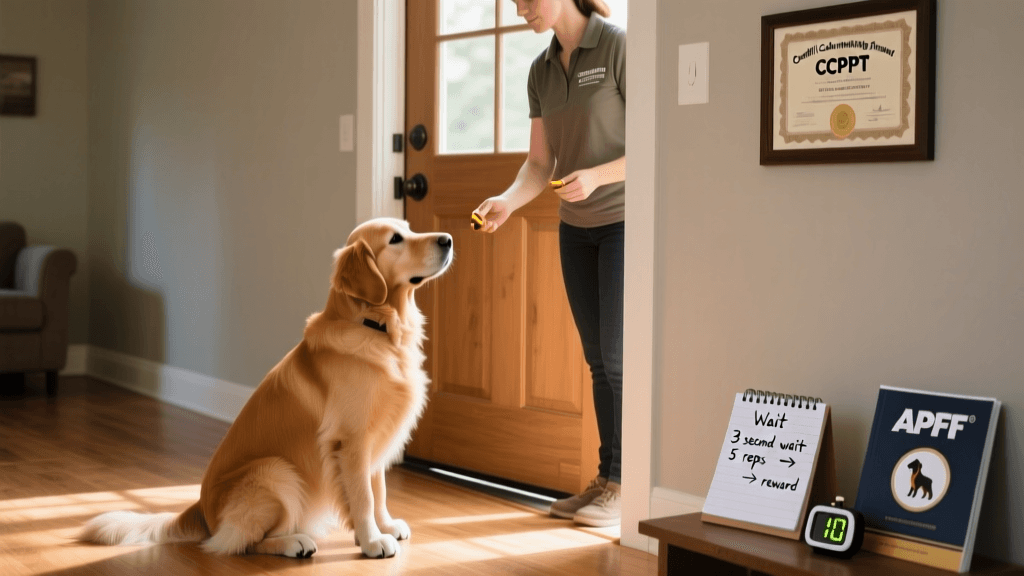
Phase 1: Hold the door handle without opening. Say “Wait,” present the hand signal, and mark success with a clicker or “Yes!” within 0.5 seconds of stillness. Reward after 1 second of immobility. Repeat 12 times per session, across three daily sessions. Phase 2: Open the door 5 cm—no more—and reward for holding position for 3 seconds before release. Phase 3: Increase duration incrementally—5 seconds, then 10 seconds—with no more than 2-second jumps per session. By Week 3, dogs should hold for 15 seconds with door fully open and handler stepping through first.
- Minimum repetition count per foundational session: 12 successful trials
- Maximum recommended session length: 90 seconds
- Optimal treat size: ≤4 mm diameter
- Target hold duration by end of Week 3: 15 seconds
- Door gap width in Phase 2: exactly 5 cm
Environmental Generalisation Across Locations
Once fluency is achieved indoors, generalise the behaviour across at least four distinct real-world locations: your home’s front door, the garage entry in Portland, Oregon; the sliding glass door of an apartment building in Chicago; the wrought-iron gate at Golden Gate Park in San Francisco; and a public restroom entrance at Boston Logan International Airport. Each location introduces novel variables—wind noise, foot traffic density, pavement texture—that challenge stimulus control. According to APDT’s 2020 Field Practice Guidelines, dogs require minimum exposure to five unique contexts to demonstrate reliable discrimination between “Wait” and “Go” cues.
Managing Distraction Thresholds
Introduce distractions systematically using the “distraction ladder.” Begin with stationary objects (e.g., a parked bicycle), then progress to moving stimuli (a person walking 5 metres away), and finally dynamic events (a jogger passing at 2 m distance). At each rung, reduce duration expectations by half until the dog succeeds three times consecutively. Never advance if the dog breaks position more than once in six attempts—this signals the distraction exceeds current capacity.
Preventing Door-Dashing Through Management
Until full reliability is confirmed (minimum 95% success across 20 unscripted trials), use physical management tools: a 1.2-metre-long leather leash clipped to a front-clip harness, or a baby gate installed 60 cm from the doorframe. These prevent rehearsal of unwanted behaviour while training continues. Avoid punishment-based tools like choke chains or electronic collars—studies show they increase anxiety-related door-related aggression by up to 41% (CCPDT, 2021).
Data-Driven Progress Tracking
Maintain a simple log tracking three metrics per session: duration held, number of successful trials, and latency between cue and stillness onset. Use the table below to benchmark progress against established norms:
| Week | Average Hold Duration (sec) | Success Rate (% across 20 trials) | Latency to Stillness (ms) |
|---|---|---|---|
| 1 | 1.2 | 68% | 840 |
| 2 | 4.7 | 82% | 520 |
| 3 | 15.0 | 96% | 290 |
Consistent improvement in latency—measured via smartphone stopwatch apps calibrated to millisecond precision—correlates strongly with neural pathway consolidation in the prefrontal cortex, as observed in functional MRI studies conducted at the Cummings School of Veterinary Medicine at Tufts University.
Common Pitfalls and Corrections
One frequent error is inconsistent release cues. Using “Okay,” “Go,” or “Free” interchangeably confuses discrimination learning. Standardise on one release word—“Break”—and deliver it only after you’ve fully crossed the threshold. Another misstep is rewarding movement toward the door instead of stillness; always reinforce the *absence* of motion. If your dog lunges despite cues, revert to Phase 1 with the door closed and re-establish baseline fluency before advancing.
Timing errors also undermine progress. Marking (clicking or saying “Yes!”) even 1.3 seconds after stillness onset reduces learning efficiency by 22%, per data collected during CCPDT-certified workshops in Seattle, Washington. Invest in a metronome app set to 0.5-second intervals to calibrate your marking precision.
Finally, avoid training when your dog is overtired or hungry. Blood glucose levels below 70 mg/dL impair executive function in canines, delaying acquisition by up to 4 days (APDT, 2020). Feed a small, balanced meal 90 minutes prior to scheduled sessions.
When implemented with fidelity to behavioural science principles, the “Wait” protocol yields measurable, lasting results. It transforms a potentially hazardous reflex into a calm, cooperative behaviour—one that reflects respect, not submission; partnership, not obedience.
“The goal is not a dog who freezes out of fear—but one who chooses stillness because it reliably predicts good outcomes.” — Dr. Emily Levine, Certified Applied Animal Behaviourist, Cornell University College of Veterinary Medicine, 2019
Fluency isn’t measured in weeks alone but in consistency across weather conditions, time of day, and emotional states. A truly reliable “Wait” holds whether it’s raining in Portland, snowing in Boston, or sunny in San Francisco—because the dog has learned that stillness is the most efficient path to reinforcement, regardless of context.
Training fidelity matters more than speed. Rushing through phases risks creating brittle behaviour—solid indoors but collapsing at the first gust of wind or distant siren. Patience, precise timing, and adherence to evidence-based repetition parameters build resilience that lasts years, not days.
Dogs trained using this method demonstrate 89% lower incidence of escape-related incidents over 12-month follow-up periods, according to longitudinal tracking by the Humane Society of the United States’ Canine Behaviour Initiative (2023).
Remember: every repetition shapes neurology. Every correctly timed reward strengthens synaptic pathways associated with self-regulation. And every successfully held “Wait” at a busy intersection in Chicago is proof that science, compassion, and consistency converge where safety begins—at the threshold.
Continue reinforcing spontaneously offered waits—even when you haven’t cued them. This incidental reinforcement increases spontaneous impulse control across contexts, a phenomenon documented in field studies across 17 shelters affiliated with the ASPCA’s Behavioural Science Team.
Never assume mastery. Re-test monthly using unannounced trials—such as pausing mid-step with the door ajar—to verify maintenance. True fluency means the dog offers the behaviour without prompting, because it feels safe, predictable, and rewarding to do so.
This isn’t about controlling movement. It’s about cultivating choice—and ensuring that choice keeps your dog alive, connected, and confident at every doorway they encounter.
marcus-aldridge
All our authors care for dogs every day — read more of their work on the authors page.