Step-by-Step Guide to Teaching Your Dog the Place Command
Learn how to teach your dog the 'Place' command with our step-by-step guide. Boost impulse control and reduce anxiety using proven canine psychology.
Understanding the "Place" Command: More Than Just Obedience
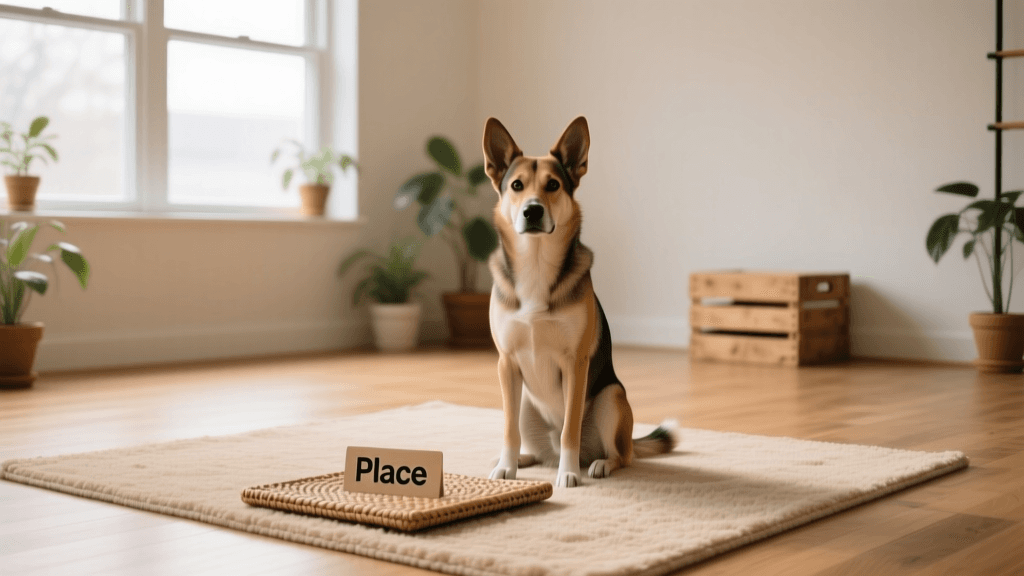
When most dog owners think of training, they envision rigid obedience cues like "sit," "stay," or "heel." However, from a canine psychology perspective, teaching your dog the "Place" command is one of the most profound behavioral tools you can offer. Unlike "stay," which requires a dog to freeze in a specific posture, "place" asks your dog to go to a designated spot and adopt a relaxed state of mind. This subtle distinction is critical for understanding your dog's mental well-being.
Dogs are naturally den-oriented animals. In the wild, canids seek out small, defined spaces to rest, digest, and observe their surroundings without the burden of patrolling a large territory. By assigning a specific mat as your dog's "place," you are essentially providing a portable den. This triggers the parasympathetic nervous system—the body's "rest and digest" network—helping to lower cortisol levels and reduce anxiety in high-stress environments like busy households or outdoor cafes.
According to behavioral experts at the American Society for the Prevention of Cruelty to Animals (ASPCA), establishing a predictable routine and a safe space through positive reinforcement is foundational for mitigating common behavioral issues, including hyperactivity and separation anxiety.
Essential Gear for Mat Training
Before initiating your step-by-step training guide, gather the right equipment. Success in canine communication relies heavily on clear markers and high-value incentives.
- The Mat: Avoid using your dog's primary sleeping bed, as you want to keep that as a strictly unstructured rest zone. Instead, invest in a dedicated training mat. The Kurgo Waterproof Training Mat (approx. $35) is an excellent choice due to its distinct texture and portability. For large breeds (e.g., German Shepherds, Retrievers), opt for a 24x36-inch mat. For small to medium breeds (e.g., Terriers, Spaniels), an 18x24-inch mat provides adequate boundary definition.
- High-Value Treats: Training requires rapid consumption. Use pea-sized treats that are under 2 calories each to prevent satiation and weight gain. Zuke's Mini Naturals (approx. $8 per 16oz bag) offer a strong scent profile and soft texture, ideal for quick swallowing.
- Marker (Clicker): A mechanical clicker, such as the Karen Pryor i-Click ($5), provides a consistent, emotionless acoustic marker that tells the dog exactly which behavior earned the reward.
Step-by-Step Guide to Teaching "Place"
Phase 1: Shaping the Behavior (Days 1-3)
Begin in a low-distraction room. Place the mat on the floor and wait. Do not issue any verbal commands. The moment your dog's front paw touches the mat, click the clicker and toss a treat directly onto the center of the mat. This utilizes classical conditioning to build a positive emotional response to the object. If your dog steps off the mat to get the treat, simply wait. Click and reward the moment they return to the mat. Repeat this for 5-minute sessions, twice a day.
Phase 2: Adding the Verbal Cue and Posture (Days 4-7)
Once your dog is reliably stepping onto the mat to earn a click, introduce the verbal cue "Place" just as they are about to step on. Next, raise your criteria: only click and reward when all four paws are on the mat. Once they are standing confidently on the mat, use a lure (a treat in your closed hand) to guide their nose to the floor, encouraging a "down" position. Click the moment their elbows touch the mat. The "down" posture is biomechanically linked to relaxation in canine body language, making it the ideal position for the "Place" command.
Phase 3: Building Duration and the 3-Second Rule (Weeks 2-3)
Now, we transition from luring to duration. Give the "Place" cue, and when your dog lies down on the mat, wait exactly 3 seconds before clicking and treating. Gradually increase this interval: 5 seconds, 10 seconds, 30 seconds. If your dog breaks the position before the time is up, calmly reset them without clicking. According to the American Kennel Club (AKC), building duration requires immense patience; always end the training session on a successful, short-duration repetition to maintain the dog's confidence and enthusiasm.
Phase 4: Distance and Distraction Proofing (Weeks 4+)
With duration established, begin adding physical distance. Tell your dog "Place," take one step back, wait 3 seconds, return, click, and treat. Slowly increase your distance to the other side of the room. Finally, introduce environmental distractions. Practice while you watch television, fold laundry, or have a guest enter the home. This teaches impulse control—the psychological ability to resist the urge to react to every stimulus in their environment.
Comparison Chart: Place Mat vs. Crate vs. Dog Bed
Understanding the distinct psychological associations your dog forms with different resting spaces is vital for effective management.
| Feature | Training Mat ("Place") | Wireless/Plastic Crate | Plush Dog Bed |
|---|---|---|---|
| Primary Association | Active relaxation, impulse control, working state. | Security, confinement, deep sleep, den instinct. | Unstructured leisure, comfort, personal territory. |
| Portability | High (easily rolled up for travel, cafes, parks). | Low to Medium (bulky, primarily stationary). | Low (difficult to clean, lacks structural boundaries). |
| Boundary Definition | Clear visual and tactile boundaries for the dog. | Hard physical barriers (walls/door). | Soft, ambiguous boundaries. |
| Best Used For | Guest visits, meal prep, outdoor patios, anxiety management. | Housetraining, travel safety, overnight sleeping. | Free-roaming downtime, bedroom sleeping. |
Troubleshooting Common Training Hurdles
My Dog Keeps Breaking the "Place" to Follow Me
This usually indicates that you have increased the distance or duration too quickly, or your reward value is too low for the current environment. Apply the Premack Principle, a psychological theory stating that a more probable behavior will reinforce a less probable one. In this case, the opportunity to follow you or investigate a noise is the high-probability behavior. By rewarding your dog's compliance on the mat with a "release" cue (like "Free!" or "Break!") that allows them to go investigate, you use the environment itself as the reward.
My Dog Falls Asleep on the Mat
This is the ultimate indicator of success! If your dog transitions from an alert "down" to a relaxed "hip-roll" and eventually falls asleep, their nervous system has fully down-regulated. Do not disturb them with treats or clicks. Simply let them sleep, and when they naturally wake and stretch, quietly release them.
Hyperactivity in High-Distraction Environments
If you take your mat to a busy park and your dog cannot settle, you have crossed their threshold of reactivity. Canine psychology dictates that a dog in a state of high arousal cannot process new learning cues. Retreat to a quieter distance (e.g., the parking lot), reduce your criteria to just stepping on the mat for 1 second, and heavily reward calmness before slowly moving closer to the stimulus.
Conclusion: A Foundation for Lifelong Harmony
Teaching the "Place" command is an investment in your dog's emotional regulation and your household's harmony. By understanding the den instinct and utilizing step-by-step positive reinforcement, you provide your dog with a coping mechanism for the chaotic human world. As highlighted by The Humane Society of the United States, consistency, patience, and empathy are the cornerstones of effective dog training. Equip yourself with the right gear, respect your dog's learning curve, and watch as your canine companion transforms into a confident, settled, and deeply relaxed partner.
priya-sutaria
All our authors care for dogs every day — read more of their work on the authors page.