Stop Dog Resource Guarding: Diagnosis and Proven Solutions
Learn how to diagnose and stop resource guarding in dogs. Discover proven behavior modification techniques, trade-up games, and management tips.
Understanding the Psychology Behind Resource Guarding
Resource guarding is one of the most common, yet profoundly misunderstood, behavioral issues in domestic dogs. At its core, resource guarding is a natural survival instinct. In the wild, canines must protect valuable assets—such as food, mates, and safe resting spaces—from competitors to ensure their survival. While our domestic dogs do not face the same life-or-death scarcity, the evolutionary psychology remains deeply wired into their brains. When a dog perceives that a high-value item might be taken away, their sympathetic nervous system triggers a fight-or-flight response.
As pet owners, it is crucial to recognize that resource guarding is not a display of "dominance" or a sign that your dog does not respect you. According to the American Kennel Club (AKC), guarding is an emotional response rooted in anxiety and fear of loss, rather than a calculated attempt to assert alpha status. Understanding this psychological distinction is the first and most critical step toward diagnosing the problem and implementing effective, compassionate solutions.
Diagnosing the Problem: The Canine Escalation Ladder
Many owners believe resource guarding appears out of nowhere, usually when a dog suddenly snaps or bites. In reality, dogs communicate their discomfort through a predictable escalation ladder long before a bite occurs. Diagnosing the severity of your dog's guarding requires careful observation of their body language. The RSPCA emphasizes that learning to read subtle calming signals and early warning signs can prevent incidents and guide your training approach.
Below is a diagnostic table to help you identify where your dog currently sits on the resource guarding escalation ladder:
| Escalation Stage | Observable Body Language | Recommended Action |
|---|---|---|
| Stage 1: Subtle Tension | Freezing, hard staring at the approaching person, whale eye (showing the whites of the eyes), eating faster. | Stop approaching immediately. Begin Desensitization and Counterconditioning (DS/CC) from a distance. |
| Stage 2: Active Warning | Lip licking, yawning, low growl, stiffening of the shoulders, hovering closely over the item. | Do not punish the growl. Toss a high-value treat away from the item to create distance and relieve pressure. |
| Stage 3: Overt Threat | Snapping at the air, baring teeth, lunging while on a leash or tethered to the object. | Implement strict environmental management. Consult a certified veterinary behaviorist immediately. |
| Stage 4: Contact Bite | Making physical contact with teeth, ranging from an inhibited warning nip to a full puncture bite. | Seek emergency professional intervention. Muzzle condition the dog for safety during management. |
Actionable Solutions: A Step-by-Step Modification Plan
Resolving resource guarding requires a two-pronged approach: immediate environmental management to ensure safety, and long-term behavior modification to change the dog's underlying emotional response. Below is a comprehensive, actionable protocol to help your dog feel secure.
Step 1: Environmental Management and Safety
Before you can train, you must manage the environment to prevent rehearsing the unwanted behavior. Every time a dog successfully guards an item (e.g., they growl and the owner backs away), the behavior is reinforced. Management prevents this rehearsal.
- Pick up the environment: Remove high-value triggers like raw bones, pig ears, or stuffed Kongs when you cannot actively supervise.
- Feed in isolation: Feed your dog in a separate room, a crate, or behind a baby gate. Do not allow children or other pets near the dog during meal times.
- Invest in enrichment alternatives: Instead of long-lasting chews that trigger guarding, use scatter feeding or a Snuffle Mat ($25 to $40) to encourage natural foraging instincts without creating a single, highly guardable focal point.
Step 2: The "Trade-Up" Game Protocol
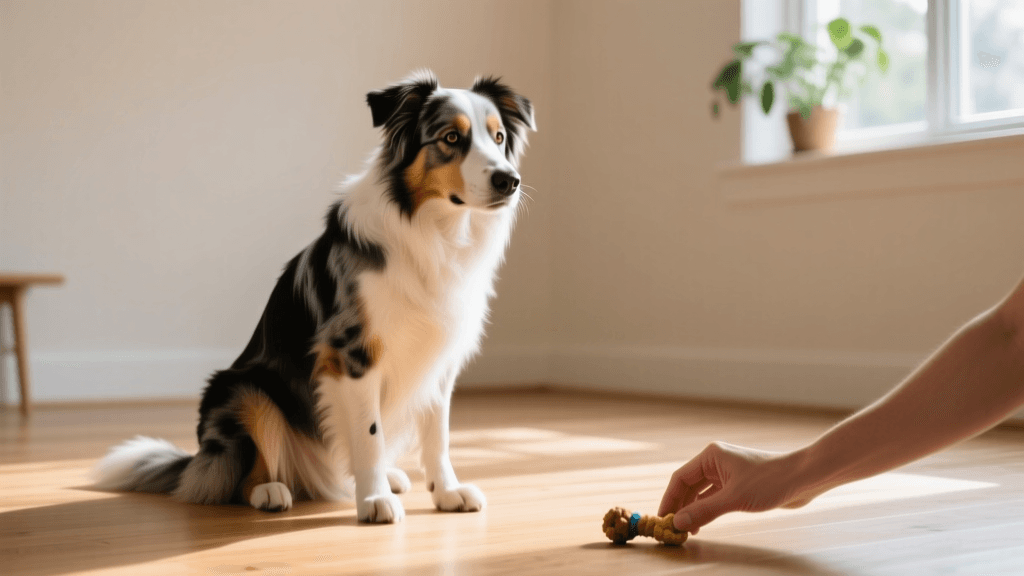
The Trade-Up game teaches your dog that giving up an item results in something significantly better. This shifts the dog's mindset from "they are stealing from me" to "they are the bringer of better things."
Materials Needed: A low-value item (e.g., a boring rubber toy) and a high-value treat (e.g., Ziwi Peak air-dried venison or Stella & Chewy's freeze-dried beef liver, costing roughly $20 to $35 per bag).
- Offer your dog the low-value toy and let them engage with it for 10 to 15 seconds.
- Present the high-value treat right at their nose. Do not reach for the toy yet.
- The moment your dog drops the toy to eat the treat, calmly pick up the toy and toss it out of sight.
- Repeat this process 5 to 10 times per session, keeping sessions under 3 minutes to avoid cognitive fatigue.
- Once your dog is readily dropping the toy, introduce a verbal cue like "Drop it" or "Trade" exactly one second before presenting the treat.
Step 3: Desensitization and Counterconditioning (DS/CC)
If your dog guards their food bowl or a specific resting place, the Trade-Up game is less effective than DS/CC. The goal is to change the emotional association of a person approaching from a negative (threat) to a positive (predictor of amazing food).
Timing and Measurements: You must work "under threshold." If your dog usually stiffens when you are 5 feet away, your starting distance must be 10 to 15 feet.
- Stand at your dog's threshold distance while they eat their standard kibble from a bowl.
- Every 3 to 5 seconds, toss a piece of high-value treat (like boiled chicken breast or hot dogs) directly into or right next to their bowl.
- Do not make eye contact, and do not reach toward the bowl. Simply toss and retreat slightly.
- After 2 minutes, calmly walk away.
- Over the course of several weeks, decrease the distance by 1 to 2 feet per week, provided the dog remains relaxed and shows no signs of Stage 1 tension.
What NOT to Do: Avoiding the Punishment Trap
Historically, outdated training advice suggested that owners should forcibly take items from puppies to "show them who is boss." Modern veterinary science has thoroughly debunked this approach. The ASPCA strongly advises against using physical punishment, alpha rolls, or yelling to correct resource guarding.
Punishing a growl does not cure resource guarding; it merely suppresses the warning system. A dog that is punished for growling will eventually learn to skip the warning entirely and proceed straight to biting.
Never put your dog in a position where they feel forced to bite to protect themselves. Avoid the following common mistakes:
- Never play "keep away": Chasing your dog to retrieve a stolen item turns guarding into a high-arousal game and reinforces the idea that you will chase them to steal their prize.
- Do not put your hands in the food bowl: Hovering your hands over a dog's meal creates unnecessary anxiety and can manufacture a guarding problem in a dog that previously had none.
- Never corner the dog: If a dog has stolen a dangerous item (like a medication pill), do not corner them. Use the Trade-Up protocol or create a distraction (like ringing the doorbell) to lure them away safely.
When to Seek Professional Help
While mild to moderate resource guarding can often be managed and improved with consistent, positive reinforcement training at home, severe cases require professional intervention. If your dog has progressed to Stage 3 or Stage 4 on the escalation ladder, or if the guarding is directed toward children, you must prioritize safety above all else.
Seek out a certified professional, such as a Certified Applied Animal Behaviorist (CAAB) or a veterinarian specializing in behavior. Expect to invest between $150 and $300 per hour for private behavioral consultations. A professional will help you implement a customized safety plan, teach you how to properly condition your dog to wear a basket muzzle for emergency management, and guide you through advanced DS/CC protocols tailored to your specific household environment. With patience, empathy, and the right scientific approach, you can help your dog feel secure and transform resource guarding from a dangerous liability into a manageable, resolved behavior.
beth-carrasco
All our authors care for dogs every day — read more of their work on the authors page.