Stop Dog Leash Reactivity: Diagnosis and Proven Solutions
Discover why your dog lunges and barks on walks. Learn actionable diagnosis steps and proven solutions to cure leash reactivity using positive reinforcement.
Understanding Leash Reactivity: More Than Just 'Bad Behavior'
Walking your dog should be a relaxing bonding experience, but for owners of leash-reactive dogs, it often feels like navigating a minefield. Leash reactivity—characterized by barking, lunging, growling, or pulling toward other dogs, people, or vehicles—is one of the most common behavioral issues reported by pet parents. It is crucial to understand that reactivity is not necessarily a sign of a 'mean' or aggressive dog. According to the American Kennel Club (AKC), reactivity is frequently a symptom of underlying anxiety, fear, or severe overstimulation rather than true malice. When a dog is attached to a leash, their natural flight response is restricted, leaving them with only one perceived option: fight. This feeling of being trapped amplifies their emotional response, resulting in explosive behavior designed to increase the distance between themselves and the perceived threat.
To effectively solve this problem, we must move away from punitive measures like prong collars or leash corrections, which only suppress the outward symptoms while increasing the dog's internal panic. Instead, we must diagnose the root emotional cause and implement a structured, positive-reinforcement-based training protocol that changes how the dog feels about their triggers.
Diagnosing the Root Cause: Fear vs. Frustration
Before you can implement a solution, you must accurately diagnose the motivation behind your dog's reactivity. Reactivity generally falls into two distinct categories: fear-based (distance-increasing) and frustration-based (distance-decreasing). Misdiagnosing the root cause can lead to ineffective training and prolonged stress for both you and your dog.
| Behavioral Feature | Fear-Based Reactivity | Frustration-Based Reactivity |
|---|---|---|
| Primary Goal | Make the trigger go away (increase distance) | Reach the trigger to interact (decrease distance) |
| Body Language | Stiff posture, tucked tail, whale eye, pinned ears, raised hackles | Loose wiggly body, high waving tail, whining, play bows, pawing |
| Off-Leash Behavior | Typically avoids, hides, or flees from other dogs | Typically rushes up to play, often with poor social manners |
| Response to Correction | Worsens fear and can lead to defensive biting | Can cause redirected aggression due to barrier frustration |
The ASPCA emphasizes that identifying specific triggers and understanding the dog's emotional state is the cornerstone of behavioral modification. If your dog is fearful, the goal is to build confidence and create positive associations. If your dog is frustrated, the goal is to teach impulse control and calmness.
The Threshold Concept: Measuring Your Dog's Limits
A fundamental concept in behavioral conditioning is the 'threshold.' This is the physical distance between your dog and their trigger at which they notice the trigger but remain under their emotional boiling point. If a dog is 50 feet away from another dog and can easily take a treat, they are 'under threshold.' If they are 10 feet away, refuse food, and are barking, they are 'over threshold.'
Training cannot occur when a dog is over threshold. The canine brain's amygdala hijacks the prefrontal cortex, making learning biologically impossible. Your first step in solving reactivity is to identify your dog's specific threshold distance. This might be 30 feet for a mild case, or 100 feet for a severe case. You must manage all walks to ensure your dog remains under this distance while you begin your conditioning work.
Essential Gear for Reactive Dog Training
Having the right equipment is non-negotiable for safety and effective communication. Avoid retractable leashes and neck collars, which can cause physical injury during a lunge. Invest in the following specific tools:
- Front-Clip Harness: A harness with a leash attachment on the chest, such as the Ruffwear Front Range Harness (Approx. $40). This gently redirects the dog's momentum back toward you if they lunge, preventing them from pulling with their full body weight.
- 15-Foot Biothane Long Line: A fixed-length, waterproof long line (Approx. $25-$35). This gives your dog enough space to sniff and decompress while maintaining total control, unlike a retractable leash which creates constant tension.
- High-Value Treats: Dry kibble will not work in high-stress environments. Use soft, smelly treats like Zuke's Mini Naturals, boiled chicken breast, or freeze-dried beef liver (Approx. $8-$15).
- Treat Pouch: A quick-access silicone or canvas pouch worn on your hip (Approx. $15) to ensure treat delivery happens within one second of the desired behavior.
Actionable Solutions: Step-by-Step Training Protocols
Protocol 1: The Engage/Disengage Game (Look At That)
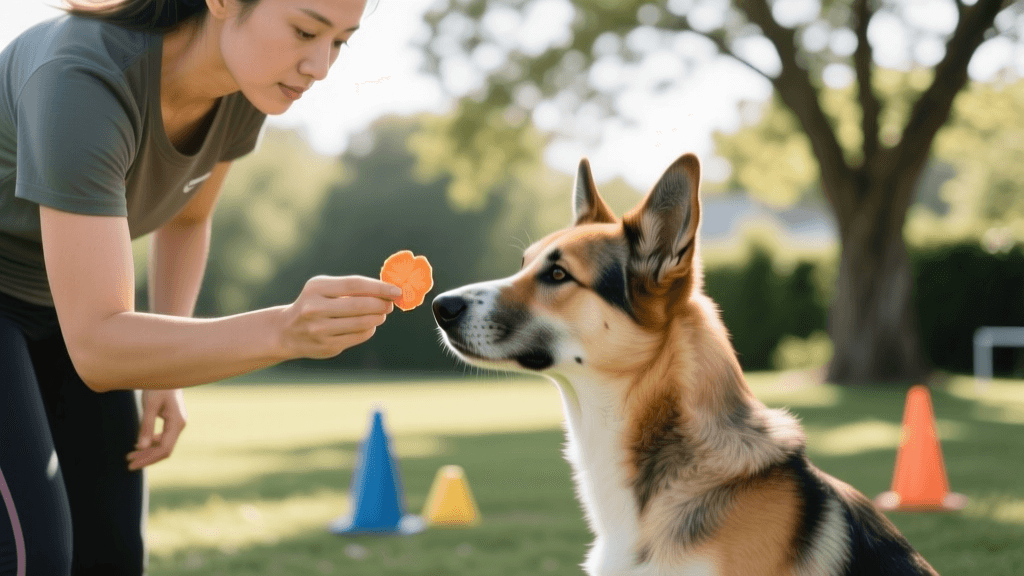
This game, rooted in classical counter-conditioning, teaches the dog that seeing a trigger predicts a high-value reward, changing their emotional response from 'threat' to 'treat dispenser.'
- Setup: Stand with your dog at their known threshold distance (e.g., 40 feet from a park where dogs pass).
- Engage: The moment your dog looks at the trigger, use a verbal marker like 'Yes!' or click a clicker. You are marking the exact millisecond they notice the trigger.
- Disengage: Immediately present the high-value treat at your dog's nose, luring them to turn their head away from the trigger and toward you. Feed the treat.
- Repeat: Wait for them to look back at the trigger and repeat the process. Over time (usually 2 to 4 weeks of daily practice), the dog will begin to voluntarily look at the trigger and then immediately look back at you for their reward without needing the verbal marker.
Pro Tip: Timing is everything. The treat must be delivered within 1 to 2 seconds of the marker. If the dog breaks threshold and starts barking, calmly increase your distance by 10 feet and try again.
Protocol 2: The Emergency U-Turn
Even with careful management, you will inevitably encounter a surprise trigger that breaches your dog's threshold. The Emergency U-Turn is a management tool that allows you to quickly retreat without dragging your dog by the leash.
- Practice Indoors First: With your dog off-leash in a hallway, take a few steps forward, say 'Let's Go!', turn 180 degrees, and run the other way while patting your leg.
- Reward Heavily: When the dog catches up to you, throw a jackpot of 3 to 5 treats on the floor.
- Add the Leash: Practice in the yard with the 15-foot line. Introduce mild distractions.
- Deploy in the Real World: When a dog suddenly rounds a corner 10 feet away, immediately say 'Let's Go!', pivot, and jog away. This taps into the dog's natural chase instinct, pulling them away from the trigger before they have time to react.
Management Strategies for Daily Walks
While training changes the dog's emotional state over months, management keeps everyone safe today. Management involves altering the environment to prevent rehearsing the reactive behavior. Every time your dog practices lunging, the neural pathway for that behavior is strengthened.
Utilize 'visual barriers' during your walks. If you see a dog approaching on the sidewalk, calmly cross the street. If a dog is in a yard behind a fence, step behind a parked car or a large tree to block your dog's line of sight. Advocate for your dog by politely telling approaching strangers, 'My dog is in training and needs space, please do not approach.' Walk during off-peak hours, such as early morning or late evening, to minimize unexpected encounters.
When to Call a Professional
While many dogs improve significantly with dedicated owner-led training, some cases require professional intervention. Veterinary behaviorists often recommend consulting a certified professional if the dog shows signs of redirected aggression, severe resource guarding, or if the owner feels physically unsafe, as noted by experts at Penn State Extension. If your dog bites, injures other animals, or causes you physical harm, seek out a Certified Applied Animal Behaviorist (CAAB) or a veterinarian specializing in behavior. They can assess whether anti-anxiety medication, such as fluoxetine or trazodone, is necessary to lower the dog's baseline arousal levels enough for training to take hold.
Conclusion
Curing leash reactivity is not a sprint; it is a marathon that requires patience, consistency, and empathy. By accurately diagnosing whether your dog is acting out of fear or frustration, managing their environment to keep them under threshold, and utilizing positive reinforcement protocols like the Engage/Disengage game, you can fundamentally change how your dog perceives the world. With the right gear, a solid management plan, and a commitment to understanding your dog's emotional needs, those stressful, embarrassing walks can eventually transform into the peaceful outings you both deserve.
anouk-beaumont
All our authors care for dogs every day — read more of their work on the authors page.