Step-by-Step Puppy Potty Training Using a Crate Guide
Master puppy potty training with our step-by-step crate guide. Learn schedules, crate sizing, and actionable tips for a mess-free first year.
The Foundation of Puppy Potty Training
Bringing a new puppy home is an exhilarating experience, but it quickly becomes apparent that potty training is one of the most demanding challenges of the first year. At Paws-Tales, we believe that successful housebreaking is not about luck; it is about consistency, environment management, and understanding canine biology. This step-by-step guide focuses on utilizing crate training as your primary tool for potty success. According to the American Kennel Club (AKC), dogs naturally avoid soiling their sleeping areas, making the crate an invaluable ally in teaching bladder control and establishing a reliable routine.
Step 1: Selecting and Sizing the Right Crate
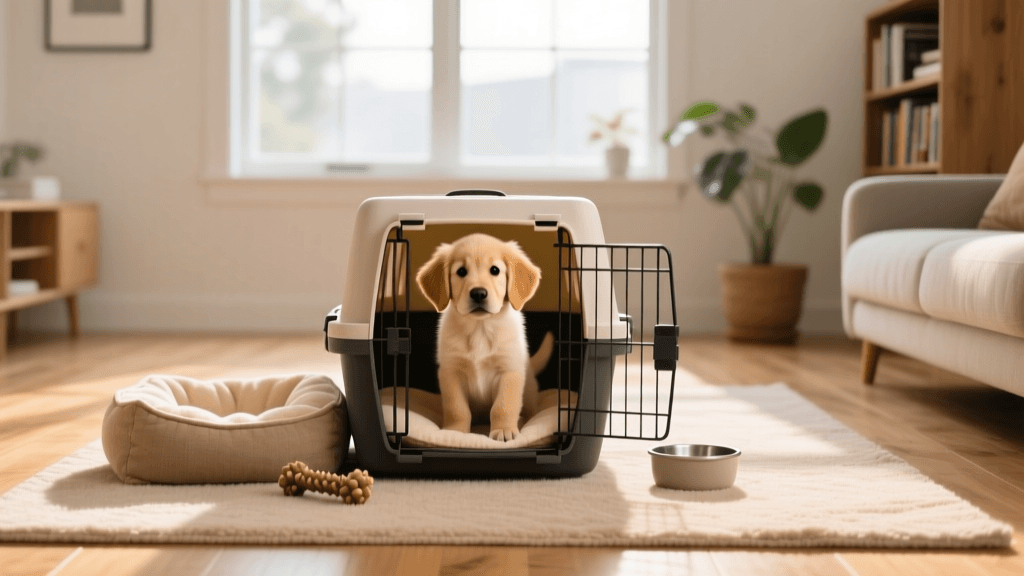
The first step in this journey is purchasing the correct crate. If a crate is too large, your puppy will designate one corner for sleeping and another for eliminating, entirely defeating the purpose of the training. Conversely, a crate that is too small will cause physical discomfort and anxiety. We highly recommend wire crates with adjustable divider panels, such as the MidWest Homes for Pets iCrate (typically priced between $45 and $80 depending on size). The divider allows you to buy a crate sized for your dog's expected adult weight while restricting the space to match their current puppy size.
Your puppy should be able to stand up, turn around, and lie down comfortably, but not have enough extra room to wander away from their bed to relieve themselves. Below is a general sizing chart to help you select the right crate based on your puppy's anticipated adult weight.
| Expected Adult Weight | Crate Length | Crate Width | Example Breeds |
|---|---|---|---|
| 11 - 25 lbs | 24 inches | 18 inches | Beagle, Corgi, French Bulldog |
| 26 - 40 lbs | 30 inches | 21 inches | Bulldog, Cocker Spaniel |
| 41 - 70 lbs | 36 inches | 24 inches | Labrador, Boxer, Border Collie |
| 71 - 90 lbs | 42 inches | 28 inches | Golden Retriever, Rottweiler |
Step 2: Establishing a Biologically Sound Schedule
Puppies have tiny bladders and rapid metabolisms. You cannot expect an eight-week-old puppy to hold their bladder for an eight-hour workday. The golden rule of puppy potty training is the 'Month Plus One' rule. Take your puppy's age in months and add one; this is the maximum number of hours they can comfortably hold their bladder during the day. For example, a two-month-old (eight-week) puppy can hold it for roughly three hours. However, during active play or immediately after meals, this window shrinks dramatically.
To set your puppy up for success, you must adhere to a strict daily schedule. Here is a baseline routine for a 10-week-old puppy:
- 7:00 AM: Wake up, immediate potty break outside.
- 7:30 AM: Breakfast. Remove food bowl after 15 minutes.
- 8:00 AM: Potty break outside (puppies usually need to go 15-30 minutes after eating).
- 9:00 AM: Nap time in the crate.
- 11:00 AM: Wake up, immediate potty break, followed by play and training.
- 12:00 PM: Potty break outside.
- 12:30 PM: Lunch. Remove food bowl after 15 minutes.
- 1:00 PM: Potty break outside.
- 1:30 PM: Nap time in the crate.
Consistency in feeding times directly translates to consistency in elimination times. Free-feeding (leaving food out all day) makes potty training nearly impossible because you cannot predict when your puppy will need to go.
Step 3: The Step-by-Step Outdoor Potty Routine
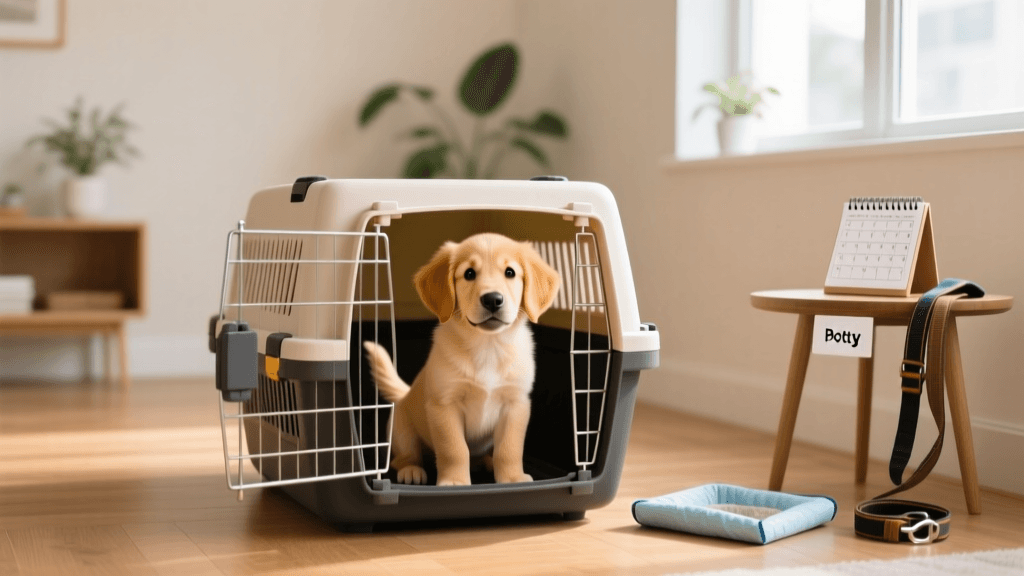
When it is time to go outside, do not simply open the back door and hope for the best. You must orchestrate the experience. Attach a standard 6-foot leather or nylon leash to a well-fitted harness, like the Rabbitgoo No-Pull Dog Harness (around $25). Avoid retractable leashes, as they do not give you the precise control needed to guide your puppy to a specific 'potty zone' in your yard.
Walk your puppy to the exact same spot every single time. The scent of their previous eliminations will act as a powerful biological trigger. Use a consistent verbal cue, such as 'Go Potty' or 'Do Your Business,' spoken in a calm, encouraging tone the moment they begin to eliminate. The moment they finish, immediately reward them with a high-value treat. We recommend Zuke's Mini Naturals (approximately $8 for a 16oz bag), as they are small, low-calorie, and highly palatable. Deliver the treat within two seconds of them finishing so they associate the reward directly with the act of eliminating outdoors.
Step 4: Managing Nighttime Potty Breaks
Nighttime training requires a separate strategy. To minimize middle-of-the-night wake-ups, remove your puppy's water bowl exactly two hours before bedtime. If you plan to sleep at 11:00 PM, pick up the water at 9:00 PM. Ensure they get a final, thorough potty break right before they go into their crate for the night.
Place the crate in your bedroom or just outside your door for the first few weeks. This allows you to hear them whine or stir when they need to go out. When they wake you up at 3:00 AM, keep the interaction entirely business-like. Keep the lights dim, do not speak to them in a playful tone, and do not engage in play. Leash them, carry them outside to their potty spot, wait for them to go, reward them quietly, and immediately return them to the crate. This teaches them that nighttime wake-ups are strictly for bathroom breaks, not for socializing.
Step 5: Handling Accidents with Enzymatic Cleaners
Accidents are an inevitable part of the puppy care journey. How you react and clean up will dictate how quickly your puppy learns. Never punish a puppy for an accident, especially if you did not catch them in the act. Rubbing their nose in it or yelling will only teach them to hide from you when they need to eliminate, leading to them sneaking behind furniture to pee. Instead, interrupt the behavior if caught in the act with a sharp 'Ah-ah!', immediately scoop them up, and carry them outside to finish.
Cleaning the accident site requires more than standard household soap. You must use an enzymatic cleaner, such as Nature's Miracle Advanced Stain and Odor Eliminator (about $15 per bottle). Standard cleaners leave behind uric acid crystals that are undetectable to human noses but act as a beacon for your puppy's highly sensitive olfactory system. Enzymatic cleaners break down these proteins entirely, removing the biological invitation to re-soil the same carpet or rug.
Expert Insights on Crate Training and Milestones
Integrating crate training with early socialization and positive reinforcement yields the best long-term behavioral outcomes. The ASPCA emphasizes that a crate should never be used as a place of punishment. It must be introduced as a safe den, utilizing puzzle toys like the Kong Classic stuffed with frozen peanut butter to build positive associations while you are away or busy.
Furthermore, the Humane Society of the United States advises keeping a meticulous log of your puppy's eating, drinking, and elimination times during the first few weeks. This data helps you identify your puppy's unique biological rhythms, allowing you to preemptively take them outside before an accident occurs.
'Patience and consistency are the most important tools in your potty training arsenal. Puppies are not being stubborn when they have an accident; they are simply learning a completely new set of rules in a foreign environment.' - Paws-Tales Senior Training Staff
Tracking Developmental Milestones
As your puppy grows, their bladder capacity and muscle control will improve. Here is what you can expect during the first year:
- 8 to 12 Weeks: Very little bladder control. Requires potty breaks every 1 to 2 hours during the day, plus multiple night breaks.
- 3 to 4 Months: Bladder control improves. Can hold it for 3 to 4 hours during the day. Nighttime sleep stretches to 5 or 6 hours.
- 5 to 6 Months: Most puppies can sleep through the night (7-8 hours) without a potty break. Daytime holding capacity reaches 5 to 6 hours.
- 7 to 12 Months: Considered fully house-trained in most environments, though adolescent regression can occur. Stick to your schedule and reward system to maintain good habits.
Conclusion
Potty training a puppy using a crate is a highly effective, humane, and structured approach to housebreaking. By selecting the right size crate, adhering to a biologically appropriate feeding and potty schedule, and utilizing high-value rewards and enzymatic cleaners, you will navigate the first year of puppy ownership with far less stress. Remember that every puppy learns at their own pace. Stay patient, keep your routines consistent, and celebrate the small victories along the way. Your dedication during these early months will lay the groundwork for a lifetime of trust and a clean, happy home.
priya-sutaria
All our authors care for dogs every day — read more of their work on the authors page.