Smart Treat Training: Managing Canine Weight and Nutrition
Learn how to use positive reinforcement training without causing weight gain. Discover low-calorie treats, portion control, and nutrition tips for dogs.
The Conflict Between Treat-Based Training and Canine Obesity
Positive reinforcement is the gold standard for canine behavioral conditioning, obedience training, and trick teaching. However, this highly effective methodology relies heavily on food rewards, creating a distinct conflict with canine health and nutrition. According to the Association for Pet Obesity Prevention (APOP), an estimated 56% of dogs in the United States are overweight or obese. When you are conducting multiple training sessions a week, the cumulative caloric intake from high-value treats can easily push your dog into a caloric surplus, leading to joint stress, metabolic dysfunction, and a shortened lifespan.
Understanding Your Dog's Daily Caloric Needs
To train effectively without compromising your dog's waistline, you must first understand their Daily Energy Requirement (DER). This is not a static number; it fluctuates based on age, breed, neuter status, and activity level. The World Small Animal Veterinary Association (WSAVA) provides comprehensive guidelines for calculating a dog's resting energy requirement (RER) using the formula: RER = 70 x (body weight in kg)^0.75. Once you have the RER, you multiply it by a specific factor (e.g., 1.6 for a neutered adult dog, 2.0 for an intact adult, or up to 3.0 for a highly active working dog).
For example, a 20 kg (44 lb) neutered adult dog has an RER of roughly 650 kcal. Multiplied by 1.6, their DER is approximately 1,040 kcal per day. If you are doing intense agility training, you might use a multiplier of 2.0, bringing the DER to 1,300 kcal. Knowing this baseline is the first step in nutrition-safe training.
The 10% Rule: Balancing Meals and Training Rewards
Veterinary nutritionists universally recommend the '10% Rule.' This dictates that treats, chews, and training rewards should never constitute more than 10% of your dog's total daily caloric intake. The remaining 90% must come from a complete and balanced commercial or veterinary-formulated home-cooked diet.
If your dog's DER is 1,000 kcal per day, their treat allowance is strictly 100 kcal. If you are running a 30-minute obedience session and using standard training treats that contain 15 kcal each, you will exhaust your dog's daily treat allowance in less than seven repetitions. This is where strategic treat selection and meal deduction become critical components of your training protocol.
High-Value vs. Low-Value Rewards: A Caloric Breakdown
Not all training scenarios require the same level of reward. 'Low-value' rewards are best for familiar behaviors in low-distraction environments (like practicing 'sit' in your living room), while 'high-value' rewards are reserved for high-distraction environments, recall training, or counter-conditioning. Below is a comparison chart of popular training rewards, detailing their caloric density, approximate cost, and ideal training use case.
| Treat Type | Calories Per Unit | Avg. Cost Per Ounce | Best Training Use Case |
|---|---|---|---|
| Zuke's Mini Naturals | 3 kcal | $0.65 | Rapid-fire marking, shaping behaviors, puppy socialization |
| Charlie Bear Crunchies | 3 kcal | $0.40 | Low-distraction obedience, basic manners, household rules |
| Blue Buffalo Bits | 3.5 kcal | $0.75 | Intermediate trick training, loose-leash walking |
| Boiled Chicken Breast (10g) | 16 kcal | $0.30 | High-distraction recall, emergency drop it, vet prep |
| Freeze-Dried Beef Liver (5g) | 18 kcal | $1.20 | Counter-conditioning, reactivity training, high-value jackpot |
| Frozen Green Beans | 1 kcal | $0.10 | Weight management dogs, repetitive trick shaping, volume feeding |
Strategic Treat Delivery and Treat Stretching
When working with overweight dogs or conducting long-duration training sessions (such as scent work or endurance agility), you must employ treat stretching techniques. This involves maximizing the psychological impact of a reward while minimizing the caloric footprint.
- The Lick Mat Technique: Spread 2 tablespoons of plain, non-fat Greek yogurt or pureed pumpkin (ensure it contains no xylitol) onto a textured silicone lick mat and freeze it. Licking releases endorphins in dogs, providing a soothing, high-value reward for settling on a place mat or enduring grooming sessions, all for under 25 calories.
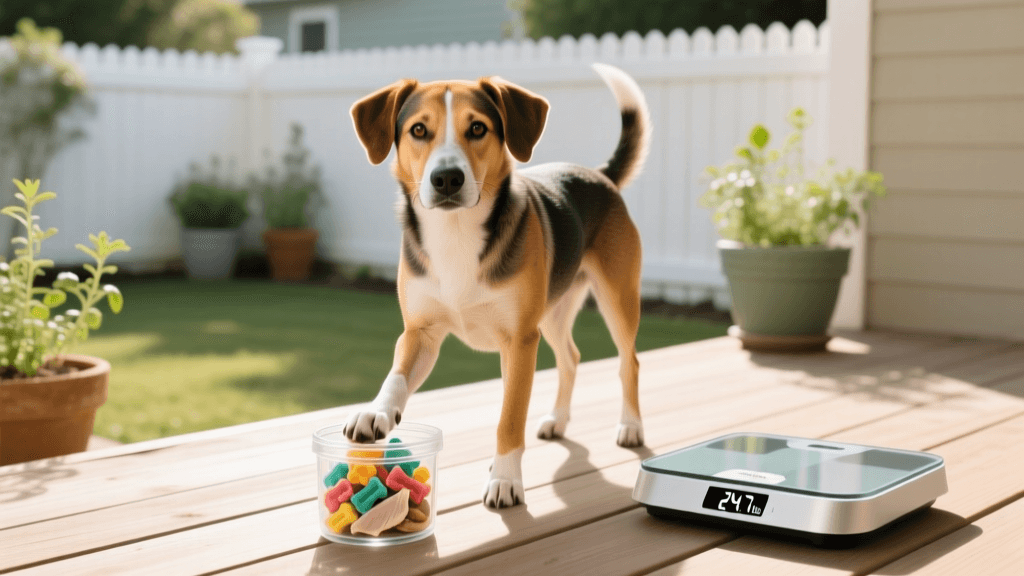
- Kibble Deduction: Measure out your dog's daily kibble allocation in the morning using a digital kitchen scale (accuracy to the gram is vital). Place 20% of this daily kibble into your training treat pouch. You are now training with their actual meals, ensuring zero caloric surplus.
- Scent Work Jackpots: Instead of giving one large 50-calorie biscuit for a successful find, deliver five 3-calorie treats in rapid succession. Dogs perceive the frequency of the reward as more exciting than the volume, triggering a stronger dopamine response without the heavy caloric load.
Decoding Commercial Treat Labels for Training
When selecting commercial rewards for repetitive obedience drills, reading the guaranteed analysis is non-negotiable. Many mass-market training treats are loaded with fillers like corn syrup, molasses, and glycerin, which spike blood sugar and lead to energy crashes during long training sessions. Look for treats where a named animal protein (e.g., deboned chicken, salmon) is the first ingredient.
Furthermore, pay attention to the moisture content. Soft and chewy treats typically have a moisture content of 20-30%, making them highly palatable but more calorie-dense by volume than freeze-dried options. If you are doing rapid-fire shaping (like clicker training for complex tricks), opt for single-ingredient freeze-dried treats that can be easily crumbled into pea-sized pieces. A single freeze-dried minnow or beef heart piece can be broken into three or four micro-rewards, allowing you to mark and reward precise behaviors without overfeeding.
Alternative Reinforcers: Beyond the Treat Pouch
Relying exclusively on food can lead to a dog that only obeys when they see the treat pouch. Furthermore, for dogs on strict veterinary weight-loss diets, food-based reinforcement must be heavily restricted. The American Veterinary Medical Association (AVMA) emphasizes that environmental and social rewards are crucial for a holistic training approach.
Toy and Play Reinforcement
For dogs with high prey drive, a 10-second game of tug or a throw of a flirt pole can be far more reinforcing than a piece of chicken. Use a dedicated training toy that only comes out during work sessions. This builds immense drive for obedience tasks like heelwork and recall, entirely bypassing the digestive system.
Premack Principle (Life Rewards)
The Premack Principle states that a more probable behavior can be used to reinforce a less probable behavior. For example, if your dog wants to go outside to sniff the yard (high probability), require them to perform a sit and wait at the door (low probability). The act of opening the door and releasing them to the yard is the reward. Sniffaris (decompression walks where the dog leads the way and sniffs at will) are excellent rewards for completing a focused 15-minute heelwork session.
Adjusting Meal Portions for Heavy Training Days
If you are competing in dog sports, attending a weekend-long training seminar, or doing intensive behavioral modification, your dog's physical and mental energy expenditure will spike. Mental processing burns a significant amount of glucose. On these heavy training days, it is acceptable to temporarily increase your dog's DER by 10-15%. However, this increase should come from nutrient-dense, high-protein, and moderate-fat meals rather than empty-calorie commercial treats.
Consider adding a topper of bone broth (low sodium, onion/garlic-free) or a scrambled egg (approx. 70 kcal) to their morning meal to provide sustained energy for cognitive tasks. Always monitor your dog's Body Condition Score (BCS) weekly. You should be able to easily feel their ribs without pressing hard, and they should have a visible abdominal tuck when viewed from the side.
Conclusion
Training your dog should never come at the expense of their metabolic health. By understanding the mathematics of canine nutrition, adhering to the 10% rule, utilizing low-calorie high-value alternatives, and incorporating life rewards, you can build a reliable, enthusiastic obedience foundation. Smart treat management ensures your dog remains physically agile, mentally sharp, and ready to learn for years to come.
anouk-beaumont
All our authors care for dogs every day — read more of their work on the authors page.