Signs Of Pain In Dogs That Owners Miss
Learn about signs of pain in dogs that owners miss with expert tips and data-backed advice.

How Dogs Hide Discomfort — and What That Means for You
Dogs are descended from animals that survived by concealing weakness. In the wild, showing pain invites predation and social displacement, so the instinct to mask suffering runs deep. This evolutionary legacy means that by the time most owners notice something is wrong, their dog has often been hurting for days, weeks, or even months. The British Small Animal Veterinary Association (BSAVA, 2022) estimates that chronic pain is underdiagnosed in at least 40% of dogs presenting to general practice, largely because the signs are subtle, gradual, and easy to rationalise as normal ageing or a "quiet day."
Understanding what pain actually looks like in dogs — rather than what we expect it to look like — is one of the most practical things an owner can do for their pet's welfare. This article walks through the real, often-missed indicators, explains the physiology behind them, and gives you a framework for deciding when a vet visit is urgent.
The Myth of the Yelping Dog
Most people associate pain in dogs with vocalisation: whimpering, yelping, or crying. While acute, sudden pain — a thorn in the paw, a bee sting — can produce these sounds, chronic or moderate pain rarely does. A dog with osteoarthritis, dental disease, or an internal problem will almost never cry out. Instead, the nervous system adapts, and the dog simply changes its behaviour in ways that are far easier to miss.
The PDSA Animal Wellbeing (PAW) Report 2023 found that 65% of dog owners surveyed could not correctly identify more than two signs of pain in their pet beyond vocalisation. This gap in owner knowledge has real consequences: delayed diagnosis, prolonged suffering, and conditions that become significantly harder and more expensive to treat.
Behavioural Changes That Signal Pain
Behaviour is the primary language dogs use to communicate internal states. When pain is present, even low-grade pain, it reshapes how a dog interacts with its environment and the people in it. The changes are often gradual enough that owners adapt alongside them without realising anything has shifted.
Withdrawal and Reduced Interaction
A dog that used to greet you at the door and now stays on its bed, or one that has stopped initiating play, is showing a classic pain response. Social withdrawal conserves energy and reduces the risk of accidental contact with a painful area. This is frequently misread as the dog "getting older" or "being independent." If the change has occurred over weeks rather than years, pain should be on the differential list.
Researchers at the Royal Veterinary College (RVC) in London published findings in 2021 showing that owner-reported reductions in greeting behaviour were associated with confirmed musculoskeletal pain in 58% of cases reviewed. The study emphasised that owners consistently attributed this change to temperament rather than physical discomfort.
Altered Sleep Patterns and Restlessness
Pain disrupts sleep architecture in dogs just as it does in humans. A dog that gets up repeatedly during the night, circles before lying down, or frequently changes position may be struggling to find a comfortable posture. Conversely, a dog sleeping far more than usual may be conserving energy in response to chronic pain. Both extremes are worth noting.
Restlessness at night is a particularly common sign of abdominal pain, joint pain, and neuropathic conditions. If your dog is waking you up by pacing or seems unable to settle, this warrants a veterinary assessment rather than a behavioural intervention.
Changes in Facial Expression
The Dog Grimace Scale, developed and validated by researchers at the University of Montreal, provides a structured way to assess pain through facial cues. The five action units scored are: orbital tightening (squinting), ear position changes, muzzle tension, whisker change, and head position. A score of 2 or above on a 0–10 scale is considered indicative of moderate pain requiring intervention.
Owners rarely think to look at their dog's face for pain signals, but a tense muzzle, ears held back and flat, and a slightly furrowed brow are reliable indicators. Photographs taken over time can help identify subtle changes that are invisible day-to-day.
Physical Signs That Are Frequently Overlooked
Beyond behaviour, the body itself gives away pain in ways that require only a little knowledge to recognise. Many of these signs are dismissed as cosmetic or age-related when they are actually clinical.
- Licking or chewing a specific area repeatedly — often indicates localised pain or neuropathy, not just a skin irritation. Dogs lick painful joints, surgical sites, and areas of referred pain.
- Muscle asymmetry — if one side of the hindquarters or shoulders appears smaller than the other, this suggests the dog has been offloading weight from a painful limb, causing disuse atrophy. This can develop within 3–4 weeks of altered gait.
- Postural changes — a hunched back, a tucked abdomen, or a head held lower than usual are classic pain postures. The "prayer position" (front end down, hindquarters raised) specifically suggests abdominal discomfort.
- Reluctance to be touched in specific areas — a dog that flinches, turns its head, or moves away when you touch its back, neck, or abdomen is communicating pain at that site.
- Changes in coat condition — dogs in chronic pain often groom less effectively, leading to a dull, unkempt coat. This is particularly noticeable in areas the dog can no longer reach comfortably.
Pain in Specific Body Systems
Different sources of pain produce different patterns of signs. Knowing which system is likely involved helps owners communicate more effectively with their vet and prioritise urgency.
Dental and Oral Pain
Dental disease affects an estimated 80% of dogs over the age of three, according to data from the PDSA (2023). Despite this prevalence, oral pain is among the most underreported conditions in veterinary practice. Dogs rarely stop eating entirely — they adapt by chewing on one side, dropping food, preferring softer textures, or swallowing kibble whole. An owner may notice their dog is "messier" at mealtimes without connecting this to pain.
Other signs of oral pain include pawing at the mouth, reluctance to pick up toys, drooling more than usual, and a change in breath odour. A dog that previously enjoyed chewing and has stopped is showing a significant behavioural shift that should prompt a dental examination.
Musculoskeletal and Joint Pain
Osteoarthritis affects approximately 1 in 5 dogs in the UK, with prevalence rising sharply in dogs over seven years old. The condition is progressive and painful, but because it develops slowly, owners often do not notice the cumulative loss of mobility until it is severe.
Early signs include stiffness after rest (particularly in the morning or after lying down for extended periods), reluctance to use stairs, hesitation before jumping into the car, and a shortened stride. A dog that used to leap onto the sofa and now waits to be lifted is not being lazy — it is avoiding pain.
"Owners often tell us their dog 'slowed down' over the past year. When we examine these animals, we frequently find significant joint disease that has been present and painful for much of that time. The dog adapted; the owner adapted with them. Early intervention changes outcomes dramatically." — Veterinary surgeon, Royal Veterinary College Small Animal Referral Hospital, Hertfordshire
Using a Pain Assessment Framework at Home
You do not need clinical training to conduct a basic pain assessment. A structured approach, repeated regularly, gives you a baseline and makes changes visible. The following framework is adapted from guidance issued by BSAVA (2022) for owner use between veterinary visits.
| Assessment Area | What to Observe | Frequency |
|---|---|---|
| Mobility | Ease of rising, gait symmetry, willingness to exercise | Daily |
| Appetite and eating behaviour | Speed of eating, food dropping, side preference | At each meal |
| Facial expression | Orbital tightening, ear position, muzzle tension | Daily |
| Social behaviour | Greeting, play initiation, response to handling | Daily |
| Sleep and rest | Settling time, position changes, night waking | Weekly review |
| Grooming and coat | Self-grooming activity, coat condition, localised licking | Weekly |
Keeping brief notes — even a few words in a phone app — allows you to present your vet with a timeline rather than an impression. Vets consistently report that owner-recorded observations are among the most useful diagnostic tools available in general practice.
When to Act and What to Tell Your Vet
Any single sign from the lists above, if new or worsening, is sufficient reason to book a veterinary appointment. You do not need to wait for multiple signs, and you do not need to be certain. Describing what you have observed — when it started, how often it occurs, and what makes it better or worse — gives your vet far more to work with than a general statement that the dog "seems off."
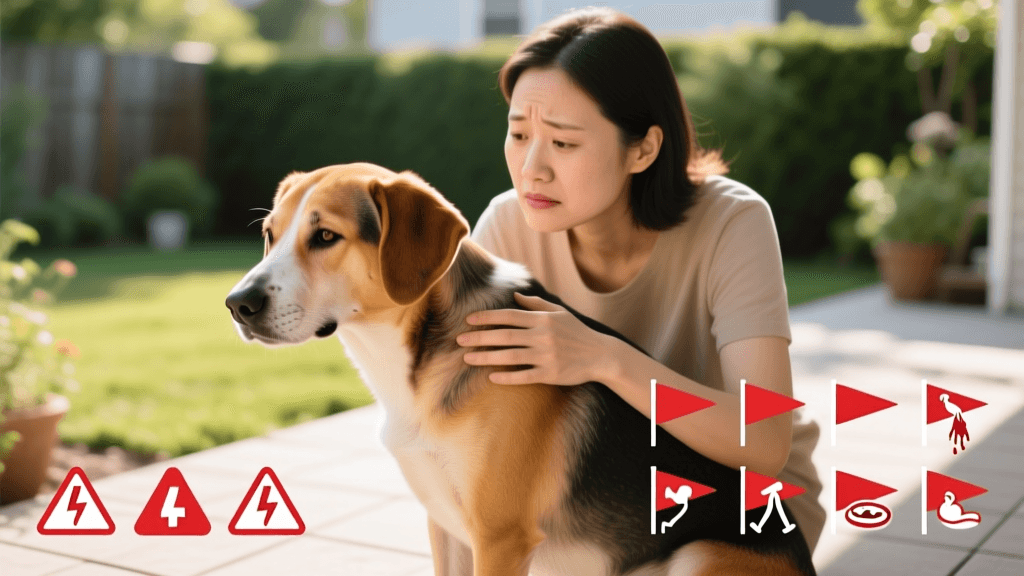
For acute signs — sudden lameness, inability to bear weight, abdominal rigidity, collapse, or extreme restlessness — same-day emergency assessment is appropriate. These can indicate conditions such as gastric dilatation-volvulus, fracture, or acute disc herniation, all of which are time-sensitive.
- Note the date the sign first appeared and any events that preceded it.
- Record whether the sign is constant or intermittent, and what time of day it is worst.
- Photograph or video the behaviour if possible — a 30-second clip of an abnormal gait is diagnostically valuable.
- List any recent changes in diet, environment, exercise, or medication.
- Bring a urine sample if the signs include increased thirst, urination changes, or abdominal discomfort.
Pain management in dogs has advanced considerably. Non-steroidal anti-inflammatory drugs (NSAIDs) such as meloxicam are commonly prescribed at an initial dose of 0.2 mg/kg on day one, followed by a maintenance dose of 0.1 mg/kg daily, though exact dosing is always determined by the prescribing vet based on the individual patient. Multimodal approaches — combining pharmacological treatment with physiotherapy, hydrotherapy, and environmental modification — are now standard of care for chronic pain conditions at referral centres including the Animal Health Trust in Newmarket and the Davies Veterinary Specialists in Hertfordshire.
The goal is not to eliminate all discomfort in every situation, but to ensure that pain is identified, assessed, and managed appropriately throughout a dog's life. Owners who understand the real signs of pain — not just the obvious ones — are the first and most important line of defence in achieving that.
Tom Renshaw
All our authors care for dogs every day — read more of their work on the authors page.