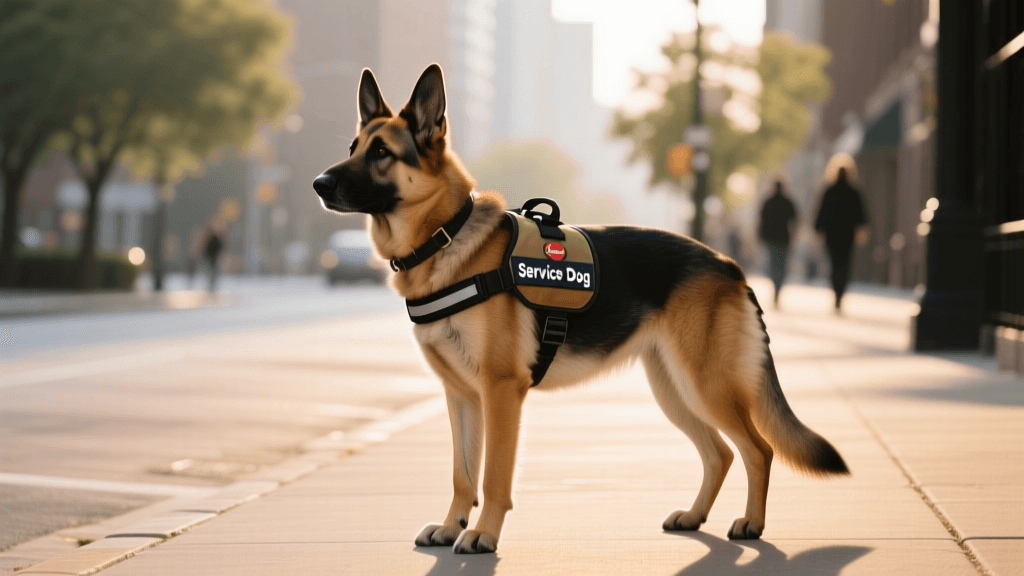
Service Dog Body Language: Decoding Stress Signals In 2026
Learn to decode service dog body language and stress signals in 2026. Understand the psychology of working dogs and how to support their mental health.
The Psychology of the Working Switch
When a service dog dons their vest or harness, a profound psychological shift occurs. This transition, often referred to by canine behaviorists as the 'working switch,' is not merely a trained trick; it is a complex cognitive state where the dog suppresses natural environmental distractions to focus entirely on their handler's needs. In 2026, our understanding of canine cognitive load has deepened significantly, revealing that maintaining this hyper-focused state requires immense mental energy. Unlike pet dogs who freely explore their surroundings, working dogs must constantly process dual streams of information: the physical environment and the physiological or psychological state of their handler.
Understanding the psychology behind this working mode is crucial for both handlers and the general public. A service dog in a crowded airport or a busy grocery store is performing high-level executive functioning tasks. They are navigating spatial obstacles, monitoring for allergens, or preparing to perform deep pressure therapy. This sustained concentration can lead to cognitive fatigue, which manifests through subtle body language cues. Recognizing these signals is the first step in ensuring the welfare and longevity of these remarkable working partners.
Decoding Subtle Stress Signals in Active Duty Dogs
While a pet dog might vocalize or retreat when stressed, a task-trained service dog is conditioned to remain steady and close to their handler. This conditioning can sometimes mask underlying stress, making it imperative to look for micro-expressions and subtle 'calming signals.' Originally popularized by canine behavior experts, these signals are a dog's way of self-soothing and communicating discomfort. In a working context, these signals are often misinterpreted by the public as the dog being tired or simply looking around.
Below is a comprehensive guide to the most common stress and displacement signals observed in active service dogs, along with the psychological context and required handler action.
| Body Language Signal | Physical Description | Psychological Context in Working Dogs | Recommended Handler Action |
|---|---|---|---|
| Rapid Lip Licking | Quick, repetitive flicks of the tongue over the nose or lips. | Indicates mild cognitive overload or anxiety regarding an environmental trigger (e.g., loud machinery, erratic children). | Create distance from the trigger; offer a brief 'reset' break in a quiet area. |
| Whale Eye | The dog turns its head away but keeps its eyes fixed on a stimulus, showing the whites of the eyes. | A sign of high vigilance and potential discomfort. The dog is monitoring a perceived threat while trying to maintain its working position. | Advocate for the dog by blocking the stimulus; reassess the environment's safety. |
| Excessive Yawning | Deep, prolonged yawns when the dog is not physically tired or waking up. | A classic displacement behavior used to lower the dog's own heart rate and self-soothe during high-stress tasks like medical alert responses. | Monitor for task fatigue; provide a low-demand decompression walk after the shift. |
| Shake-Offs | A full-body shake starting from the nose and ending at the tail, similar to shaking off water. | The dog is attempting to 'shake off' accumulated cortisol and adrenaline after completing a difficult task or navigating a stressful encounter. | Allow the dog to complete the shake; praise calmly to reinforce the release of tension. |
| Pinned Ears & Low Tail | Ears pulled back flat against the head; tail tucked or held significantly below the topline. | Indicates acute stress, fear, or overwhelming environmental pressure. The working switch may be close to breaking. | Immediately remove the dog from the working environment; prioritize welfare over task completion. |
Breed-Specific Masking Behaviors
The breed or mix of a service dog heavily influences how they display stress. In 2026, assistance organizations are highly attuned to these breed-specific masking behaviors. Labrador Retrievers and Golden Retrievers, the most common breeds utilized for mobility and guide work, are genetically predisposed to be highly tolerant and eager to please. Consequently, they often internalize stress, showing very little outward agitation until they reach a breaking point. A Retriever might exhibit a tightly closed mouth, a stiffened gait, or a sudden reluctance to take treats, which are glaring red flags for an experienced handler.
Conversely, German Shepherds and Belgian Malinois, frequently used in diabetic alert or psychiatric service work due to their high drive and sensitivity, tend to display stress more outwardly. They may exhibit pacing, whining, or hyper-vigilance when their cognitive load becomes too heavy. Understanding the genetic baseline of the specific dog is essential. The Assistance Dogs International (ADI) emphasizes that handlers must be educated not just on universal canine body language, but on the specific ethological profiles of their chosen breed to accurately read their dog's internal state.
Cognitive Load and Environmental Stressors
The modern world presents unique challenges for working dogs. Navigating automatic doors, riding in rideshare vehicles, and walking on slippery, polished commercial floors require constant spatial awareness and physical adaptation. When you add the cognitive load of a specific task—such as smelling the volatile organic compounds associated with a drop in blood sugar or recognizing the onset of a PTSD flashback—the dog's brain is working at maximum capacity.
Environmental stressors compound this cognitive load. Unpredictable noises, strong artificial scents, and extreme temperatures force the dog to divert mental energy away from their primary task to manage their own physiological comfort. According to the American Veterinary Medical Association (AVMA), chronic exposure to unmitigated environmental stressors can lead to elevated baseline cortisol levels, which ultimately compromises the dog's immune system and working longevity. Handlers must practice 'environmental auditing,' constantly assessing the space for hidden stressors that might be taxing their dog's mental reserves.
The Public's Role in Service Dog Welfare
One of the most significant external stressors for a working dog is public interference. Despite widespread educational campaigns, the urge to pet, speak to, or make eye contact with a service dog remains a pervasive issue. When a member of the public attempts to engage a working dog, the dog faces a psychological conflict: the ingrained desire to be social and friendly versus the strict conditioning to ignore distractions and focus on the handler.
This conflict causes a spike in the dog's heart rate and forces them to expend extra mental energy to inhibit their natural social behaviors. The ADA guidelines clearly state that service animals must not be distracted while working, yet the burden of enforcement often falls on the disabled handler. For the dog, repeated forced inhibitions of social behavior can lead to 'learned helplessness' or, conversely, reactivity. The public must understand that ignoring a working dog is not an act of rudeness; it is a vital act of respect for the dog's psychological well-being and the safety of the handler.
2026 Handler Best Practices for Mental Health
To mitigate the psychological toll of service work, modern handlers are adopting proactive mental health routines for their canine partners. The concept of 'decompression' is now a cornerstone of service dog management. After a demanding shift, dogs require unstructured, off-leash (in safe, enclosed areas) or long-line time in nature to engage in natural foraging, sniffing, and exploring behaviors. This allows their nervous system to down-regulate from the high-alert working state back to a resting baseline.
Furthermore, handlers are utilizing positive reinforcement not just for task completion, but for stress-recovery behaviors. Rewarding a dog for offering a 'shake-off' or for voluntarily disengaging from a stressful stimulus reinforces the dog's agency and builds confidence. Regular consultations with certified veterinary behaviorists are also becoming standard practice in 2026, ensuring that any subtle shifts in the dog's working drive or body language are addressed before they develop into burnout or anxiety disorders.
Conclusion
Service dogs give their mental, physical, and emotional energy to profoundly improve the lives of their handlers. In return, they rely entirely on those handlers to be their advocates and interpreters. By learning to decode the subtle body language and stress signals of working dogs, we can ensure that these incredible animals are not just effective at their jobs, but are genuinely happy, healthy, and psychologically sound. Understanding your dog means looking beyond the vest and seeing the complex, feeling creature beneath it.
hannah-wickes
All our authors care for dogs every day — read more of their work on the authors page.