Service Dog Task Fatigue: Recognizing Stress Signals in 2026
Learn to identify task fatigue and subtle stress signals in service dogs. Explore 2026 ergonomic harness reviews and decompression protocols for working dogs.
The Hidden Epidemic of Task Fatigue in Working Dogs
In 2026, the integration of service dogs into daily human life has reached unprecedented levels. From mobility assistance and diabetic alert to complex psychiatric support, working dogs perform critical, life-saving tasks. However, this increased reliance has brought a hidden behavioral challenge to the forefront of the canine working world: task fatigue. Unlike human caregivers who can vocalize their burnout, working dogs are bred and conditioned for high biddability and an eagerness to please. This inherent drive often causes them to mask their physical and mental exhaustion until it manifests as sudden behavioral shifts, task refusal, or chronic anxiety.
Understanding the psychology of the working dog requires looking past the "good dog" syndrome. A service dog's willingness to work should never be mistaken for an infinite capacity to do so. According to guidelines emphasized by the American Kennel Club (AKC), the welfare and ongoing behavioral health of service animals must be prioritized to ensure they remain sound, confident, and capable. Recognizing the micro-expressions of fatigue is the first step in advocating for the dogs who dedicate their lives to human independence.
Decoding the "Good Dog" Mask: Subtle Stress Signals
Because service dogs are heavily desensitized to environmental stimuli and trained to ignore distractions, their stress signals are often much more subdued than those of pet dogs. A pet dog might bark or pull on the leash when overwhelmed; a service dog will often simply shut down or exhibit micro-behaviors that untrained handlers might miss. In 2026, advanced canine behavioral science has identified several key indicators of task fatigue that handlers and trainers must monitor daily.
Response Latency and Cognitive Load
One of the earliest signs of cognitive burnout is response latency. If a mobility dog typically retrieves a dropped set of keys in 1.5 seconds, but suddenly takes 3 to 4 seconds to process the cue, their cognitive load is maxed out. This hesitation is not disobedience; it is a neurological sign that the dog's brain is fatigued from sustained focus and environmental filtering.
Displacement Behaviors in High-Stimulus Environments
When asked to perform a task in a busy environment—such as a crowded transit hub or a noisy retail store—a fatigued dog may exhibit displacement behaviors. These include sudden, out-of-context scratching, repetitive lip licking, yawning when not tired, or sniffing the ground intensely. These behaviors are the canine equivalent of a nervous tic, indicating that the dog is struggling to self-regulate their arousal levels.
Proprioceptive Fatigue and Weight Shifting
For mobility and guide dogs, physical fatigue directly impacts mental willingness. A dog experiencing muscle fatigue or joint strain will begin to subtly shift their weight away from the handler during bracing tasks. You may notice the dog leaning slightly outward or offering a "lazy" sit when asked to anchor. This is a critical biomechanical warning sign that the dog's musculoskeletal system is overtaxed.
Psychiatric Service Dogs and Emotional Sponging
Psychiatric Service Dogs (PSDs) face a unique form of fatigue known as "emotional sponging." These dogs are trained to perform deep pressure therapy (DPT), interrupt panic attacks, and provide tactile grounding for handlers with PTSD or severe anxiety disorders. In 2026, veterinary behaviorists have noted that PSDs often absorb the physiological stress markers of their handlers. When a handler's heart rate spikes and cortisol levels rise, the dog reads these biometric shifts and responds with calming tasks. However, continuous exposure to a handler's unmanaged anxiety can lead to secondary traumatic stress in the dog, resulting in hyper-vigilance, restlessness at night, and a decreased appetite. Handlers must recognize that their own emotional regulation is a vital component of their dog's working longevity.
The Biomechanics of Mobility Work: 2026 Harness Standards
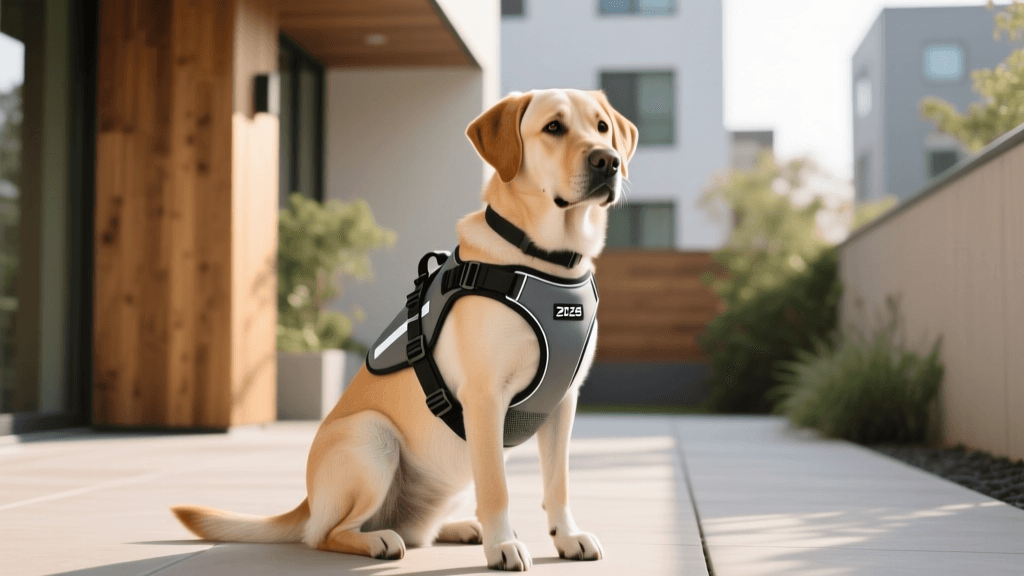
Physical discomfort is a primary driver of behavioral task refusal. If a mobility dog experiences chafing, restricted shoulder movement, or poor load distribution, they will quickly associate their working gear with pain. The American Veterinary Medical Association (AVMA) consistently highlights the importance of ergonomic gear in preventing early-onset osteoarthritis and soft tissue injuries in working canines. In 2026, harness technology has evolved significantly, utilizing aerospace-grade breathable meshes, dynamic load-bearing straps, and custom-molded handles that distribute weight across the dog's sternum rather than their delicate spinal column.
Choosing the right gear is not just about human comfort; it is a behavioral imperative. A dog that is physically comfortable is a dog that remains mentally engaged and willing to work. Below is a comparison of the top-tier mobility and working harnesses available in 2026, evaluated for biomechanical safety and canine comfort.
| Harness Brand & Model (2026) | Best Use Case | Load Distribution Tech | Weight | Approx. Price |
|---|---|---|---|---|
| Ruffwear Web Master Pro Mobility | Light bracing, balance support, and guide work | Padded sternum strap with dynamic flex-points | 1.4 lbs | $135 |
| Bal-Dogz Custom Mobility Harness | Heavy pulling, wheelchair assistance, counter-balance | Custom-molded leather and neoprene, spinal relief channel | 2.8 lbs | $380 |
| Julius-K9 IDC Longwalker Pro | Detection, medical alert, and non-pulling guide tasks | Breathable 3D mesh with titanium D-ring placement | 1.1 lbs | $160 |
| Houndwear Ortho-Brace Elite | Handlers requiring full weight-bearing stabilization | Carbon-fiber reinforced frame with shock-absorbing pads | 3.2 lbs | $450 |
When fitting any mobility harness in 2026, handlers must adhere to the "two-finger rule" under all straps and ensure the handle does not pull the dog's skin toward their spine when weight is applied. Regular veterinary orthopedic checkups are essential to ensure the dog's physical structure remains sound enough for the tasks requested.
Decompression Strategies for the Active Service Dog
To mitigate task fatigue and protect the psychological well-being of working dogs, structured decompression is non-negotiable. Assistance Dogs International (ADI) standards dictate that working dogs must be provided with ample off-duty time to engage in natural canine behaviors. Decompression is not simply "sleeping under a desk"; it is an active neurological reset that lowers cortisol and allows the dog's nervous system to return to baseline.
The Off-Duty Ritual
Dogs thrive on predictable transitions. Establishing a clear "off-duty" ritual signals to the dog that their working responsibilities have ended. In 2026, many top trainers recommend a specific sequence: removing the working vest, offering a high-value chew (which naturally releases endorphins and lowers heart rate), and transitioning to a designated "safe space" mat or crate. This ritual creates a psychological boundary between the high-alert working state and the relaxed resting state.
Sensory Diets and Sniffaris
Working dogs spend their days filtering out environmental stimuli to focus on their handler. To decompress, they need to engage their primary sense: smell. Taking the dog on a "sniffari"—a walk where the dog is allowed to lead the pace, sniff every bush, and process environmental scents without heel commands—provides immense cognitive relief. Sniffing lowers a dog's pulse rate and engages the pleasure centers of their brain, effectively washing away the stress of a long working day in crowded public spaces.
Play and Socialization
Not all service dogs are dog-social, and that is perfectly acceptable for their working role. However, for those that are, scheduled, off-leash play with familiar, stable canine friends is a vital decompression tool. For dog-selective or dog-aggressive service dogs, decompression might look like solitary flirt-pole games, puzzle feeders, or swimming sessions in a private canine hydrotherapy pool. The goal is to allow the dog to make choices and experience joy without the expectation of a trained response.
Creating a Sustainable Working Life
The bond between a service dog and their handler is built on profound trust and mutual reliance. However, it is the handler's responsibility to act as the dog's advocate, recognizing when the dog needs a break, a gear adjustment, or a day off. Task fatigue is not a failure of training; it is a natural biological limit. By staying attuned to the subtle micro-expressions of stress, investing in the latest 2026 ergonomic harness technology, and prioritizing daily decompression protocols, handlers can ensure their working dogs remain physically sound, mentally resilient, and happy in their vital roles. Ultimately, understanding your service dog means recognizing that before they are a medical device or an assistance tool, they are a living, feeling canine who deserves a life rich in rest, play, and unconditional care.
aaron-whyte
All our authors care for dogs every day — read more of their work on the authors page.