How to Safely Introduce Your Puppy to Toddlers and Kids
Learn how to safely introduce your new puppy to toddlers and kids. Discover actionable tips, supervision rules, and socialization milestones for families.

Bringing a new puppy into a home with toddlers and young children is a magical experience, but it is not without its unique challenges. Puppies explore the world with their mouths, and young children are often unpredictable, loud, and uncoordinated. Without proper management, this combination can lead to nipped fingers, fearful puppies, and stressed parents. However, with the right strategy, you can foster a lifelong bond between your child and your new dog. This guide covers everything from environmental setup to reading canine body language, ensuring your puppy's first year is safe and enriching for the entire family.
The Critical Socialization Window
Puppies experience a prime socialization period between 3 and 14 weeks of age. According to the American Kennel Club (AKC), positive exposure to different people, environments, and sounds during this window is crucial for preventing fear and aggression later in life. When introducing your puppy to your children, keep early sessions incredibly brief. A five-minute session of your child sitting calmly while you feed the puppy high-value treats like boiled chicken or freeze-dried liver is far more effective than an hour of chaotic play. Always pair the presence of your child with something the puppy loves, building a positive emotional response.
Setting Up the Physical Environment
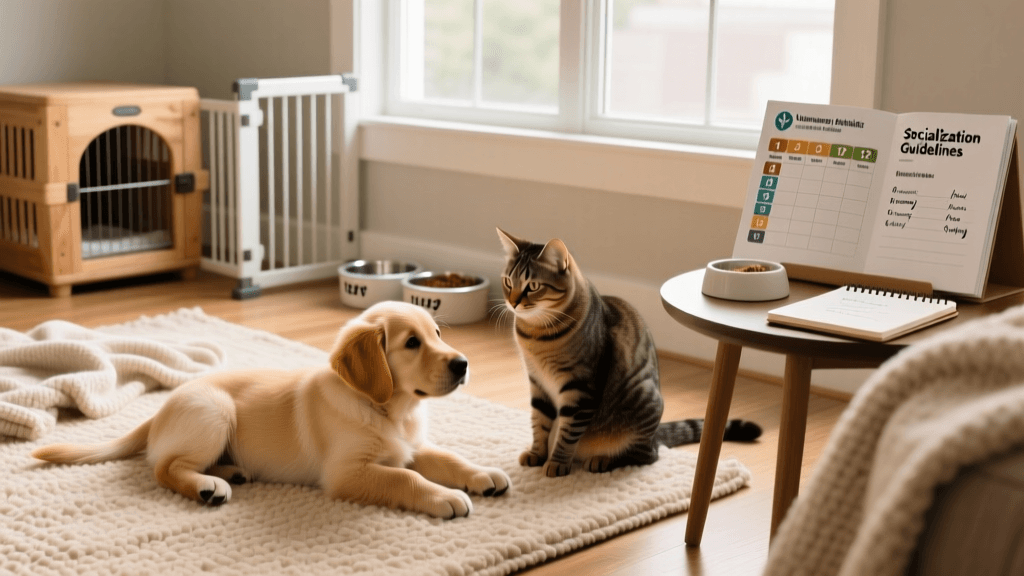
Before bringing your puppy home, you must puppy-proof your living space and create physical boundaries. Relying on verbal commands to keep a toddler away from a chewing puppy will not work. Invest in hardware-mounted baby gates, such as the Regalo Easy Step Walk Thru Gate (typically costing between $40 and $60). Hardware-mounted gates are essential because pressure-mounted gates can easily be pushed over by a determined toddler or a jumping puppy. Additionally, set up a foldable wire playpen, like the Midwest Homes for Pets Playpen, in the center of your living area. This gives the puppy a safe space to play and decompress while remaining part of the family activity, without the risk of being trampled by running children.
Age-Specific Interaction Guidelines
Children of different ages possess varying levels of empathy and motor control. Use the following chart to tailor your expectations and rules based on your child's developmental stage.
| Child Age Group | Puppy Interaction Rules | Supervision Level Required |
|---|---|---|
| Toddlers (1-3 Years) | No direct unsupervised touching. Child can toss treats from a distance or pet the puppy's back while parent holds the puppy. | Constant Active Supervision (100% visual contact, arms length away). |
| Preschoolers (3-5 Years) | Teach 'Be a Tree' when puppy gets excited. Petting only on the back and shoulders. No hugging or face-to-face contact. | Constant Active Supervision. Parent must be in the same room, fully engaged. |
| School Age (5-8 Years) | Can participate in training games like fetch or tug (with rules). Child can help with feeding routines under guidance. | Direct Supervision. Parent is present and monitoring, but can engage in light multitasking. |
Teaching Kids the Rules of Engagement
Children naturally want to hug, kiss, and chase animals, but these actions are deeply unsettling to most dogs. You must actively teach your children how to interact with the puppy. Introduce the 'Be a Tree' method: if the puppy starts jumping or nipping, the child should stand completely still, fold their arms like branches, and look at the sky. Puppies are triggered by movement; when the child stops moving, the puppy will quickly lose interest and move on to a toy. Furthermore, ban hugging. While humans see hugging as a sign of affection, dogs often perceive a tight embrace around the neck as a restraint or a threat. Teach your kids to pet the puppy gently on the back, chest, or shoulders, avoiding the face, paws, and tail entirely.
Recognizing Canine Stress Signals
Preventing a bite starts with recognizing when a puppy is overwhelmed long before they resort to growling or snapping. The ASPCA outlines several subtle calming signals and stress indicators that every parent must learn to identify. Watch for 'whale eye' (when the puppy turns its head away but keeps its eyes fixed on the child, showing the whites of the eyes), excessive lip licking when no food is present, sudden yawning, or a stiff, frozen body posture. If you notice any of these signs, immediately intervene and separate the puppy from the child. Do not punish the puppy for these signals; they are polite requests for space. Instead, calmly redirect the puppy to a quiet zone or a chew toy.
Creating Safe Zones and Enforced Naps
Puppies require between 18 and 20 hours of sleep per day. An overtired puppy is much like an overtired toddler: they become cranky, hyperactive, and prone to aggressive nipping, often referred to as the 'landshark' phase. To prevent this, implement a schedule of enforced naps. After every 45 to 60 minutes of awake time, place your puppy in their crate or a quiet, darkened room for a nap. To help the puppy settle, use a product like the Snuggle Puppy Heartbeat Stuffed Toy, which mimics the warmth and heartbeat of littermates, reducing crying and anxiety. The crate must be established as an absolute no-fly zone for children. Make a physical rule that if the crate door is closed, or if the puppy is inside, the children cannot approach, talk to, or touch the puppy.
Active vs. Passive Supervision
The American Veterinary Medical Association (AVMA) emphasizes that proper supervision is the cornerstone of dog bite prevention. Many parents mistakenly believe that being in the same room constitutes supervision. However, if you are cooking dinner, scrolling on your phone, or reading a book while your toddler and puppy play on the floor, you are practicing passive supervision. Active supervision means your eyes are constantly moving between the child and the dog, and you are close enough to physically intervene within a single second. If you need to step away to answer the door or use the restroom, the puppy must be placed in their crate or behind a baby gate, or the child must come with you. There are zero exceptions to this rule during the puppy's first year.
Remember: It is the adult's responsibility to manage the environment and protect both the child and the puppy. A puppy is an infant animal, not a furry babysitter or a living toy.
Building a Lifelong Bond
Raising a puppy alongside young children requires immense patience, strict boundaries, and proactive management. By respecting the puppy's need for sleep, teaching your children appropriate interaction skills, and maintaining vigilant active supervision, you lay the groundwork for a beautiful, lifelong friendship. The effort you invest during these early developmental months will pay dividends as your puppy matures into a confident, gentle, and beloved family companion.
beth-carrasco
All our authors care for dogs every day — read more of their work on the authors page.