Resource Guarding in Multi-Dog Homes: A Behaviorist Guide
Learn expert behavior analysis techniques to manage and prevent resource guarding in multi-dog households with actionable training steps.
The Behavioral Mechanics of Resource Guarding
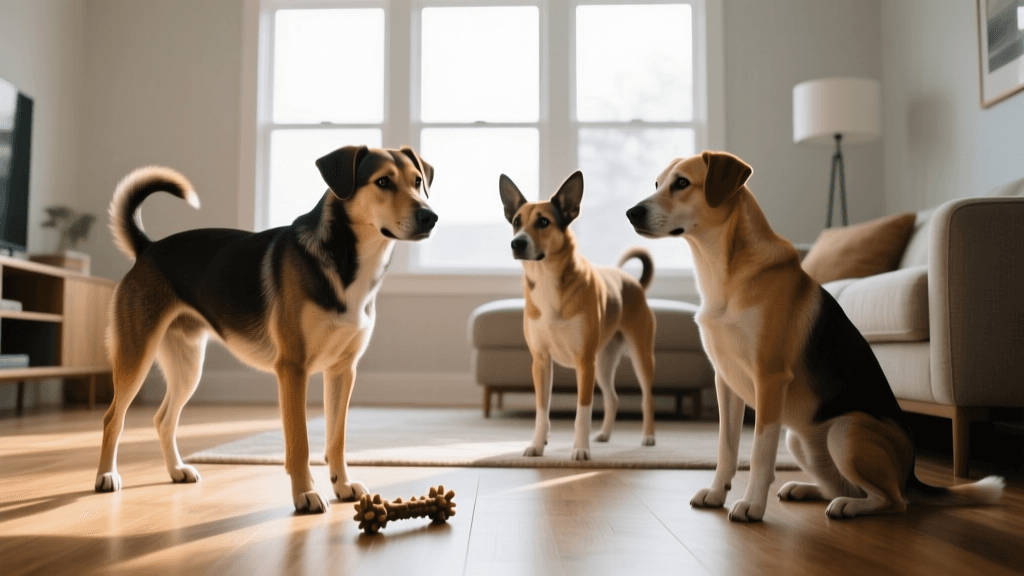
Sharing your home with multiple dogs is a rewarding experience, but it introduces complex social dynamics that can quickly escalate into conflict. One of the most common and dangerous behavioral challenges in multi-pet households is resource guarding. From an Applied Behavior Analysis (ABA) perspective, resource guarding is not a symptom of 'dominance' or a flawed personality trait. Rather, it is a natural, operant survival behavior maintained by negative reinforcement. When Dog A perceives a threat to a valued resource (such as a bully stick, a favorite toy, or even a human's attention), they display defensive body language. If Dog B retreats as a result, Dog A's guarding behavior is negatively reinforced—the threat was removed, and the resource was secured.
To effectively modify this behavior, we must stop viewing the dog as 'stubborn' and start analyzing the Antecedent-Behavior-Consequence (ABC) loop. The ASPCA defines resource guarding as a dog's use of avoidance, threatening, or aggressive behaviors to retain control of food or non-food items. Understanding this framework is the first step toward creating a peaceful, multi-dog environment.
Decoding the Escalation Ladder
Dogs rarely bite without warning. However, human owners often miss the subtle early signs of the canine escalation ladder because they are looking for obvious aggression, like baring teeth or growling. By the time a growl occurs, the dog is already at stage two or three of their stress response. Below is a behaviorist's matrix for identifying and intervening in resource guarding.
| Stage | Canine Body Language | Behaviorist Intervention |
|---|---|---|
| 1. Early Warning | Freezing, hard stare, lip licking, whale eye, eating faster | Increase distance, remove trigger, log data |
| 2. Escalation | Low growl, stiff posture, raised hackles, hovering over item | Interrupt with neutral noise, separate dogs safely |
| 3. Critical | Air snap, lunging, biting, pinning the other dog | Immediate physical separation, consult DACVB/CAAB |
Recognizing Stage 1 is crucial. If you see your dog 'whale eye' (showing the whites of their eyes) while chewing a bone and another dog walks by, you must intervene before the behavior escalates to Stage 2.
Environmental Management: Setting Up for Success
Behavior modification cannot occur in an environment where the dog is continually pushed over their threshold. Management is your first line of defense and involves altering the antecedents so the unwanted behavior cannot be practiced. Every time a dog successfully guards a resource and drives another dog away, the neural pathway associated with that behavior is strengthened.
Spatial Separation and Physical Barriers
For high-value chews (like raw bones, yak cheese, or pig ears), dogs must be physically separated. The general rule of thumb is a minimum of 6 feet of clearance between dogs, or ideally, separate rooms. Invest in a sturdy, hardware-mounted baby gate. The Carlson Super Wide Walk-Thru Metal Baby Gate (approx. $75-$90) is an excellent choice, as it expands up to 108 inches and features a walk-through door for human convenience while keeping dogs securely separated. Avoid cheap, pressure-mounted gates for known resource guarders, as the force of a lunging dog can easily dislodge them.
Scatter Feeding and Enrichment
For daily meals, avoid placing bowls directly next to each other. If spatial separation isn't possible, utilize enrichment tools that change the dog's focus from 'protecting a bowl' to 'foraging.' Snuffle Mats ($25-$40) scatter the kibble, encouraging natural sniffing behaviors and reducing the spatial defensiveness associated with a static food bowl. Alternatively, use Kong Classic toys ($15-$20 each) stuffed with wet food and frozen, fed to the dogs in separate crates.
Behavior Modification Protocols: Desensitization and Counterconditioning
Once management is in place, we can begin active behavior modification using Desensitization and Counterconditioning (CC/DS). The goal is to change the dog's emotional response to the presence of the other dog near their valued item. According to the American Kennel Club (AKC), teaching a dog that the approach of another dog (or human) predicts something even better than what they currently have is the most effective, force-free method for resolving guarding.
The 'Trade-Up' Protocol
This exercise requires two handlers if you are working with two dogs simultaneously, or one handler if you are working on human-directed guarding while the other dog is crated.
- Identify the Hierarchy of Value: Create a list of items from lowest value (e.g., a boring rubber toy) to highest value (e.g., a piece of freeze-dried beef liver).
- Introduce the Low-Value Item: Give Dog A a low-value toy. Ensure Dog B is present but at a safe distance (e.g., 10 feet).
- The Approach and Trade: As Dog B takes a single step forward, immediately toss a high-value treat (like Zuke's Mini Naturals, approx. $8/bag) directly to Dog A. The timing must be precise: the treat must hit the floor within a 3-second window of Dog B moving.
- Repeat and Close Distance: Over multiple 15-minute training sessions, gradually decrease the distance between the dogs. Dog A learns that Dog B's approach equals the arrival of premium treats.
Note: Never reach into a dog's mouth or physically pry an item away. This triggers a defensive bite reflex and destroys trust. Always trade for an item of equal or greater value.
The Dangers of Suppression: Why Punishment Fails
A common and dangerous mistake in multi-dog households is punishing the growl. If Dog A growls at Dog B, and the owner yells, uses a shock collar, or performs an 'alpha roll,' the owner is not removing the dog's anxiety; they are merely suppressing the warning signal. Fear Free Pets and leading veterinary behaviorists warn that punishing a growl teaches the dog that warning signals result in punishment. Consequently, the dog skips the growl in the future and goes straight to biting. This is known as 'learned suppression' and it creates a dog that bites without warning, posing a severe liability and safety risk to both humans and other pets.
Positive reinforcement and environmental management address the root cause—the emotional anxiety and the operant reinforcement loop—rather than just masking the symptom.
Tracking Progress: Data Collection for Pet Parents
As an expert behaviorist, I require my clients to keep a daily ABC log. Purchase a simple notebook and track the following for every incident or successful training session:
- Date/Time: Note if incidents happen more frequently in the evening when the household is chaotic or the dogs are fatigued.
- Antecedent: What was the exact item? Who was nearby? What was the noise level in the house?
- Behavior: What specific body language did you observe? (e.g., 'Stiffened over bone, whale eye, low rumble').
- Consequence: What happened immediately after? (e.g., 'Other dog left the room, I threw a treat').
Reviewing this data after 30 days often reveals hidden triggers, such as sleep deprivation, specific types of chews, or high-stress environments (like guests visiting), allowing you to adjust your management strategy accordingly.
When to Call a Professional
While mild guarding over low-value toys can often be managed with the protocols above, severe guarding that involves biting, puncture wounds, or intense anxiety requires professional intervention. Budgeting for a certified professional is a necessary aspect of responsible multi-dog ownership. Expect to pay between $150 and $250 per hour for a private consultation. Always seek out a Certified Applied Animal Behaviorist (CAAB) or a Diplomate of the American College of Veterinary Behaviorists (DACVB). These professionals possess the advanced academic and clinical credentials required to safely prescribe behavior modification plans and, if necessary, collaborate with your veterinarian on psychopharmacological support to lower your dog's baseline anxiety.
Living with multiple dogs requires patience, keen observation, and a commitment to force-free science-based training. By managing the environment and changing the emotional response to shared resources, you can foster a safe, harmonious pack dynamic.
robin-maitland
All our authors care for dogs every day — read more of their work on the authors page.