Resource Guarding in Dogs: Expert Behavior Analysis and Fixes
Discover the psychology behind canine resource guarding. Learn expert behavior analysis techniques, threshold management, and actionable modification steps.
The Ethology of Resource Guarding: A Survival Instinct
From an ethological perspective, resource guarding is not a sign of dominance, malice, or a 'bad' temperament. It is a deeply ingrained survival mechanism. In the wild, canids that failed to protect their food, mates, or shelter from competitors did not survive to pass on their genetics. In our modern domestic environments, this evolutionary hangover manifests when a dog perceives a threat to a high-value item—be it a raw bone, a stolen sock, a favorite sleeping spot, or even a beloved human family member.
As canine behavior analysts, we must reframe resource guarding not as an act of rebellion, but as an expression of anxiety and insecurity. The dog is communicating a fundamental fear: 'If I do not defend this, I will lose it.' Understanding this psychological baseline is the critical first step in developing an effective, humane behavior modification protocol.
Recognizing the Escalation Ladder
Dogs rarely bite without warning. Instead, they utilize a complex vocabulary of body language known as the 'Aggression Escalation Ladder.' Unfortunately, many owners miss the early, subtle distance-increasing signals and only react when the dog reaches the top of the ladder (growling or snapping). By punishing the growl, we inadvertently teach the dog to skip the warning phases and bite immediately. The Best Friends Animal Society emphasizes the importance of recognizing these early stress signals to prevent bite incidents.
| Stage | Behavioral Indicators | Expert Action Required |
|---|---|---|
| Stage 1: Distance-Increasing Signals | Lip licking, yawning, 'whale eye' (showing the whites of the eyes), turning the head away, stiffening of the shoulders. | Stop approaching immediately. Give the dog space. Acknowledge the communication and do not force interaction. |
| Stage 2: Tension and Freezing | Hovering over the item, hard staring, sudden stillness, eating at an accelerated pace, bracing the body. | Do not reach for the item. Toss a high-value treat away from the resource to create voluntary distance. |
| Stage 3: Active Warning | Low-pitched guttural growl, snarling (lifting lips to show teeth), snapping at the air (warning bite). | Calmly retreat. Do not yell or punish the growl. Consult a certified behaviorist immediately. |
| Stage 4: Biting | Inhibited bite (making contact but not breaking skin) or full puncture bite. | Implement strict environmental management. Seek professional intervention from a DACVB or CAAB. |
Identifying Triggers and Thresholds
Before initiating a modification plan, an expert behavior analyst conducts a functional assessment to identify specific triggers and the dog's threshold distance. A 'trigger' is the specific stimulus that initiates the guarding response (e.g., a human walking toward the food bowl, a hand reaching for a toy, or another dog entering the room). The 'threshold' is the exact distance or intensity at which the dog begins to show Stage 1 or Stage 2 stress signals.
For example, if your dog freezes when you are 6 feet away from his chew, but remains relaxed at 8 feet, his threshold is somewhere between 6 and 8 feet. All initial behavior modification must occur under threshold (e.g., at 10 feet), where the dog's prefrontal cortex is engaged and capable of learning, rather than the amygdala, which handles fight-or-flight survival responses.
The Expert Modification Protocol: Desensitization and Counter-Conditioning (DS/CC)
The gold standard for treating resource guarding is Desensitization and Counter-Conditioning (DS/CC). This protocol changes the dog's emotional response from 'They are coming to take my stuff' to 'When humans approach, amazing things happen.' The American Kennel Club (AKC) advocates for positive reinforcement strategies that build trust rather than relying on intimidation.
Step 1: The 'Trade-Up' and Tossing Protocol
Never physically pry an item from a guarding dog's mouth. Instead, use the 'Trade-Up' game. If the dog has a low-value item (like a cardboard tube), approach from under threshold (e.g., 10 feet away). Toss a piece of 100% freeze-dried beef liver or Zuke's Mini Naturals near the dog. When the dog drops the cardboard to eat the liver, calmly pick up the cardboard tube, and then immediately give it back or offer an even better chew. This teaches the dog that giving up an item results in a net-positive outcome.
Step 2: The Approach and Retreat (Desensitization)
Start with the dog eating a standard meal. Stand 15 feet away (well under threshold). Toss a piece of boiled chicken breast into the bowl. Take one step forward, toss another piece, and immediately take two steps back. Repeat this for 10 repetitions per meal. Over the course of several weeks, gradually decrease the distance—moving to 10 feet, then 5 feet, then standing directly beside the bowl—only advancing when the dog displays relaxed body language, a wagging tail, and eagerly anticipates your approach.
Step 3: Timing and Marker Words
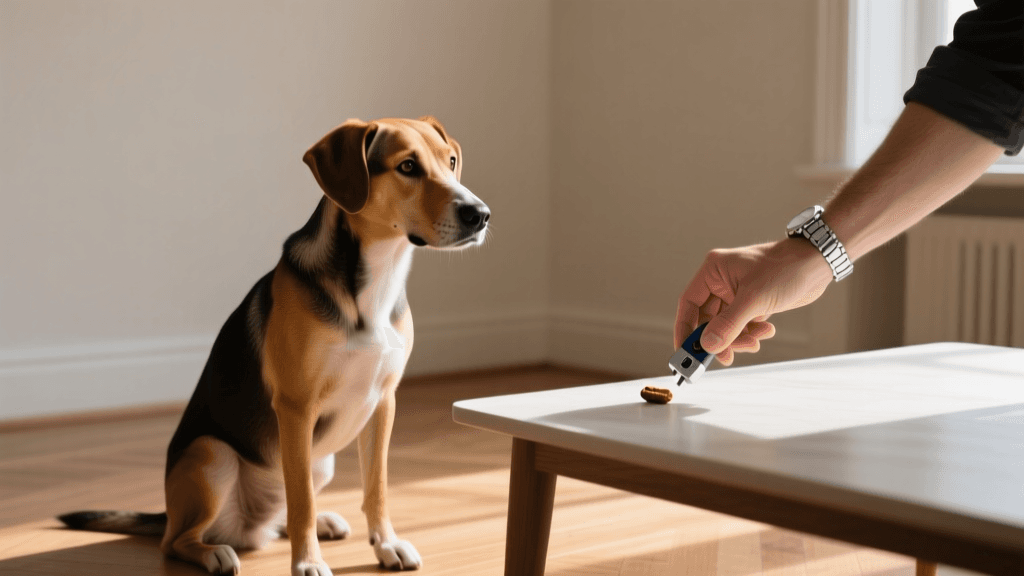
Precision is paramount in DS/CC. Use a marker word like 'Yes!' or a clicker the exact moment the dog notices you approaching but before they show tension. The sequence must be: Dog looks at you -> Marker ('Yes!') -> Toss high-value treat. The marker must occur within a 0.5-second window of the dog noticing the trigger to properly wire the classical conditioning association in the brain.
Management Tools and Associated Costs
Behavior modification takes weeks or months. During this time, strict environmental management is required to prevent the dog from rehearsing the guarding behavior. Every time a dog successfully guards a resource, the neural pathway associated with that behavior is reinforced.
- Baby Gates and Exercise Pens: Use hardware-mounted gates (e.g., Regalo Easy Step, approx. $40-$60) to separate the dog from children or other pets during feeding times or when high-value chews are provided.
- Basket Muzzles: For dogs that guard scavenged items on walks, condition a Baskerville Ultra Muzzle ($15-$25). This allows the dog to pant, drink, and take treats while preventing the ingestion of dangerous items or bites directed at owners trying to retrieve contraband.
- Puzzle Feeders: Replace standard bowls with Kong Wobblers or Snuffle Mats ($15-$30). These tools engage the dog's foraging instincts and reduce the 'bowl defensiveness' often seen with traditional feeding methods.
Common Mistakes to Avoid
1. The 'Alpha' Roll or Bowl Removal: Outdated dominance theories suggest owners should routinely put their hands in a dog's food bowl or take the bowl away to 'show who is boss.' The ASPCA strongly advises against this, as it only validates the dog's fear that humans are unpredictable thieves, thereby worsening the guarding behavior.
2. Punishing the Growl: A growl is a gift; it is a dog's way of saying 'I am uncomfortable, please give me space.' If you scold or shock a dog for growling, you suppress the warning system, resulting in a dog that bites without warning.
3. Advancing Too Quickly: Pushing past the dog's threshold during DS/CC will cause 'spontaneous recovery' of the guarding behavior. Progress is measured in weeks and months, not days.
When to Seek Professional Help
If your dog has progressed to Stage 3 (snapping) or Stage 4 (biting), or if the guarding involves children, DIY behavior modification is no longer safe. Seek out a certified professional. Look for credentials such as a DACVB (Diplomate of the American College of Veterinary Behaviorists) or a CAAB (Certified Applied Animal Behaviorist). Expect to invest between $120 to $250 per hour for private behavior consultations, which is a necessary investment in household safety and your dog's long-term welfare.
Conclusion
Resource guarding is a complex, emotionally driven behavior rooted in canine survival instincts. By abandoning punitive measures and embracing expert behavior analysis—specifically threshold management, classical counter-conditioning, and strategic environmental management—we can fundamentally alter a dog's emotional response. With patience, high-value reinforcement, and a deep respect for canine body language, we can transform a fearful guardian into a confident, relaxed companion.
jonas-cole
All our authors care for dogs every day — read more of their work on the authors page.