Decoding Breed Instincts: Herding vs Guarding Dog Selection
Discover the behavioral differences between herding and guarding breeds. Learn how canine instincts impact family life, training costs, and daily routines.
The Psychology of Purpose: Why Breed Instincts Matter
When bringing a new canine companion into your home, it is easy to be swayed by a puppy's fluffy coat or soulful eyes. However, true compatibility lies beneath the surface, deeply rooted in centuries of selective breeding. Dogs were not originally bred to be couch companions; they were engineered for specific, demanding jobs. Understanding the psychology and innate instincts of different breed groups is the cornerstone of a harmonious human-canine relationship. According to the Humane Society's guide on choosing a dog, matching a dog's inherent energy levels and behavioral drives with your household's lifestyle is the single most critical factor in preventing surrenders and behavioral issues.
In this comprehensive guide, we will decode the behavioral blueprints of two vastly different categories: Herding breeds and Livestock Guardian breeds. By examining their body language, communication signals, and psychological needs, you can make an informed, actionable decision about which instinctual profile best suits your family.
Herding Breeds: The Micro-Managers of the Canine World
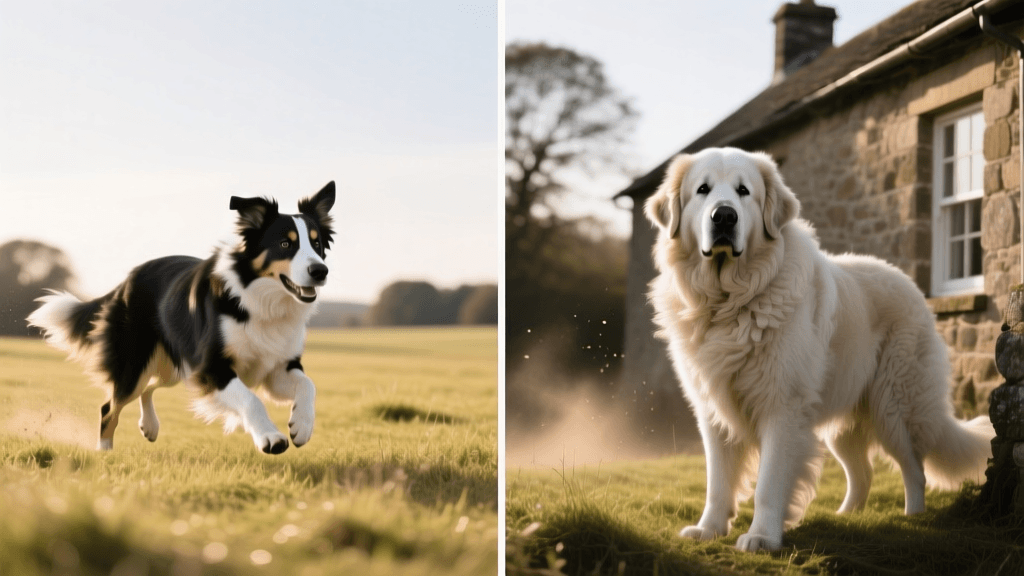
Herding breeds, such as the Border Collie, Australian Shepherd, and Shetland Sheepdog, were developed to control the movement of other animals. This required a unique psychological profile: high intelligence, intense focus, extreme stamina, and a heightened sensitivity to motion. The American Kennel Club's Herding Group notes that these dogs possess an innate 'herding instinct' that does not simply vanish when they are placed in a suburban home.
Behavioral Traits and Communication
Herding dogs communicate and interact with their environment through movement and intense visual focus. You will often notice the 'herding eye'—a hard, unblinking stare accompanied by a lowered head and crouched posture. While this is effective for moving sheep, in a home environment, it can translate into stalking the family cat, chasing passing cars, or even nipping at the heels of running children. When overstimulated, a herding dog may exhibit 'whale eye' (showing the whites of their eyes) and pinned-back ears, signaling that their arousal threshold has been breached.
Actionable Advice for Herding Breeds
- Mental Enrichment: Physical exercise is not enough. You must tax their brains. Invest in interactive puzzle toys like the Outward Hound Dog Brick ($15-$25) or the Kong Wobbler ($20-$30) to simulate the problem-solving required in the field.
- Structured Outlets: Enroll in dog agility or herding treibball classes. Expect to budget between $150 and $250 for a 6-week beginner agility course, which provides a safe, controlled environment for their chasing instincts.
- Impulse Control Training: Teach a solid 'leave it' and 'place' command by 12 weeks of age to manage their reaction to moving stimuli like bicycles or joggers.
Livestock Guardian Breeds: Independent Protectors
On the opposite end of the working spectrum are Livestock Guardian Dogs (LGDs), such as the Great Pyrenees, Anatolian Shepherd, and Maremma Sheepdog. Unlike herders, LGDs were bred to blend in with the flock and protect them from predators. Their psychology is defined by independence, territoriality, and a deep-seated protective instinct. The AKC Working Group highlights that these breeds are intelligent but notoriously stubborn, as they were required to make life-or-death decisions without human direction.
Behavioral Traits and Communication
Guardian breeds communicate primarily through spatial pressure and vocalization. Their body language is often subtle until a threat is perceived. A relaxed LGD may appear aloof or even lazy, but their ears are always swiveled, monitoring their perimeter. When alerting to a perceived threat (which could be a delivery driver or a stray dog), they will puff out their chest, raise their tail high, and emit a deep, resonant bark designed to carry across miles of open pasture. They do not typically stalk; instead, they place their bodies between the perceived threat and their family, utilizing 'blocking' behavior.
Actionable Advice for Guardian Breeds
- Secure Perimeters: LGDs are notorious roamers if they feel their territory is inadequate. You must invest in a minimum 6-foot woven wire fence with a dig-guard (concrete footer or buried wire) at the base. Installation costs for a standard suburban yard can range from $2,500 to $4,500.
- Early Socialization: The critical socialization window for LGDs closes earlier than other breeds, typically around 14 weeks. You must expose them to diverse people, surfaces, and sounds before this deadline to prevent severe territorial aggression later in life.
- Nighttime Management: Because their guarding instincts peak at dusk and dawn, expect nocturnal barking. Providing a soundproofed indoor sleeping area or a heavily insulated outdoor kennel can save your relationship with your neighbors.
Reading the Signals: A Body Language Comparison
Understanding how these two groups express stress and contentment is vital for preventing bites and managing anxiety.
| Behavioral Signal | Herding Breeds | Guardian Breeds |
|---|---|---|
| Stress Indicator | Pacing, frantic barking, lip licking, lowered tail | Stillness, hard staring, raised hackles, deep growl |
| Play Style | Chasing, nipping, crouching, high-speed circling | Wrestling, body slamming, slow-motion chasing |
| Response to Strangers | Excitable, jumping, vocal, seeking engagement | Aloof, observant, positioning between stranger and owner |
| Recall Reliability | High (if trained), highly responsive to handler | Low, will assess the situation before deciding to return |
Real-World Costs and Time Commitments
Selecting between a herder and a guardian is not just a behavioral choice; it is a financial and temporal one. Herding breeds demand your time, while guardian breeds demand your infrastructure.
Herding Breed Budget (Annual Estimates)
- Daily Time Commitment: 90 to 120 minutes of dedicated, high-intensity physical and mental exercise.
- Training & Sports: $500 - $1,200/year for agility, flyball, or advanced obedience classes.
- Enrichment Toys: $200/year (these dogs destroy standard toys quickly; durable rubber and puzzle feeders are mandatory).
- Grooming: $400 - $800/year for professional deshedding and coat maintenance for double-coated herders.
Guardian Breed Budget (Annual Estimates)
- Daily Time Commitment: 45 to 60 minutes of leisurely walking and extensive socialization outings.
- Food Costs: $800 - $1,500/year. LGDs are giant breeds, requiring high-quality, large-breed specific kibble to support joint health.
- Medical & Joint Care: $300 - $600/year for joint supplements (glucosamine/chondroitin) and higher doses of heartworm/flea prevention due to their massive weight.
- Property Maintenance: Upfront costs of $2,500+ for specialized fencing, plus ongoing landscape repair, as LGDs love to dig cooling pits in the summer.
Making the Right Selection for Your Household
If your household is highly active, enjoys outdoor sports, and has the time to dedicate to daily training sessions, a herding breed will be a deeply rewarding, interactive partner. They thrive on collaboration and will look to you for direction in almost every situation.
Conversely, if you have a large, securely fenced property, prefer a more independent companion, and want a dog that will naturally patrol and protect your home without needing constant entertainment, a Livestock Guardian breed is an excellent fit. They do not want to be micro-managed; they want to be respected as the silent sentinels of their domain.
Ultimately, understanding your dog begins before you ever bring them home. By respecting the genetic legacy of herding and guarding breeds, you set the stage for a lifetime of mutual understanding, safety, and profound companionship.
tom-renshaw
All our authors care for dogs every day — read more of their work on the authors page.