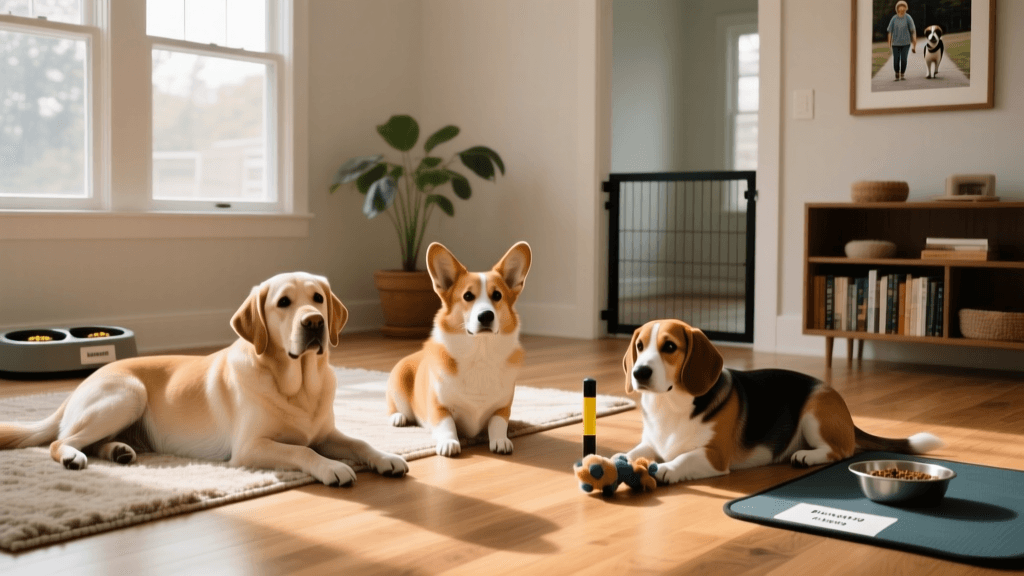
Case Study: Resolving Resource Guarding in Multi-Dog Homes
Discover how we resolved severe resource guarding between two rescue dogs using desensitization, management tools, and structured feeding routines.

The Hidden Danger of Resource Guarding in Multi-Dog Homes
Sharing your life with multiple dogs can be a deeply rewarding experience, but it also introduces complex social dynamics that require careful management. One of the most volatile and dangerous behavioral issues that can arise in a multi-dog household is resource guarding. According to the ASPCA, resource guarding is a natural survival instinct where a dog exhibits aggressive behaviors to protect valuable items like food, toys, or sleeping spaces. While this behavior is normal from an evolutionary standpoint, it is entirely unacceptable and dangerous in a modern home, especially when multiple dogs are competing for the same resources.
In this behavior case study, we will walk through the real-life rehabilitation of two rescue dogs who developed severe inter-dog resource guarding. By utilizing environmental management, desensitization, and counterconditioning (DS/CC), we were able to restore peace to the household without the use of aversive punishment.
Case Study Background: Buster and Daisy
Buster is a 75-pound, 3-year-old Labrador Retriever mix with a high food drive and a clumsy, exuberant personality. Daisy is a 20-pound, 5-year-old Jack Russell Terrier mix who is highly intelligent, easily stressed, and fiercely independent. Both dogs were adopted six months apart and initially got along well during low-stakes play. However, as they settled into their permanent routine, Daisy began exhibiting severe resource guarding behaviors over high-value chews, specifically bully sticks and yak cheese.
Because Buster is highly food-motivated, he would frequently wander into Daisy's space while she was chewing. Daisy's warning signs were subtle at first: stiffening of the body, whale eye (showing the whites of her eyes), and lip licking. When Buster failed to read these canine calming signals and continued to approach, Daisy escalated to snapping, resulting in a minor puncture wound to Buster's muzzle. The owners immediately reached out for behavioral intervention before a more severe injury could occur.
Initial Behavioral Assessment
Before implementing a modification plan, we needed to map out Daisy's specific triggers and thresholds. We conducted a controlled assessment to determine exactly what items triggered the guarding and at what distance Buster's presence became a trigger. Below is the Trigger Assessment Matrix we developed for Daisy:
| Resource Item | Guarding Intensity (1-5) | Buster's Distance Threshold | Warning Signs Observed |
|---|---|---|---|
| Daily Kibble (Bowl) | 2 (Mild) | 4 feet | Eating faster, hovering over bowl |
| Pig Ears | 3 (Moderate) | 6 feet | Stiffening, low growl |
| Bully Sticks | 5 (Severe) | 12 feet | Whale eye, snapping, lunging |
| Frozen KONG Toys | 4 (High) | 10 feet | Freezing, hard stare, snarling |
As the data shows, the higher the value of the treat, the larger the 'spatial bubble' Daisy required to feel secure. Our goal was to shrink this spatial bubble through classical conditioning while ensuring absolute safety through management.
Phase 1: Environmental Management and Safety
Behavior modification cannot succeed if the dog continues to rehearse the unwanted behavior. Every time Daisy snapped at Buster, the neural pathway associated with that aggressive response was reinforced. Our first step was strict environmental management.
Physical Separation
We mandated that all high-value chews and meals be given with the dogs in completely separate areas. We installed the Carlson Pet Products Design Studio Walk-Thru Gate (Cost: $49.99) to block off the kitchen. Daisy was given her chews inside a crate in the living room, while Buster was kept in the kitchen. This zero-interaction rule was enforced for the first four weeks of the protocol.
Muzzle Conditioning
To ensure Buster's safety during the eventual reintroduction phases, we conditioned Daisy to wear a Baskerville Ultra Muzzle (Cost: $24.99). We used a slow, positive reinforcement protocol, feeding high-value treats through the front basket hole so Daisy associated the muzzle with peanut butter and boiled chicken. Within 10 days, Daisy was happily volunteering her snout into the muzzle.
Phase 2: Desensitization and Counterconditioning (DS/CC)
With management in place, we began the active modification phase. The American Kennel Club strongly emphasizes that punishing a dog for resource guarding only suppresses the warning signs, leading to a dog that bites without warning. Instead, we used DS/CC to change Daisy's underlying emotional response to Buster approaching her resources.
Exercise 1: The 'Trade-Up' Protocol
We needed to teach Daisy that a human or another dog approaching her item means something even better is coming. We used Stella & Chewy's Freeze-Dried Beef Liver (Cost: $14.00 for a 3oz bag) as the ultimate high-value trade.
The Steps:
1. Give Daisy a medium-value chew (e.g., a carrot or low-fat dental chew).
2. Approach from the side (never head-on, which is confrontational).
3. Toss a piece of freeze-dried liver near her nose.
4. As she drops the chew to eat the liver, calmly pick up the chew.
5. Give the chew back immediately after she finishes the liver.
This exercise was performed in 10-minute sessions, twice a day, for two weeks. It taught Daisy that giving up an item is temporary and highly profitable.
Exercise 2: Parallel Distance Feeding
Next, we addressed Daisy's reaction to Buster. We started with both dogs on leashes, held by two separate handlers. Daisy was given a lick mat smeared with KONG Easy Treat. Buster was placed exactly 15 feet away—just outside her 12-foot threshold distance.
Every time Buster looked at Daisy or took a step, Daisy was fed a high-value treat. We were building a positive association: Buster's presence = Chicken and Liver. Over the course of three weeks, we decreased the distance by 2 feet every three days, provided Daisy remained relaxed (loose body, wagging tail, soft eyes). If she stiffened, we immediately increased the distance by 5 feet and progressed slower.
Timeline and Progress Tracking
Rehabilitating resource guarding is not an overnight fix. It requires consistency, patience, and meticulous data tracking. Here is the week-by-week breakdown of Buster and Daisy's progress:
- Weeks 1-2 (Management & Baseline): Complete physical separation during feeding and chew times. Muzzle conditioning initiated for Daisy. Trade-Up protocol started with humans only.
- Weeks 3-4 (Threshold Introduction): Parallel distance feeding introduced at 15 feet. Daisy wore the Baskerville muzzle for safety. Buster was trained to 'go to mat' on command to give him an alternative behavior when chews were distributed.
- Weeks 5-6 (Closing the Gap): Distance reduced to 8 feet. Muzzle removed during low-value treat sessions (e.g., kibble-stuffed KONGs), but kept on for bully sticks. Daisy's body language showed significant relaxation; whale eye and lip licking ceased.
- Weeks 7-8 (Generalization): Dogs allowed in the same room with high-value chews, separated only by a low baby gate. Handlers actively rewarded both dogs for calm, disengaged behavior. No aggressive incidents recorded.
Financial Breakdown of the Intervention
Investing in the right tools prevents costly veterinary bills and emotional distress. Here is the itemized cost of the management and training tools used in this case study:
| Item | Purpose | Estimated Cost |
|---|---|---|
| Carlson Walk-Thru Gate | Physical separation during chew times | $49.99 |
| Baskerville Ultra Muzzle | Safety during close-proximity DS/CC | $24.99 |
| Stella & Chewy's Beef Liver | High-value 'Trade-Up' reinforcement | $14.00 |
| KONG Classic & Easy Treat | Long-lasting, low-guarding enrichment | $22.00 |
| Total Investment | $110.98 |
Compared to the cost of an emergency veterinary visit for a dog bite puncture (which can easily exceed $500 to $1,500), this proactive behavioral investment is highly cost-effective.
Key Takeaways for Multi-Dog Households
If you are managing resource guarding between dogs in your home, remember these critical rules:
Management is not a failure of training; it is the foundation of safety. You cannot train a dog out of a behavior if they are allowed to practice it daily in an uncontrolled environment.
First, never leave high-value items like raw bones, bully sticks, or pig ears out in common areas. These are the primary catalysts for inter-dog aggression. Second, avoid the outdated and dangerous advice of 'taking the food bowl away to show dominance.' This only validates the dog's fear that their resources will be stolen, making them guard more fiercely. Finally, recognize when you need professional help. If your dogs have a history of inflicting deep puncture wounds, or if you feel unsafe managing their interactions, consult a board-certified veterinary behaviorist (DACVB) or a certified applied animal behaviorist (CAAB).
By respecting your dog's spatial boundaries, utilizing desensitization, and managing their environment with the right tools, you can transform a volatile multi-dog household into a peaceful, harmonious pack.
anouk-beaumont
All our authors care for dogs every day — read more of their work on the authors page.