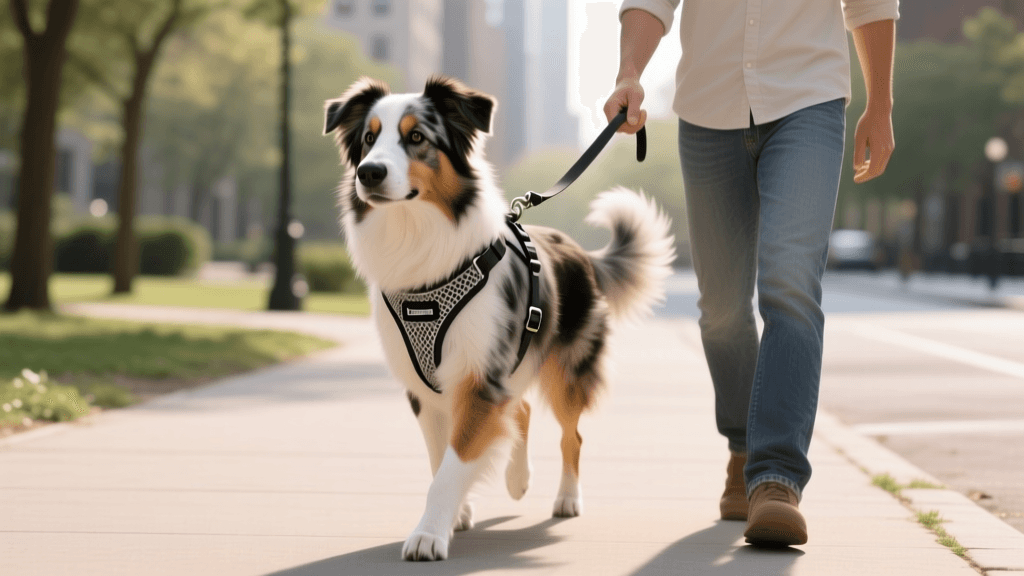
Master Loose Leash Walking: No Pull Dog Harness Training in 2026
Learn how to stop leash pulling in 2026 using a front-clip no pull dog harness. Discover step-by-step loose leash walking training techniques and expert tips.
Introduction: The Reality of Leash Pulling in 2026
For many dog owners, daily walks feel more like a competitive game of tug-of-war than a relaxing stroll. If your arm is constantly being yanked out of its socket, you are not alone. Leash pulling remains one of the most common behavioral challenges reported by pet parents. However, as we navigate modern dog ownership in 2026, the veterinary and behavioral consensus is clear: aversive tools like prong collars and choke chains are outdated and harmful. Instead, the gold standard for teaching loose leash walking is the strategic use of a no pull dog harness combined with positive reinforcement training.
It is crucial to understand that a no pull dog harness is not a magic switch that instantly cures pulling. Rather, it is a highly effective biomechanical tool that buys you the time and control needed to actually train your dog. In this comprehensive guide, we will explore the mechanics of front-clip harnesses, review top models like the Rabbitgoo No-Pull Dog Harness, and provide a step-by-step training protocol to transform your chaotic walks into peaceful outings.
The Biomechanics of the No Pull Dog Harness
To understand why a no pull dog harness works, we must look at canine biomechanics and the "opposition reflex." When pressure is applied to a dog's chest or neck (as with a standard back-clip harness or flat collar), their natural instinct is to lean into that pressure and pull harder. This is why sled dogs can pull massive weights while wearing back-clip harnesses.
A front-clip no pull dog harness features a leash attachment ring located on the sternum. When the dog surges forward and hits the end of the leash, the front attachment point redirects their forward momentum sideways, gently turning their chest back toward the handler. This disrupts their balance and breaks the opposition reflex without causing pain or tracheal damage. According to the American Veterinary Society of Animal Behavior (AVSAB), force-free tools that rely on negative punishment (removing the reward of forward motion) and positive reinforcement are the safest and most effective methods for behavioral modification.
Top Front-Clip Harness Models for Training in 2026
Not all harnesses are created equal. When selecting a no pull dog harness for training, you need a model that offers durability, comfort, and dual-clip functionality (allowing you to transition to a back-clip once training is complete).
- Rabbitgoo No-Pull Dog Harness: A perennial favorite in 2026, the Rabbitgoo features a breathable air-mesh design that prevents overheating during summer walks. It includes four adjustable straps for a custom fit, reflective stitching for nighttime visibility, and both front and back leash rings. The front ring is reinforced with heavy-duty webbing to withstand sudden lunges from strong breeds like German Shepherds or Huskies.
- Kurgo Tru Fit Smart Harness: Designed with input from veterinarians, the Kurgo Tru Fit features a padded chest plate that distributes pressure evenly across the dog's sternum. It is also crash-tested for car travel, making it a fantastic dual-purpose investment for active owners.
- 2 Hounds Design Freedom No Pull Harness: This model utilizes a unique patented control loop on the back that gently tightens around the dog's torso when they pull, providing additional feedback without choking. It is particularly effective for barrel-chested breeds that easily slip out of standard harnesses.
Step-by-Step Training Protocol: The Engage-Disengage Method
Equipping your dog with a Rabbitgoo or Kurgo harness is only step one. To achieve true loose leash walking, you must implement a structured training protocol. The Humane Society of the United States emphasizes that consistency and timing are the cornerstones of successful leash training.
Phase 1: Indoor Desensitization
Before hitting the streets, your dog must associate the no pull dog harness with positive experiences. Put the harness on indoors and immediately offer high-value treats (like boiled chicken or freeze-dried liver). Play a quick game of tug or engage in a short training session. Do this for 10 minutes a day over three days. If your dog freezes or tries to back out of the harness, you have moved too fast. Loosen the straps and use treats to lure their head through the neck hole.
Phase 2: The "Be a Tree" Technique
Attach a standard 4-to-6-foot flat leash to the front chest ring of the harness. Step outside into a low-distraction environment, such as your driveway or a quiet cul-de-sac. 1. Begin walking. The moment your dog pulls ahead and the leash becomes taut, stop immediately. 2. Become a tree. Do not yank the leash, do not scold your dog, and do not move forward. 3. Wait. Eventually, your dog will turn to look at you or take a step backward, creating slack in the leash. 4. The exact second the leash forms a "J" shape (slack), mark the behavior with a "Yes!" or a clicker, and resume walking.
Phase 3: The 180-Degree U-Turn
If your dog is highly motivated by a distraction (like a squirrel or another dog) and the "Be a Tree" method isn't breaking their focus, use the U-Turn. 1. When the dog pulls toward the distraction, cheerfully say "Let's go!" 2. Pivot 180 degrees and walk in the exact opposite direction. 3. Because the leash is attached to the front chest ring of the no pull dog harness, this pivot will naturally and gently guide the dog's body to follow you without jerking their neck. 4. When the dog catches up to your side, reward them heavily at your hip.
Comparison Chart: Leash Walking Tools
Understanding how the no pull dog harness compares to other tools on the market can help you make informed decisions for your dog's behavioral health in 2026.
| Tool | Pulling Deterrence | Safety Profile | Training Value |
|---|---|---|---|
| Front-Clip No Pull Harness | High (Redirects momentum) | Excellent (Protects trachea/neck) | High (Teaches handler engagement) |
| Back-Clip Harness | Low (Encourages opposition reflex) | Excellent (Safe for neck) | Low (Does not deter pulling) |
| Prong / Choke Collar | High (Relies on pain compliance) | Poor (Risk of tracheal/thyroid damage) | Negative (Causes behavioral fallout) |
| Head Halter (e.g., Gentle Leader) | High (Controls the snout) | Moderate (Risk of whiplash if lunging) | Moderate (Requires extensive desensitization) |
The Secret Sauce: Reward Placement and Timing
Many owners fail at loose leash walking not because they lack the right no pull dog harness, but because they deliver treats in the wrong location. If you hold a treat up by your chest or drop it on the ground in front of your dog, you are inadvertently encouraging them to jump or forge ahead.
The Sweet Spot: Deliver your reward at the seam of your pants, right next to the leg you want your dog to walk on. By feeding at your hip, you are reinforcing the exact spatial position you want the dog to maintain. Use a treat pouch worn on your waist to ensure you can deliver rewards fluidly without fumbling in your pockets.
Common Mistakes That Sabotage Harness Training
Even with the best Rabbitgoo no pull dog harness and a pocket full of treats, certain human errors can derail your progress. Avoid these common pitfalls:
- Using a Retractable Leash: Retractable leashes (Flexi-leads) teach dogs that pulling is required to gain more distance. Furthermore, the thin cord can cause severe friction burns or snap under the sudden force of a lunging dog. Always use a standard 4-to-6-foot flat leash or a biothane lead during training.
- Inconsistency Between Handlers: If you use the "Be a Tree" method, but your partner allows the dog to pull them to the mailbox, the dog will learn that pulling works 50% of the time. Intermittent reinforcement makes a behavior much harder to extinguish. All family members must adhere to the same rules.
- Starting in High-Distraction Environments: Do not attempt to train loose leash walking at a busy farmer's market or a crowded dog park. Start in your living room, move to the backyard, then the front yard, and slowly increase environmental difficulty as your dog's proficiency improves.
Fading the No Pull Harness
Once your dog has mastered loose leash walking and consistently checks in with you on walks, you can begin to fade the front-clip harness. Switch your leash attachment to the back D-ring of the harness. If the dog begins to pull, immediately switch back to the front-clip for a few days. Eventually, you may be able to transition to a standard flat collar for casual sniffaris, keeping the no pull dog harness reserved for high-distraction environments or hiking trails.
Conclusion
Training a dog to walk politely on a leash is a marathon, not a sprint. By leveraging the biomechanical advantages of a front-clip no pull dog harness like the Rabbitgoo or Kurgo, you remove the physical struggle from the equation. This allows you to focus on what truly matters: building communication, trust, and a positive reinforcement history with your dog. Stay patient, keep your treat pouch full, and enjoy the journey toward peaceful, enjoyable walks in 2026 and beyond.
tom-renshaw
All our authors care for dogs every day — read more of their work on the authors page.