Puppy biting and mouthing — how to stop it kindly
Why puppies bite, why it is not aggression, and a four-step plan to teach a soft mouth that holds up for life.
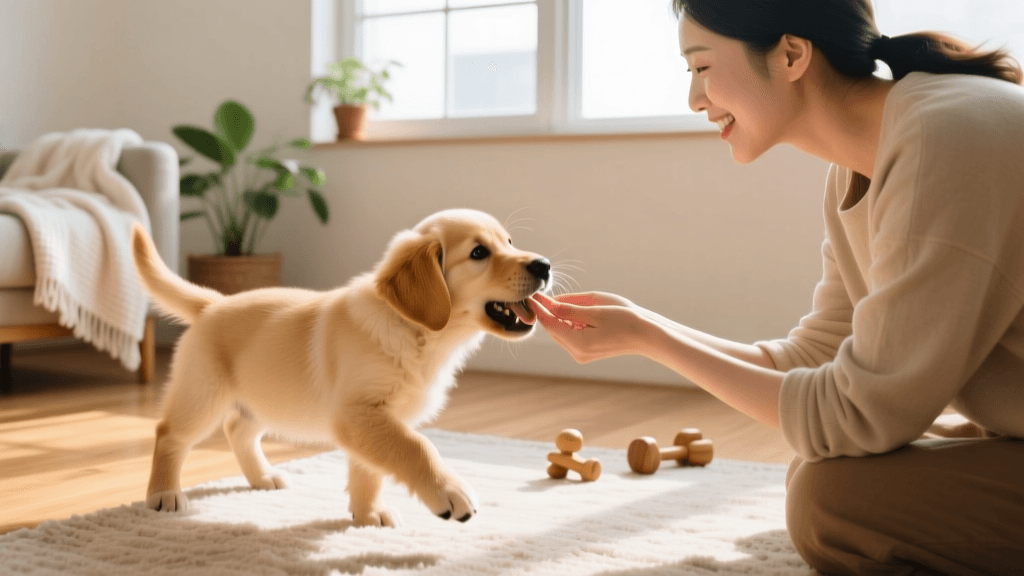
Almost every new puppy owner is shocked by how much their puppy bites. Needle-sharp teeth, constant mouthing, and the apparent inability to play without using teeth. The good news is that puppy biting is a developmental phase, not a behaviour problem — and with the right response it resolves by 4-5 months.
This guide explains why puppies bite, what bite inhibition is, and the four-step plan we teach in our puppy classes.
Why puppies bite — three reasons
Reason one: they need to. Mouthing is how puppies explore the world. They lack hands; the mouth is their primary tool for learning about texture, taste, and resistance.
Reason two: teething. Puppies start losing milk teeth at about 12 weeks. The process continues to around 6 months. Sore gums make chewing relieving.
Reason three: arousal management. Over-tired and over-excited puppies bite more. A 2018 cohort study by Smith et al. (Veterinary Behaviour) tracked 90 puppies and found that 73% of severe biting incidents occurred when the puppy had been awake for over four hours straight.
What bite inhibition is and why it matters
Bite inhibition is the dog's lifelong ability to control the pressure of their mouth. A dog with good bite inhibition who feels threatened later in life will mouth without breaking skin. A dog with poor bite inhibition will inflict serious damage.
Bite inhibition is learned, not innate, and the window to teach it is the first 4-5 months of life. This is the single most important behavioural lesson your puppy will learn.
The four-step plan
Step 1 — yelp and remove attention. When the puppy bites you, give a high-pitched "ouch" or "ah", stand up, and walk a few steps away. Five seconds of no-attention is enough. The puppy learns that biting ends the fun.
Some puppies escalate when you stand up — they think this is a new game. In that case, step over a baby gate or into another room for 10 seconds, then return calmly.
Step 2 — offer a legitimate target. Every time you redirect a bite, offer something the puppy CAN chew — a soft tug toy, a frozen washcloth, a chew. The message is not "don't bite" but "bite this, not me".
Step 3 — manage arousal. Watch for biting bursts and intervene early. If your puppy has been awake for 90 minutes, put them in a pen or crate with a frozen kong for a nap. Most puppies under 16 weeks need 16-18 hours of sleep per day. Overtired puppies bite hardest.
Step 4 — teach a polite hand-touch. Hold a treat in a closed fist near the puppy's nose. The instant they nose your hand without using teeth, open the fist and let them have the treat. Repeat 10 times a session. The puppy learns that closed mouths near hands pay; open mouths do not.
What NOT to do
- Do not hold the puppy's mouth shut — it teaches fear of hands
- Do not scruff or pin the puppy — it does not mimic mother-dog behaviour as is sometimes claimed; she actually rarely does this
- Do not push the puppy away — to a puppy this looks like play
- Do not yell — it adds to the arousal
Expected timeline
| Age | What is normal | What you should be seeing if doing the work |
|---|---|---|
| 8–12 weeks | Constant mouthing, very sharp | Puppy redirects to toy about half the time |
| 12–16 weeks | Mouthing reduces; some teething | Pressure noticeably softer |
| 16–20 weeks | Adult teeth in; rare hard mouth | Mouthing only when over-aroused |
| 20+ weeks | Should not bite hard at all | Soft, infrequent mouthing |
"A puppy who never learns bite inhibition is a real public-safety problem ten years later. Take this seriously, even when it feels like a phase." — Priya Sutaria, IMDT.
Three real scenarios you will see
The over-aroused-evening scenario. Every evening 7-8 pm, your puppy turns into a piranha. Pattern recognition: the puppy is over-tired. Bring nap-time forward by an hour. Bites usually drop to near zero within 3 days.
The trouser-leg scenario. Puppy attaches to your trouser leg as you walk past. Stop dead. Drop a handful of kibble on the floor 1 metre away. While the puppy is eating, walk away. Repeat. The trouser leg becomes uninteresting; the floor scatter becomes interesting.
The visiting-children scenario. Children encourage chase, which encourages biting. Set rules before the visit: children sit, puppy on lead, only calm interactions, breaks every 5 minutes. Manage the environment, do not rely on the puppy to control themselves.
Puppy biting is short-lived if managed well. Stay calm, redirect to legitimate targets, manage sleep, and protect the bite-inhibition window. Five months from now you will barely remember it.
Priya Sutaria
All our authors care for dogs every day — read more of their work on the authors page.