Puppy Proofing Your Home: Diagnosing Hidden Hazards
Discover how to puppy proof your home by diagnosing hidden hazards. Get actionable solutions, product recommendations, and room-by-room safety checklists.
The Problem: Why 'Dog-Safe' Homes Fail
Bringing a new puppy home is an exciting milestone, but it often comes with a harsh reality check: homes that are perfectly safe for humans are riddled with hidden hazards for a curious, teething dog. Many new owners mistakenly believe that simply putting away shoes and cleaning supplies is enough. However, puppies explore the world primarily through their mouths and possess a low center of gravity, meaning they interact with your environment from an entirely different perspective. According to the American Kennel Club (AKC), thousands of puppies visit emergency veterinary clinics each year due to preventable household accidents, ranging from intestinal blockages to toxic poisonings.
To truly secure your home, you must adopt a 'Problem Diagnosis & Solutions' mindset. This means getting down on your hands and knees to view your space from six inches off the floor, identifying blind spots, and implementing targeted, heavy-duty solutions before your dog ever crosses the threshold.
Diagnosing the Living Room: Choking and Chewing Hazards
The Cord Chaos
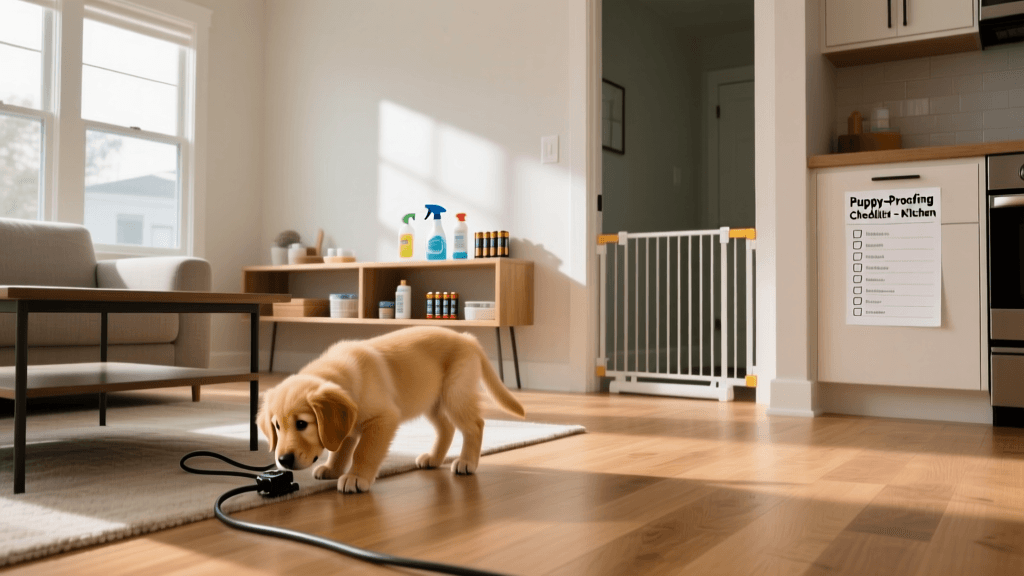
The Problem: Puppies are naturally drawn to the texture and resistance of electrical cords. Chewing through a lamp wire can result in severe oral burns, electrocution, or even house fires.
The Diagnosis: Crawl around your living room and trace every wire. Are they resting loosely against baseboards? Are power strips accessible under desks or behind the sofa? If a cord is within three feet of the floor and unprotected, it is a critical hazard.
The Solution: Do not rely on bitter sprays alone, as many puppies will chew through the taste deterrent. Instead, use physical barriers. Purchase split loom tubing or hard plastic cord concealers. A highly effective product is the D-Line Cord Cover Channel (approx. $18-$25 for a 10-foot kit), which adheres directly to baseboards and hides cables entirely. For loose power strips, mount them to the side of desks or walls using heavy-duty 3M Command Strips or screw-mounted brackets, keeping them at least four feet off the ground.
The Low-Shelf Threat and Choking Hazards
The Problem: Remote controls, children's toys, and decorative items left on low coffee tables pose massive choking and intestinal blockage risks. Button batteries (like CR2032s found in remotes) are particularly lethal; if punctured, they can burn through a dog's esophagus in under two hours.
The Diagnosis: Apply the 'Toilet Paper Tube Test.' If an object can fit entirely inside a standard toilet paper tube, it is a choking hazard for a puppy. Check all shelves below the two-foot mark.
The Solution: Relocate all small decor, books, and electronics to shelves that are at least 36 inches high. For coffee tables, commit to a strict 'clear top' rule until your dog is past the teething phase (usually around 6 to 8 months of age). Store all remotes in a closed drawer or a designated remote caddy out of reach.
Diagnosing the Kitchen: Toxins and Trash
The Trash Can Dilemma
The Problem: Kitchen trash is a treasure trove of dangerous items for a puppy, including cooked bones (which can splinter and puncture the GI tract), xylitol-sweetened wrappers, and toxic food scraps like onions and grapes.
The Diagnosis: Does your trash can have a secure, locking lid? Can a 15-pound puppy knock it over by bumping it? If the answer to either is yes, it needs an immediate upgrade.
The Solution: Invest in a heavy-duty, step-operated trash can with a secure seal. The Simplehuman 50L Semi-Round Hands-Free Step Can (approx. $120) is a favorite among dog owners because its weight and pedal mechanism prevent dogs from prying it open. Alternatively, move your trash can inside a lower cabinet and install a magnetic child lock, such as the Safety 1st Magnetic Locking System ($25 for a multi-pack), which requires a magnetic key on the outside to open.
Toxic Food and Plant Blindspots
The Problem: Many common household foods and plants are highly toxic to dogs. The ASPCA Animal Poison Control notes that xylitol (an artificial sweetener found in peanut butter and sugar-free gum), grapes, raisins, macadamia nuts, and chocolate are leading causes of emergency toxicity calls.
The Diagnosis: Audit your pantry and countertops. Is your dog's peanut butter treat verified xylitol-free? Are your countertop fruit bowls accessible? Do you have Sago Palms, Oleander, or Aloe Vera in or near the kitchen?
The Solution: Read every ingredient label on your pantry shelves. Swap any toxic houseplants for dog-safe alternatives like Spider Plants, Boston Ferns, or Calatheas. Store all human food in closed pantries or the refrigerator, never left out on counters where a growing puppy might eventually reach.
Diagnosing the Bathroom and Laundry: Chemical Dangers
The Problem: Bathrooms contain concentrated cleaning supplies, human medications, and personal care items that can cause acute renal failure or neurological damage if ingested. Furthermore, open toilets pose a drowning risk for small breeds and a source of toxic blue cleaning water for larger ones.
The Diagnosis: Check under your sink. Are the cabinet doors easy to nudge open with a paw? Are your medications stored in a low medicine cabinet? Is the toilet lid currently up?
The Solution: Install sliding door locks or magnetic latches on all lower bathroom and laundry cabinets. Human medications must be moved to a high shelf (at least five feet off the ground) or a locked lockbox. Make it a strict household rule to keep toilet lids closed at all times, and consider installing a Toilet Lid Lock ($8) to ensure puppies cannot nudge the lid open to drink from the bowl.
Room-by-Room Hazard Diagnosis & Solution Chart
Use this structured chart to conduct a systematic sweep of your home before your puppy arrives.
| Room / Area | Hidden Hazard | Diagnosis Method | Solution & Recommended Product | Est. Cost |
|---|---|---|---|---|
| Living Room | Exposed Electrical Cords | Check baseboards from floor level | D-Line Cord Cover Channel / Split Loom | $15 - $25 |
| Kitchen | Unsecured Trash / Scraps | Attempt to tip can with one hand | Simplehuman 50L Step Can | $120 |
| Bathroom | Under-sink Chemicals | Check cabinet door tension | Safety 1st Magnetic Locks | $25 |
| Bedroom | Shoes / Socks (Blockages) | Look under bed and in closets | Sealed under-bed storage bins | $20 |
| Yard | Fence Gaps / Escapes | The '4-Inch Sphere' Test | Hardware cloth / Wire mesh patching | $30 |
Essential Puppy-Proofing Shopping List
To streamline your preparation, here is a consolidated shopping list of actionable products to secure your home, complete with estimated costs and installation timing.
- Hardware Cloth (1/2 inch mesh): Use this to patch gaps under wooden decks or chain-link fences. Puppies can squeeze through incredibly small spaces. Measure all gaps; if a 4-inch sphere can pass through, a puppy's head can get stuck. Cost: $25 per roll. Install time: 2 hours.
- Freestanding Pet Gate: Pressure-mounted gates often fail against determined breeds. Opt for a hardware-mounted gate like the Carlson Pet Products Design Studio Metal Gate for the top of stairs. Cost: $45. Install time: 30 minutes.
- Bitter Apple Spray: While not a standalone solution, Grannick's Bitter Apple Spray ($12) is excellent for treating wooden baseboards and furniture legs to deter initial chewing. Reapply every 48 hours.
- Heavy-Duty Toy Box: Puppies need an outlet for their chewing. Provide a dedicated, reinforced canvas or hard plastic toy bin so they learn to differentiate between their toys and your belongings. Cost: $30.
Conclusion
Puppy-proofing is not a one-time chore; it is an ongoing process of environmental management. As your dog grows, their reach and problem-solving skills will expand, requiring you to continually reassess your home's security. By diagnosing hazards from the puppy's perspective and investing in robust, physical barriers rather than relying on training alone, you create a safe sanctuary for your new companion. For a comprehensive list of toxic and non-toxic flora, always refer to the VCA Animal Hospitals database or consult your primary veterinarian before bringing new plants into your home. Taking these proactive steps ensures that your puppy's first months are filled with safe exploration, rather than emergency vet visits.
beth-carrasco
All our authors care for dogs every day — read more of their work on the authors page.