Puppy Potty Training: Answering Google's Top Questions
Discover answers to Google's most-asked puppy potty training questions. Learn daily schedules, crate tips, and accident cleanup for a housebroken pup.
Bringing a new puppy home is an exhilarating experience, but the excitement can quickly fade when you find yourself constantly cleaning up puddles on your living room rug. Potty training is universally recognized as one of the most challenging hurdles of early dog ownership. If you have found yourself endlessly scrolling through forums and search engines looking for a definitive guide, you are not alone. To help you navigate this messy milestone, we have compiled answers to Google’s most-asked questions regarding puppy potty training. From establishing a foolproof daily schedule to understanding the biology of a puppy's bladder, this comprehensive guide provides actionable, expert-backed advice to get your furry friend housebroken efficiently. According to the American Kennel Club (AKC), consistency and positive reinforcement are the absolute cornerstones of successful house training. Let us dive into the specific questions every new puppy parent is searching for.
How Long Can a Puppy Hold Its Bladder?
One of the most frequent "People Also Ask" questions revolves around a puppy's physical limitations. Understanding your puppy's biological limits is crucial to preventing accidents. The general rule of thumb, widely cited by veterinarians, is that a puppy can hold their bladder for one hour for every month of age, up to a maximum of about eight hours for an adult dog. However, this rule applies primarily to puppies that are resting or crated. An active puppy playing fetch or running around the yard will need to eliminate much more frequently.
It is important to note that forcing a puppy to hold it longer than their physical capacity will not "train" them; it will only result in inevitable accidents and potential urinary tract issues. Below is a structured breakdown of what you can realistically expect regarding your puppy's bladder control during their first few months of life.
| Puppy Age | Maximum Bladder Capacity (Resting/Crated) | Active Playtime Potty Breaks |
|---|---|---|
| 2 Months (8 Weeks) | 2 Hours | Every 30-45 Minutes |
| 3 Months (12 Weeks) | 3 Hours | Every 1 Hour |
| 4 Months (16 Weeks) | 4 Hours | Every 1.5 Hours |
| 6 Months (24 Weeks) | 6 Hours | Every 2-3 Hours |
Keep in mind that small and toy breeds, such as Chihuahuas or Pomeranians, have significantly smaller bladders and faster metabolisms than large breeds like Golden Retrievers. Consequently, toy breeds often require more frequent potty breaks and may take slightly longer to fully housebreak.
What Is the Best Daily Potty Training Schedule?
Routine is the secret weapon of successful potty training. Puppies thrive on predictability, and their digestive systems operate on a remarkably consistent internal clock once a schedule is established. The ASPCA recommends taking your puppy out at the same times every single day to build a reliable habit. But what does an ideal schedule actually look like?
Here is a highly effective, actionable daily potty schedule tailored for an 8-to-12-week-old puppy:
- 7:00 AM (Wake Up): Carry your puppy immediately outside the moment they wake up. Do not let them walk, as walking stimulates the bladder and may cause an accident en route to the door.
- 7:30 AM (Breakfast): Feed your puppy their measured morning meal. Remove the food bowl after 15 minutes to establish a strict eating window.
- 8:00 AM (Post-Meal Potty): Puppies typically need to eliminate within 15 to 30 minutes after eating. Take them to their designated potty spot.
- 10:00 AM & 12:00 PM (Mid-Day Breaks): Take them out after naps and active play sessions.
- 5:00 PM (Dinner): Serve the evening meal, again removing the bowl after 15 minutes.
- 5:30 PM (Post-Dinner Potty): Head outside to the designated spot.
- 8:00 PM (Water Curfew): Pick up the water bowl to prevent excessive overnight drinking. Ensure they have had ample hydration throughout the day.
- 10:30 PM (Final Potty & Bedtime): A final, boring, business-only trip outside before settling into the crate for the night.
By strictly controlling food and water intake windows, you can accurately predict when your puppy will need to eliminate, drastically reducing indoor accidents.
Puppy Pads vs. Outdoor Training: Which Is Better?
A massive debate in the dog-owning community centers around whether to use indoor puppy pee pads or train exclusively for the outdoors. Google search trends show thousands of queries asking if pee pads ruin outdoor training. The short answer from most professional trainers is: yes, pee pads can confuse a puppy and delay outdoor housebreaking.
Puppy pads teach your dog that it is acceptable to eliminate on a soft, absorbent surface indoors. This can lead to your puppy mistaking your expensive area rugs or bathmats for pee pads. However, there are exceptions. If you live in a high-rise apartment without quick yard access, work 12-hour shifts, or live in a climate with extreme winter weather, pads may be a necessary compromise.
Here is a quick cost and effectiveness comparison to help you decide:
| Method | Average Cost | Pros | Cons |
|---|---|---|---|
| Direct Outdoor Training | $0 (Free) | Builds a clear, single habit; no indoor messes; encourages outdoor exercise. | Requires high time commitment; difficult for high-rise dwellers or extreme weather. |
| Indoor Puppy Pads | $20 - $30 per month | Convenient for apartments; protects floors from immediate damage; good for absent owners. | Confuses the "indoors vs. outdoors" rule; ongoing financial cost; can cause odor issues. |
If you must use pads, place them in a designated indoor "potty area" (like a bathroom or laundry room) and use a plastic tray with artificial grass to better mimic the outdoor environment. This helps bridge the gap between indoor convenience and outdoor expectations.
How Do I Stop My Puppy From Having Accidents Inside?
Accidents are an inevitable part of the process, but how you handle them dictates how quickly your puppy learns. The most critical mistake new owners make is punishing a puppy after the fact. If you find a puddle on the carpet ten minutes after it happened, rubbing your puppy's nose in it or yelling will only teach them that you are a scary presence when they eliminate. They will simply learn to hide behind the sofa or under the bed to do their business next time.
Instead, practice active supervision. Keep your puppy tethered to you with a leash indoors or confine them to a puppy-proofed playpen when you cannot give them 100% of your attention. If you catch them in the act, clap your hands loudly to interrupt the behavior, immediately scoop them up, and carry them outside to finish. When they finish outdoors, reward them heavily with high-value treats (like small pieces of boiled chicken or commercial training treats costing around $8-$12 a bag) and enthusiastic praise.
Furthermore, cleaning up accidents properly is non-negotiable. You must use an enzymatic cleaner specifically designed for pet urine (brands like Nature's Miracle or Rocco & Roxie, typically costing $15-$25). Standard household cleaners or ammonia-based products will not break down the uric acid crystals. According to the Humane Society of the United States, if a dog can still smell their previous accident, they will view that spot as a designated bathroom and return to it repeatedly.
When and How Should I Use a Crate for Potty Training?
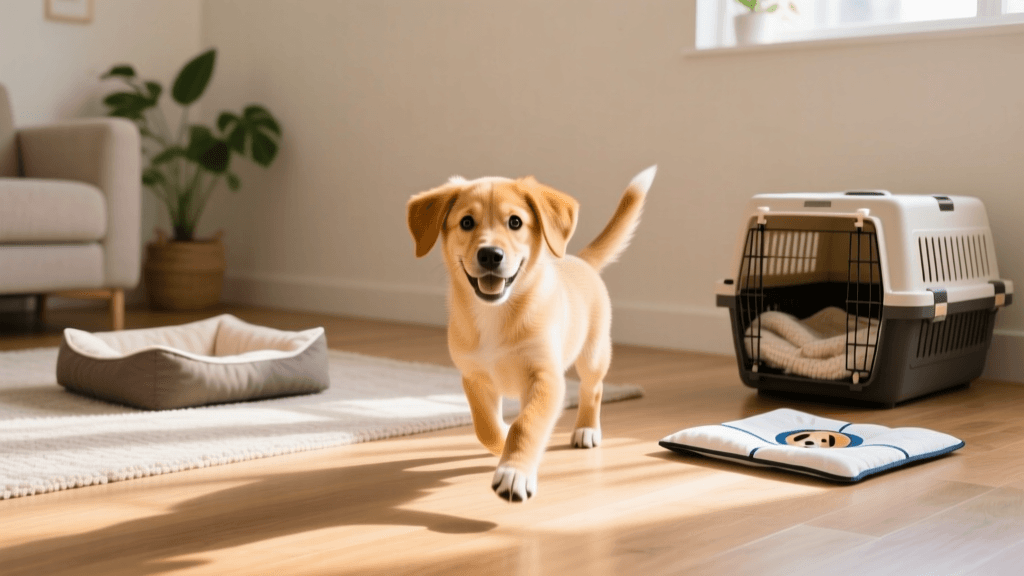
Crate training leverages a dog's natural den instinct; dogs naturally avoid soiling the area where they sleep. When used correctly, a crate is the single most effective tool for preventing unsupervised indoor accidents. You should introduce the crate on your puppy's very first day home.
The dimensions of the crate are vital to its success as a potty training tool. The crate should be just large enough for your puppy to stand up, turn around, and lie down comfortably. If the crate is too large, the puppy will designate one corner for sleeping and the opposite corner for eliminating, completely defeating the purpose of the crate. If you have purchased a large wire crate to accommodate your puppy's adult size, use the included wire divider panel to block off the excess space, adjusting it as your puppy grows.
Never use the crate as a form of punishment, and never leave a young puppy crated for longer than their bladder capacity allows. A crate is a management tool to prevent mistakes when you are cooking, showering, or otherwise distracted, ensuring that your puppy only has the opportunity to eliminate when you are there to guide them to the appropriate outdoor spot.
Final Thoughts on Patience and Consistency
Potty training is not a weekend project; it is a developmental process that takes several months. Most puppies are not reliably housebroken until they are between four and six months of age, and some toy breeds may take up to a year. By understanding your puppy's physical limitations, adhering to a strict daily schedule, managing their environment with a properly sized crate, and cleaning accidents with enzymatic solutions, you will set your dog up for lifelong success. Bookmark this guide, stay patient, and remember that every successful outdoor potty break is a step toward a harmonious life with your new best friend.
tom-renshaw
All our authors care for dogs every day — read more of their work on the authors page.