First-Time Owner Guide To Puppy Potty Training Schedules
Master puppy potty training with our first-time owner guide. Learn exact schedules, crate setup tips, and cleanup routines for a stress-free start.
Welcome to Puppy Parenthood: The Potty Training Reality
Bringing home a new puppy is one of the most exciting milestones in life, but it is also a profound test of patience, sleep endurance, and carpet-cleaning skills. As a first-time dog owner, you are likely drowning in a sea of conflicting advice regarding housebreaking. The truth is that potty training is not about teaching your puppy a complex trick; it is about establishing a rigid, predictable routine that aligns with their biological limitations. Puppies do not soil their living spaces out of spite or stubbornness. They do so because their nervous systems and sphincter muscles are simply not fully developed. According to the American Kennel Club (AKC), most puppies can be reliably house-trained between four and six months of age, provided the owner maintains absolute consistency. This guide will walk you through the exact science, gear, and daily schedules you need to navigate the first few months of puppyhood without losing your mind—or your security deposit.
The Science of Puppy Bladders: What First-Time Owners Must Know
Before setting an alarm clock, you must understand the physiological constraints of your new companion. Veterinary behaviorists frequently cite the 'Month Plus One' rule to estimate a puppy's maximum bladder capacity. This rule dictates that a puppy can hold their bladder for roughly one hour per month of age, plus one additional hour. Therefore, a two-month-old (eight-week-old) puppy can physically hold it for a maximum of three hours under ideal, resting conditions. A four-month-old puppy can manage roughly five hours.
However, this rule comes with a massive caveat for first-time owners: the clock resets the moment the puppy engages in physical activity, eats a meal, or drinks water. Playtime accelerates metabolism and digestion, meaning a puppy that just spent twenty minutes wrestling with a chew toy will likely need to eliminate immediately, regardless of what the 'Month Plus One' chart suggests. Understanding this biological reality prevents owners from unfairly punishing puppies for accidents that were entirely the result of human miscalculation.
Essential Gear for Potty Training Success
Success in potty training requires the right tools. Skipping these foundational items is a common mistake that prolongs the training process by weeks or even months. Here is your first-time owner shopping list, complete with estimated costs and product recommendations:
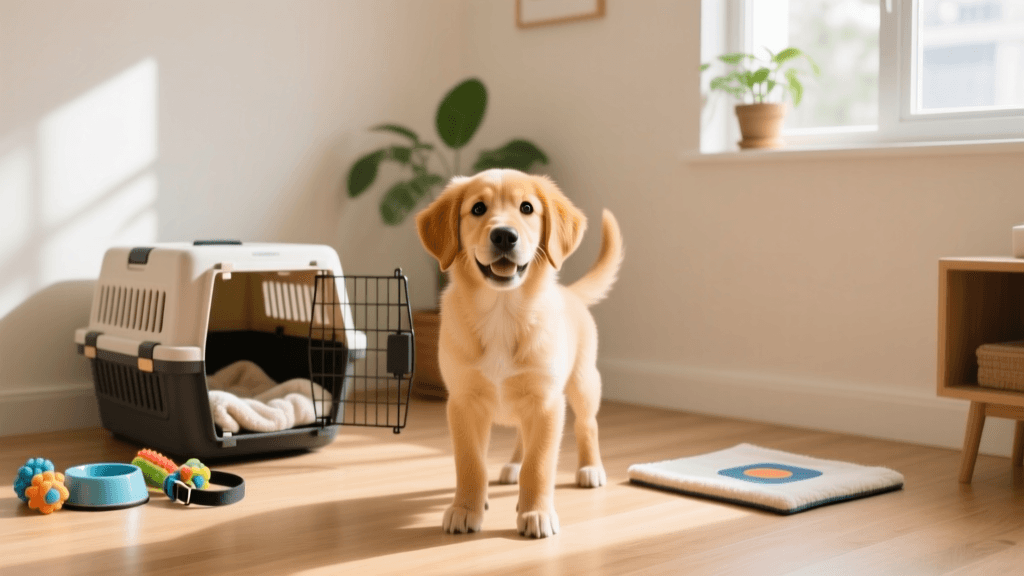
- Adjustable Wire Crate (e.g., MidWest Homes for Pets iCrate, $50 - $80): You must purchase a crate that will fit your dog's adult size, but it must include an adjustable divider panel. Puppies instinctively avoid soiling their immediate sleeping area. If the crate is too large, they will designate one corner as a bedroom and the opposite corner as a bathroom. The divider allows you to expand the space only as the puppy grows and proves their reliability.
- Bio-Enzymatic Cleaner (e.g., Nature's Miracle Advanced Stain & Odor Eliminator, $15): Standard household cleaners, vinegar, and bleach do not break down the uric acid crystals found in dog urine. If you use standard cleaners, your puppy's highly sensitive nose will still detect the biological markers of the accident, signaling to them that this is an acceptable bathroom zone. Enzymatic cleaners literally consume the organic matter causing the odor.
- High-Value, Low-Calorie Training Treats (e.g., Zuke's Mini Naturals, $8): You will be rewarding your puppy multiple times an hour during the first few weeks. Zuke's Minis are less than three calories each, preventing rapid weight gain while keeping the puppy highly motivated to perform for a reward.
- Leash and Harness (e.g., Rabbitgoo No-Pull Harness, $20): Even if you have a fenced backyard, you must keep your puppy on a leash during potty breaks for the first few months. This prevents them from wandering off to play and ensures you are physically present to reward them the exact second they finish eliminating.
The Ultimate Daily Potty Training Schedule
Routine is the bedrock of housebreaking. Puppies thrive on predictability. Below is a highly structured daily schedule tailored for a typical 12-week-old puppy. This schedule assumes three meals a day, which is the veterinary standard for puppies under six months of age to maintain stable blood sugar levels.
| Time | Activity | Potty Action & Owner Duty |
|---|---|---|
| 7:00 AM | Wake Up | Carry puppy immediately outside to the designated potty spot. Do not let their paws touch the indoor floor. |
| 7:15 AM | Breakfast | Feed measured portion of puppy food. Remove bowl after 15 minutes. |
| 7:30 AM | Post-Meal Potty | Leash walk to potty spot. Reward heavily with treats and verbal praise immediately upon elimination. |
| 8:00 AM | Supervised Play | Indoor play session. Watch closely for sniffing or circling behaviors. |
| 9:00 AM | Morning Nap | Puppy goes into the crate for a nap. (Puppies need 18-20 hours of sleep daily). |
| 11:00 AM | Wake & Potty | Carry outside immediately upon waking. Reward success. |
| 12:00 PM | Lunch | Second meal of the day. |
| 12:20 PM | Post-Meal Potty | Leash walk to potty spot. Reward heavily. |
| 1:00 PM | Afternoon Nap | Crate time for digestion and rest. |
| 3:00 PM | Wake, Potty & Play | Outdoor potty break followed by a training session or outdoor exploration. |
| 5:00 PM | Dinner | Third and final meal of the day. |
| 5:20 PM | Post-Meal Potty | Leash walk to potty spot. Reward heavily. |
| 6:00 PM | Evening Wind Down | Low-energy play, chew toys, and bonding time. |
| 8:00 PM | Water Cutoff | Remove the water bowl to ensure the bladder empties before bedtime. |
| 9:30 PM | Final Potty | Quiet, boring trip outside. No play. Just business. |
| 9:45 PM | Bedtime | Puppy goes into the crate for the night. Set an alarm for 2:00 AM or 3:00 AM for a midnight potty break. |
Crate Training: Your Secret Weapon
Many first-time owners feel guilty about using a crate, viewing it as a cage. However, the ASPCA emphasizes that when introduced correctly, a crate taps into a dog's natural denning instinct, providing them with a secure sanctuary. More importantly for potty training, it leverages their instinct not to soil their sleeping quarters.
To introduce the crate, start by feeding all meals inside it with the door open. Toss high-value treats into the back of the crate and use a consistent verbal cue like 'Kennel' or 'Place.' Never use the crate as a punishment; it must always be associated with positive experiences. When you cannot actively supervise your puppy with your eyes on them, they must be in the crate or a securely gated, puppy-proofed pen. Unsupervised roaming is the number one cause of prolonged potty training regression.
Dietary Impacts on Elimination
What goes in on a schedule comes out on a schedule. Free-feeding (leaving a bowl of kibble out all day) is a disastrous strategy for potty training. By measuring meals and offering them at the exact same times daily, you can accurately predict when your puppy will need to eliminate. Furthermore, picking up the water bowl two to two-and-a-half hours before bedtime drastically reduces the likelihood of middle-of-the-night accidents, allowing both you and your puppy to get more uninterrupted sleep.
Handling Accidents Like a Pro
Despite your best efforts, accidents will happen. How you react in the first three seconds of an accident will dictate how quickly your puppy learns. If you catch your puppy in the act, do not yell, scream, or physically punish them. Yelling only teaches the puppy that eliminating in front of you is dangerous, which will result in them hiding behind furniture or in closets to do their business.
'Never rub your puppy's nose in an accident or scold them after the fact. Dogs do not connect past actions with present punishments. You will only succeed in making your puppy fear you.'
Instead, interrupt the behavior with a sharp, neutral sound like a clap or a quick 'Oops!' Scoop the puppy up immediately and carry them outside to their designated spot to finish. If they finish outside, reward them lavishly.
When cleaning the indoor accident, soak the area thoroughly with your bio-enzymatic cleaner. Let it sit for the time specified on the bottle (usually 10 to 15 minutes) so the enzymes can break down the proteins. As noted by the Humane Society of the United States, eliminating the scent marker entirely is crucial to preventing the puppy from returning to the same spot. Avoid steam cleaners on urine stains, as the high heat can permanently bind the proteins to synthetic carpet fibers, locking the scent in forever.
When to Seek Veterinary Help
While frequent urination is normal for young puppies, certain signs indicate a medical issue rather than a training deficit. If your puppy is straining to urinate, producing only drops, crying while eliminating, or if their urine is tinged with blood or has a foul odor, contact your veterinarian immediately. Urinary tract infections (UTIs) are relatively common in puppies and make it physically impossible for them to hold their bladder, rendering all behavioral training useless until the infection is treated with antibiotics.
Final Thoughts for the First-Time Owner
Potty training is a marathon, not a sprint. There will be days when you feel like you are taking steps backward, usually coinciding with growth spurts, teething phases, or changes in the household environment. Stay anchored to your schedule, manage your puppy's environment using the crate, and reward the behaviors you want to see. With consistency, patience, and the right enzymatic cleaner on standby, your puppy will master this essential life skill, paving the way for a lifetime of trust and companionship.
beth-carrasco
All our authors care for dogs every day — read more of their work on the authors page.