Puppy Potty Training Schedule: A First-Time Owner Guide
Master puppy potty training with our step-by-step schedule for first-time owners. Learn timing, crate sizing, and actionable tips for quick success.
Welcome to Dog Ownership: Conquering the Potty Training Hurdle
Bringing a new puppy home is one of life’s greatest joys, but it comes with an immediate, messy reality: potty training. For first-time dog owners, the seemingly random nature of puppy accidents can feel overwhelming. However, successful house training is not about luck; it is about behavioral conditioning, strict scheduling, and positive reinforcement. According to the ASPCA, consistency and supervision are the foundational pillars of teaching your puppy where to eliminate.
This comprehensive guide provides first-time owners with an actionable, data-driven potty training schedule, exact product recommendations, and behavioral troubleshooting tips to get your puppy fully house-trained in weeks, not months.
Essential Potty Training Supplies and Costs
Before you begin, you need the right tools. Investing in the correct supplies upfront saves time, money, and frustration. Here is your starter kit:
- Enzymatic Cleaner: Standard household cleaners do not break down uric acid crystals. You must use an enzymatic cleaner like Nature’s Miracle Advanced Stain & Odor Eliminator (approx. $12 for 32 oz). If a puppy smells old urine, they will re-mark the spot.
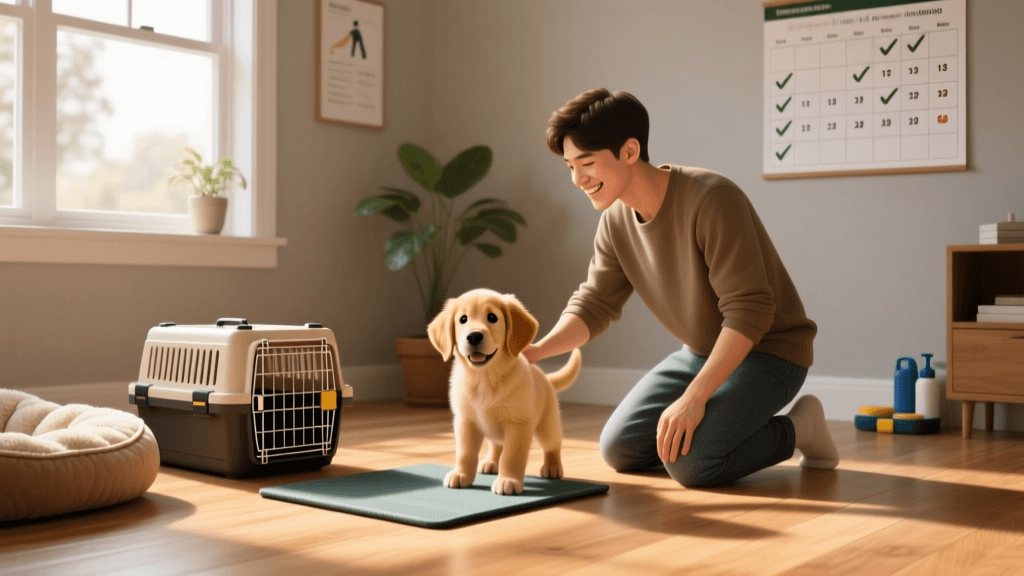
- Properly Sized Crate: A wire crate with a divider panel, such as the MidWest Homes for Pets iCrate ($45–$70). The crate should be large enough for the puppy to stand, turn around, and lie down, but no larger. Measure your puppy from the tip of the nose to the base of the tail, and add 2 to 4 inches for the correct length.
- High-Value Training Treats: Small, soft treats that can be consumed in under two seconds. Zuke’s Mini Naturals (approx. $6 for 6 oz) are excellent for immediate positive reinforcement.
- Potty Bells: A door-mounted bell system like the Mighty Paw Smart Bell 2.0 ($15) helps teach your dog to signal when they need to go out, bridging the communication gap.
The Ultimate Puppy Potty Training Schedule by Age
A puppy's bladder capacity grows predictably as they age. The general rule of thumb endorsed by the American Kennel Club (AKC) is that a puppy can hold their bladder for one hour per month of age, up to a maximum of about eight hours for adult dogs. However, during active daytime training, you should take them out much more frequently to ensure success.
| Puppy Age | Estimated Bladder Capacity | Daytime Potty Break Frequency | Nighttime Potty Breaks Needed |
|---|---|---|---|
| 8–10 Weeks | 1 to 2 Hours | Every 1 Hour | 2 to 3 Breaks |
| 11–14 Weeks | 2 to 3 Hours | Every 2 Hours | 1 to 2 Breaks |
| 15–16 Weeks | 3 to 4 Hours | Every 3 Hours | 0 to 1 Break |
| 6+ Months | 4 to 6+ Hours | Every 4 to 6 Hours | 0 Breaks |
Step-by-Step Outdoor Potty Routine
When it is time for a potty break, follow this exact behavioral conditioning loop to build a strong habit:
- Leash Up: Always use a leash, even in a fenced yard. This prevents the puppy from wandering off to play and keeps them focused on the task.
- Designate a Spot: Take the puppy to the exact same outdoor location every time. The lingering scent of previous eliminations will act as a biological trigger to go again.
- Use a Verbal Cue: As soon as the puppy begins to eliminate, say a specific cue word in a calm, encouraging tone, such as 'Go potty' or 'Do your business.' Do not say it before they start, or you may startle them.
- The 3-Second Reward Rule: The moment the puppy finishes, praise them enthusiastically and deliver a high-value treat within three seconds. Timing is critical in behavioral conditioning; if you wait until you are back inside, you are rewarding the puppy for coming inside, not for eliminating outdoors.
Nighttime Potty Training Strategies
Nighttime is often the most stressful period for first-time owners. To minimize middle-of-the-night wake-ups, implement a strict evening routine. Remove your puppy’s water bowl exactly two hours before bedtime. For example, if lights out is at 10:00 PM, pick up the water at 8:00 PM. Ensure the puppy has a vigorous play session and a final potty break right before being placed in their crate.
Keep the crate in your bedroom for the first few weeks. Puppies are den animals and social pack members; isolating them in a distant laundry room can cause separation anxiety, leading to stress-induced elimination. If the puppy whines in the middle of the night, take them out immediately on a leash, keep the lights low, do not speak to them, and put them right back to bed after they eliminate.
Handling Accidents: What to Do and What Not to Do
Accidents are a guaranteed part of the process. How you react will dictate how quickly your puppy learns.
What NOT to Do
Never rub a puppy’s nose in their mess, yell at them, or hit them. According to the Humane Society of the United States, punishment after the fact is entirely ineffective because dogs cannot associate a delayed punishment with a past action. It only teaches the puppy to fear you and to hide behind furniture to eliminate in the future.
What to Do
If you catch your puppy in the act, interrupt them with a sharp, sudden noise—like a loud clap or saying 'Ah-ah!'—to stop the flow. Immediately scoop them up or leash them, carry them outside to their designated spot, and let them finish. Praise and reward them heavily if they finish outside. Afterward, clean the indoor accident site thoroughly with your enzymatic cleaner. Avoid any cleaning products containing ammonia, as ammonia smells like urine to a dog's sensitive nose and will encourage re-marking.
Troubleshooting: Submissive and Excitement Urination
First-time owners often confuse behavioral marking or lack of training with submissive or excitement urination. If your puppy leaks small amounts of urine when greeting you, meeting new people, or during vigorous play, this is an involuntary physiological response, not a potty training failure. Puppies simply lack full muscular control over their sphincters when highly stimulated. To manage this, keep greetings incredibly calm and low-key. Ignore the puppy for the first two minutes you walk through the door, and avoid direct eye contact until they have settled down. Never scold a puppy for submissive urination, as this increases their anxiety and exacerbates the problem.
Why You Should Avoid Potty Pads
Many first-time owners purchase indoor potty pads, believing it will make training easier. In reality, potty pads teach a puppy that it is acceptable to eliminate indoors on soft, absorbent surfaces. This creates a confusing mixed message. Furthermore, puppies often mistake bath mats, area rugs, and towels for potty pads due to the similar texture. Unless you live in a high-rise apartment without immediate yard access and plan to permanently use an indoor litter system, skip the pads and focus entirely on outdoor conditioning.
'Patience and consistency are your best tools. A puppy's brain is developing rapidly, and every positive outdoor experience builds a neural pathway that eventually results in a fully house-trained adult dog.'
Final Thoughts for First-Time Owners
Potty training is a marathon, not a sprint. By adhering to a strict schedule based on your puppy's age, utilizing the right enzymatic cleaners and crate sizes, and mastering the 3-second reward rule, you will set your new companion up for success. Stick to the routine, forgive the inevitable accidents, and celebrate the small victories. Within a few short months, your puppy will be reliably asking to go outside, leaving you free to enjoy the incredible bond of dog ownership.
tom-renshaw
All our authors care for dogs every day — read more of their work on the authors page.