Puppy Potty Training FAQs: Timeline, Tips, and Nighttime Survival
Answering Google's most-asked puppy potty training questions. Discover timelines, nighttime schedules, crate tips, and expert advice to stop indoor accidents fast.
Welcome to the Potty Training Trenches
Bringing a new puppy home is a joyous occasion, but the honeymoon phase often ends the moment you spot the first puddle on your living room rug. Potty training is universally recognized as one of the most frustrating hurdles of early dog ownership. If you are losing sleep over midnight whimpers and constantly scrubbing carpets, you are not alone. To help you navigate this messy milestone, we have compiled the answers to Google’s most-asked questions about puppy potty training. From understanding bladder capacity to mastering the nighttime schedule, this comprehensive guide provides the actionable, expert-backed strategies you need to raise a cleanly house-trained dog.
FAQ 1: How Long Does It Actually Take to Potty Train a Puppy?
The most common question searched by exhausted puppy parents is about the timeline. According to the American Kennel Club (AKC), most puppies can be mostly house-trained by the time they are four to six months old. However, the word 'mostly' is the operative term here. Small breeds with tiny bladders, or rescue puppies with previously ingrained bad habits, may take up to a full year to become completely reliable indoors.
Consistency is the ultimate deciding factor. A puppy left alone for eight hours a day without a dog walker will naturally take much longer to train than a puppy whose owner adheres to a strict, supervised schedule. Below is a general guideline of what to expect regarding your puppy's physical development and bladder control.
| Puppy Age | Max Bladder Capacity | Required Potty Break Frequency |
|---|---|---|
| 2 Months | 2 to 3 Hours | Every 2 hours, plus immediately after meals and naps |
| 3 Months | 3 to 4 Hours | Every 3 hours during the day |
| 4 Months | 4 to 5 Hours | Every 4 hours during the day |
| 6 Months | 6 to 7 Hours | Every 6 hours |
| 12 Months | 8+ Hours | Standard adult schedule (3 to 4 times daily) |
FAQ 2: How Often Should I Take My Puppy Outside?
A widely accepted veterinary rule of thumb is the Month Plus One formula. Take your puppy’s age in months and add one; this equals the absolute maximum number of hours they can comfortably hold their bladder. For example, a three-month-old puppy can physically hold it for roughly four hours. However, this is the maximum capacity, not the recommended training schedule.
To prevent accidents, puppies need to be taken out immediately upon waking up from a nap, within 15 to 30 minutes after eating or drinking, and immediately after vigorous play sessions. Praise and reward them every single time they eliminate outdoors.
Actionable Tip: Keep a potty log on your refrigerator or use a smartphone app to track your puppy's elimination habits. You will quickly notice patterns (such as realizing they always need to defecate exactly 20 minutes after breakfast) that allow you to preemptively take them outside before an accident occurs indoors.
FAQ 3: What Are the Best Tools and Methods for Success?
The ASPCA strongly advocates for positive reinforcement and crate training as the gold standards for housebreaking. Punishing a puppy for accidents after the fact only teaches them to fear you, not to hold their bladder. They simply learn to hide from you when they need to go.
Here is an actionable breakdown of the essential toolkit you need, along with estimated costs to help you budget:
- Properly Sized Crate ($40 to $80): Puppies instinctively avoid soiling their sleeping area. Buy a wire crate (like the MidWest Homes for Pets series) that comes with a divider panel. The crate should only be large enough for the puppy to stand up, turn around, and lie down. If it is too large, they will use one corner as a bathroom and sleep in the other.
- Enzymatic Cleaner ($15 to $25): Standard household cleaners do not break down uric acid crystals. If a puppy can still smell their urine, they will mark the spot again. Invest in a high-quality enzymatic cleaner like Nature’s Miracle or Rocco & Roxie Stain & Odor Eliminator. Saturate the area and let it air dry completely.
- High-Value Training Treats ($10 to $15): Reserve special treats exclusively for outdoor potty success. Zuke’s Mini Naturals or freeze-dried beef liver work exceptionally well. The moment your puppy finishes eliminating outside, praise them enthusiastically and deliver the treat within two seconds so they associate the action with the reward.
FAQ 4: How Do I Stop My Puppy from Peeing Inside at Night?
Nighttime accidents are a primary source of sleep deprivation for new owners. To survive the nighttime potty training phase, you must strictly manage your puppy's intake and environment.
Water Cutoff: Pick up your puppy’s water bowl exactly two to two-and-a-half hours before bedtime. If bedtime is 10:00 PM, water goes away at 7:30 PM. Ensure they have ample opportunity to hydrate heavily throughout the day so they do not become dehydrated.
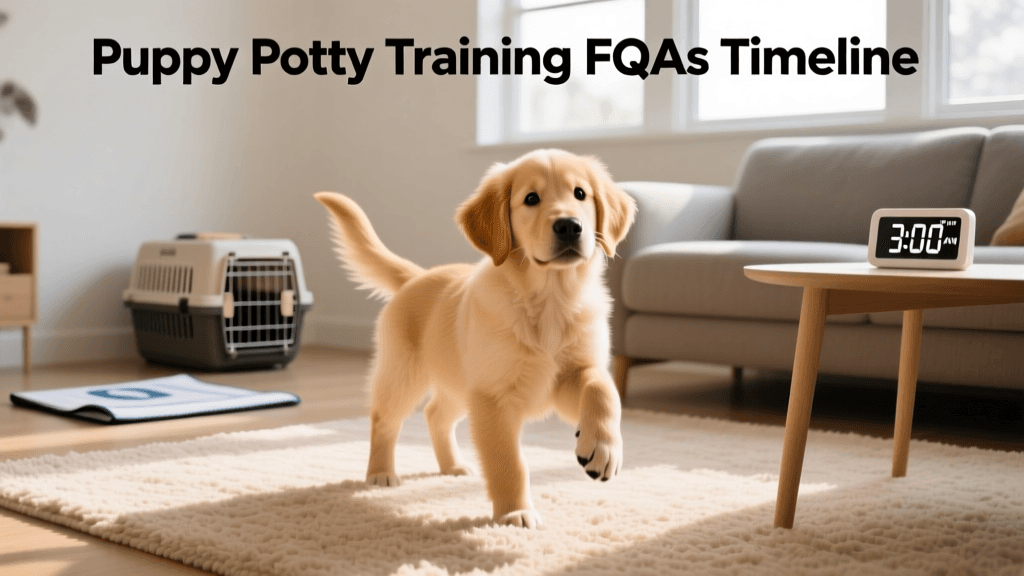
The Nighttime Alarm: For puppies under four months old, you will likely need to set an alarm for a midnight or 2:00 AM potty break. Keep this trip strictly business. Do not turn on bright lights, do not play, and do not speak in an excited voice. Leash them, carry or walk them directly to their designated potty spot, wait for them to go, reward quietly, and return immediately to the crate.
Proximity: Keep the crate in your bedroom or just outside your door for the first few weeks. Puppies whine when they need to go, but if they are too far away, you might sleep through their subtle cues until it is too late.
FAQ 5: Why Is My Puppy Suddenly Having Accidents Again?
Potty training regression is incredibly common and usually occurs between six and nine months of age, coinciding with adolescent hormonal changes, teething distractions, and increased independence. However, before assuming it is purely behavioral, you must rule out medical issues.
Urinary Tract Infections (UTIs), gastrointestinal upset, or parasites can cause sudden incontinence. If your previously reliable puppy suddenly starts having accidents indoors, straining to urinate, or licking their genital area excessively, schedule a veterinary visit immediately.
If the vet gives your puppy a clean bill of health, treat the regression by reverting to the strict schedule you used when they were eight weeks old. Increase the frequency of potty breaks, heavily reward outdoor successes, and restrict their freedom indoors by keeping them tethered to you with a leash or confining them to a smaller, puppy-proofed area when you cannot actively supervise them.
FAQ 6: Should I Use Puppy Pads?
The Humane Society of the United States notes that while puppy pads can be useful for owners living in high-rise apartments without immediate yard access, they often confuse puppies. Pads teach a dog that it is acceptable to eliminate on soft, absorbent surfaces indoors—which unfortunately includes your bathmats, rugs, and piles of laundry.
If you must use pads due to your living situation, place them in a very specific, confined area (like a bathroom or an exercise pen) and begin moving them closer to the exterior door each week until you can transition entirely to the outdoors. For most suburban and rural dog owners, bypassing pads entirely and heading straight to the grass yields much faster, less confusing results.
Conclusion: Patience is Your Best Tool
Potty training is a marathon, not a sprint. There will be setbacks, ruined rugs, and moments of profound frustration. However, by adhering to a strict schedule, utilizing positive reinforcement, and managing your puppy's environment with a properly sized crate, you will build lifelong habits. Remember to celebrate the small victories, keep your enzymatic cleaner handy, and trust the process. Your patience during these first few months will result in a well-mannered, cleanly companion for the next decade and beyond.
hannah-wickes
All our authors care for dogs every day — read more of their work on the authors page.